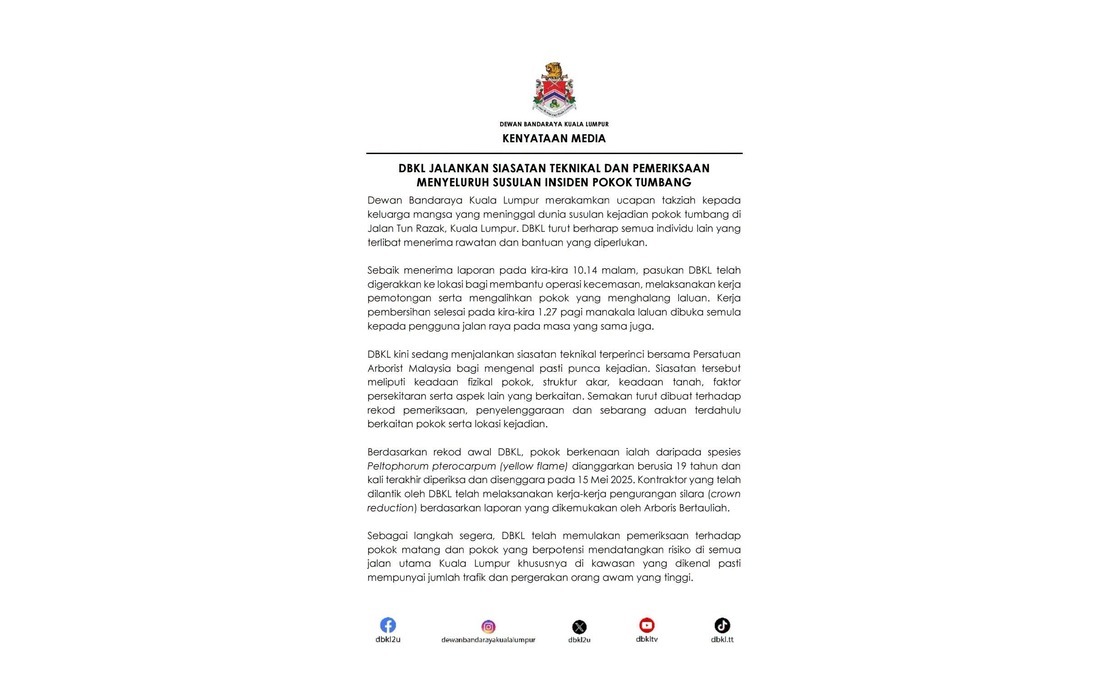
Kuala Lumpur City Hall (DBKL) has launched an extensive technical investigation into a fatal tree-fall incident on Jalan Tun Razak, working alongside the Malaysian Society of Arborist to establish what caused a mature tree to topple and claim a life. The collaborative probe signals a serious response to public safety concerns following the overnight tragedy, with authorities pledging full transparency and cooperation with police and related agencies as the inquiry progresses.
The investigation encompasses a comprehensive assessment touching multiple dimensions of arboricultural and environmental science. Inspectors will scrutinise the tree's physical integrity, examine its root network and the surrounding soil composition, and evaluate environmental stressors that may have contributed to failure. In addition, the team will review all available documentation, including inspection records, maintenance schedules, and any prior complaints residents or officials had lodged about the tree or its location.
Records indicate the fallen tree was a Peltophorum pterocarpum, commonly known as Yellow Flame, approximately 19 years of age. The specimen had undergone professional inspection and maintenance on May 15, with contracted arborists having already performed crown reduction work based on earlier expert recommendations. This recent intervention raises questions about whether the remedial work was adequate or whether underlying structural weakness had been overlooked.
Beyond its immediate response to the incident, DBKL articulated concern for those affected. The authority extended condolences to the victim's family and pledged support for other persons impacted by the incident, acknowledging the trauma such an event inflicts on the broader community.
Emergency response procedures operated swiftly once the incident was reported at 10.14 pm. Response teams mobilised immediately, undertaking tree-cutting operations and clearing debris from the thoroughfare to restore traffic flow. The road was reopened within approximately three hours, at 1.27 am, demonstrating organisational capacity to manage crisis situations on Kuala Lumpur's congested urban network.
In response to this incident, DBKL has initiated an ambitious inspection campaign targeting mature and potentially unstable trees throughout the city's major arterial routes. The authority recognises that a single failure, particularly one claiming human life, demands systematic review of similar specimens across the metropolitan landscape. Priority areas include Jalan Ampang, Jalan Sultan Ismail, Jalan Raja Laut, Jalan Datuk Keramat, and additional sections of Jalan Tun Razak itself. This phased inspection programme mobilises eight teams, including five certified arborists, with completion expected within ten weeks.
The geographical focus on high-traffic corridors and zones with concentrated public movement reflects risk assessment logic. Urban tree failures in busy areas carry exponentially greater consequences for human safety than incidents in peripheral locations. By concentrating initial efforts on arterial roads where foot traffic and vehicular movement peak, DBKL prioritises protection of the largest population segments.
Beyond immediate and intermediate measures, DBKL is pursuing longer-term technological solutions to prevent recurrence. The authority is awaiting SIRIM certification for deployment of four hundred tree sensors that will monitor structural and environmental health indicators in real time. These instruments will track soil conditions, moisture saturation levels, internal structural movement, and weather-related stresses such as heavy rainfall and flood impact, providing early-warning signals before catastrophic failure occurs.
The sensor deployment strategy adopts a phased geographical approach. Four priority locations have been identified for initial installation: Jalan Bangsar, Dataran Merdeka, Jalan Ampang, and Jalan Raja Chulan. These nodes presumably represent areas where risk assessment identified elevated hazard levels based on tree density, specimen age, traffic intensity, or prior incidents.
From a broader urban governance perspective, this incident exposes vulnerabilities in Malaysia's metropolitan tree management infrastructure. Kuala Lumpur's rapid urbanisation has created dense canopy networks that furnish environmental and aesthetic benefits but also concentrate risks. A single maturing tree in a confined urban space becomes a potential hazard to hundreds of daily pedestrians and motorists. Traditional inspection regimes relying on periodic visual assessment and arborist judgment may prove insufficient as tree populations age and weather patterns grow increasingly volatile.
The Malaysian Society of Arborist's involvement signals professionalisation of arboricultural standards within the country. Collaboration between municipal authorities and specialist technical bodies strengthens investigative capacity and elevates public confidence in findings. For Southeast Asian cities wrestling with similar challenges of balancing greening initiatives against safety imperatives, the DBKL model offers a template combining emergency response, systematic audit, and predictive technology.
The incident also raises questions about liability frameworks and insurance coverage for tree-related casualties in urban environments. As cities across the region intensify tree-planting programmes to combat heat stress and improve air quality, regulatory clarity around duty of care and financial responsibility becomes increasingly important. Malaysia's response to this case will likely influence how other municipalities approach arboricultural governance.
Moving forward, the technical findings from this investigation should inform industry guidelines across Southeast Asia. Whether the tree failed due to soil instability, root disease, inadequate crown management, or unforeseen structural defect will carry implications for how similar specimens are assessed and maintained citywide. DBKL's commitment to transparency in releasing investigation conclusions will determine whether public trust in urban tree management infrastructure is restored or further eroded.

