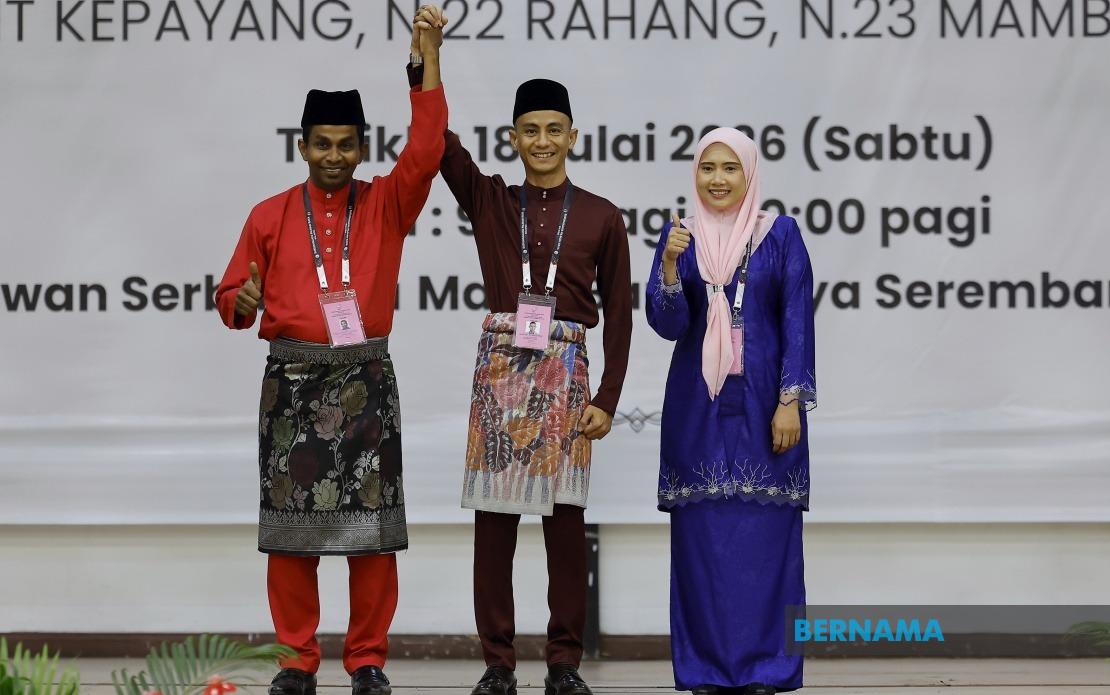
Datuk Ahmad Faez Abdul Razak is banking on three years of grassroots engagement and his professional credentials as a property developer to reclaim the Labu state seat for Pakatan Harapan in the upcoming 16th Negeri Sembilan state election. The PKR candidate, announcing his nomination in Seremban on July 18, acknowledged the nervousness accompanying his maiden electoral contest whilst projecting confidence that his extended community presence has generated sufficient momentum among voters.
The first-time political contestant characterised his entry into electoral politics as both exhilarating and sobering, noting that nearly thirty months of constituency work had positioned him to understand local aspirations. His optimism rests partly on what he perceives as expanding public appetite for PH's governance, coupled with the alignment between state and federal policy directions under the incumbent administration. This dual narrative—that voters are increasingly receptive to the coalition's platform—will be tested decisively at the ballot box, where Ahmad Faez confronts a triangular contest against the sitting assemblyman and a Barisan Nasional challenger.
Central to Ahmad Faez's campaign pitch is his professional identity as a property developer, which he positions as an uncommon asset in navigating Labu's transformation. Rather than presenting development and community welfare as competing interests, he frames his background as equipping him with practical knowledge to orchestrate growth without displacing or marginalising existing residents. This framing attempts to address a recurrent tension in rapidly urbanising Malaysian constituencies: how expansion generates prosperity without eroding social cohesion or environmental quality.
The candidate's manifesto emphasises youth infrastructure, a recognised gap in the constituency. Plans for a dedicated community centre and recreational facilities targeting younger residents suggest an attempt to address demographic concerns and retain talent within Labu. Youth unemployment and out-migration remain persistent challenges across Negeri Sembilan, and Ahmad Faez's focus on recreational and gathering spaces reflects awareness that brick-and-mortar projects alone do not anchor communities when economic opportunity is perceived to lie elsewhere.
The Malaysia Vision Valley development corridor, spanning eleven to twelve thousand hectares designated for industrial and residential expansion, frames the broader context for Ahmad Faez's campaign. This mega-development zone, within which Labu sits, promises substantial employment generation and infrastructural modernisation. However, such large-scale projects carry inherent risks: infrastructure strain, environmental degradation, property speculation, and demographic upheaval. Ahmad Faez's acknowledgment that careful management is essential suggests he recognises these tensions, though his specific mechanisms for oversight remain largely undetailed in his public remarks.
The electoral landscape in Labu reflects the fluid political dynamics now characteristic of Negeri Sembilan. The incumbent, Mohamad Hanifah Abu Baker of Bersatu, claimed the seat in the 2023 state election with a margin of just 1,640 votes, defeating the previous PH-PKR candidate Datuk Ismail Ahmad, who garnered 10,021 votes. This relatively tight victory suggests the constituency remains competitive and potentially swingable, particularly given that PH's candidate still commanded substantial support despite losing. The margin—approximately seven percent—is sufficiently narrow to make the upcoming contest genuinely contested rather than predetermined.
Barisan Nasional's decision to field Siti Nur Umaira Hasim in Labu introduces another variable into the dynamics. A three-way contest typically benefits the incumbent or the candidate with deepest organisational entrenchment, though vote-splitting can also produce unexpected outcomes if one opposition faction significantly outperforms the others. For Ahmad Faez, the three-cornered battle presents both opportunity and risk: if anti-incumbent sentiment consolidates behind PH, he could profit; conversely, divided opposition support could advantage the sitting assemblyman.
The constituency's voter profile comprises 32,884 registered electors as of the Electoral Commission's May 31, 2026 roll, with a marginal presence of police personnel and spouses among the electorate. This scale suggests Labu is neither a pocket constituency nor a particularly sprawling one, meaning localised engagement and community recognition carry disproportionate weight. Ahmad Faez's extended ground presence since 2023 thus represents a tangible investment in voter familiarity, though whether such groundwork translates into ballot-box support remains empirically uncertain.
Negeri Sembilan's political trajectory has shifted notably in recent years, reflecting broader national trends toward coalition volatility and voter pragmatism. The state's shift in fortunes between elections indicates that traditional party loyalties are weakening in favour of performance-based evaluation and perceived responsiveness to local concerns. Ahmad Faez's emphasis on understanding constituency-specific needs and balancing competing interests aligns with this apparent voter preference for candidates presenting themselves as problem-solvers rather than merely party functionaries.
The timing of Ahmad Faez's candidacy coincides with PH's broader strategy to recover ground lost in the 2023 state elections across several Negeri Sembilan constituencies. His selection as the coalition's standard-bearer in Labu suggests party confidence, perhaps reinforced by internal polling or constituency-level assessments indicating recovery potential. However, confidence and electoral outcome are distinct phenomena, and multiple candidates nationwide harbour similar expectations that ultimately do not materialise on polling day.
Looking ahead to polling on August 1, following early voting on July 28, Ahmad Faez's campaign will likely intensify efforts to translate constituency work into electoral support. The balance between development and community preservation he emphasises represents a legitimate policy debate relevant across Negeri Sembilan and broader Malaysia, where rapid urbanisation continues reshaping constituencies. How effectively he articulates this vision and persuades voters that his professional background genuinely equips him to navigate these tensions will substantially determine whether his electoral debut proves successful.

