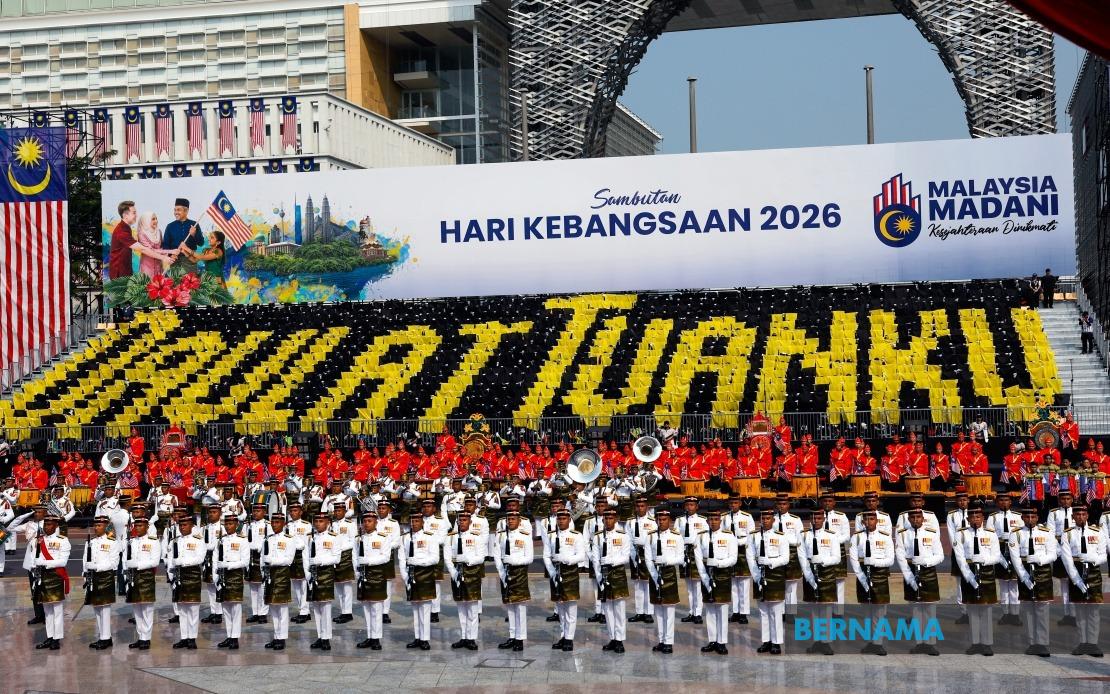
Dataran Putrajaya will transform into a showcase of national pride tomorrow as Malaysia marks its 69th National Day, with the administrative capital hosting an elaborate gathering designed to celebrate independence and reinforce the collective patriotic spirit across the nation. The event, commencing at 8:00 am, represents one of the country's most significant annual commemorations, drawing thousands of participants and spectators to witness displays of cultural heritage, national assets, and military prowess. His Majesty Sultan Ibrahim, King of Malaysia, and Her Majesty Raja Zarith Sofiah, Queen of Malaysia, will grace the occasion alongside Prime Minister Datuk Seri Anwar Ibrahim and Cabinet members, underscoring the event's ceremonial importance in Malaysia's political calendar.
Organised under the banner "Malaysia MADANI: Kesejahteraan Dinikmati" (Malaysia MADANI: Shared Prosperity Enjoyed), this year's celebration weaves together the government's development philosophy with tangible demonstrations of national accomplishment. The theme itself reflects the administration's emphasis on inclusive prosperity and collective wellbeing, moving beyond conventional independence day messaging to articulate a broader vision for the nation's future trajectory. By anchoring celebrations in this framework, organisers seek to connect historical commemoration with contemporary policy objectives, creating a narrative that links past struggles with present aspirations.
The scale of tomorrow's parade underscores the logistical complexity required to orchestrate such national events. Organisers have mobilised 10,819 participants distributed across 76 contingents, complemented by 22 marching bands and 11 float vehicles that will wind through designated routes. The military dimension proves particularly substantial, with 328 land, naval, and air assets participating alongside 112 working animals, demonstrating the defence establishment's commitment to showcasing national security capabilities to the assembled crowds and television audiences. Additionally, 22 electric vehicles will feature in the procession, signalling the government's pivot toward sustainable transportation and environmental consciousness within state ceremonies.
The opening performance, "Gema Inovasi MADANI", presents a conceptual bridge between Malaysia's multicultural heritage and contemporary aspirations. Coordinated by the National Department for Culture and Arts, this sequence mobilises 150 musical instruments and 700 traditional and innovative kompang frame drums to create a percussion-driven spectacle. The deliberate representation of instruments from Malaysia's principal ethnic communities transforms the performance into a statement on national unity and cultural equity. By fusing traditional percussion with contemporary musical innovation, organisers articulate the MADANI philosophy through artistic expression, suggesting that national progress need not abandon cultural roots but rather integrate them with modern sensibilities.
Participating contingents reflect the structural priorities of contemporary governance, with representation from defence institutions, civilian agencies, and private sector entities. The National Resilience Leadership Academy and National Defence University of Malaysia will field cadet officers, while the National Service Training Programme contributes personnel, emphasizing youth engagement in national ceremonies. The inclusion of Glasgow 2026 Commonwealth Games medalists within the sports well-being component elevates individual athletic achievement into a collective national narrative, leveraging sporting success as evidence of Malaysian excellence on the international stage. This integration of sporting achievement into state ceremonial demonstrates how modern nations weaponise athletic performance as soft power.
Civil society representation through private enterprises and cooperative bodies signals a deliberate attempt to position the private sector as stakeholder in national celebrations. Companies including Munchy's Malaysia, ZUS Coffee, MR. D.I.Y Group, and Carsome appear alongside security industry associations and cooperative movements, creating a visual taxonomy of Malaysia's economic ecosystem. This approach transforms the parade from a purely governmental display into a collaborative national project, suggesting that economic progress and patriotic sentiment are complementary rather than competing forces. The visibility granted to private entities within state ceremonies reflects broader trends in Southeast Asian governance, where public-private partnerships feature increasingly in national representation.
Public order and security agencies occupying dedicated parade positions underscores governmental messaging regarding safety and institutional competence. The Malaysia Civil Defence Force, Road Transport Department, and Malaysian Fire and Rescue Department will march alongside military units, presenting security provision as central to national identity. The Johor Military Force's participation as Malaysia's oldest military unit introduces historical continuity into the contemporary celebration, connecting present ceremonies to institutional legacies stretching back to colonial-era military establishments. This temporal layering enriches the narrative beyond simple independence celebration to encompass institutional continuity and organisational memory.
Cultural and tourism dimensions permeate the event through multiple channels. Floats promoting the Visit Malaysia Year 2026-2027 campaign will showcase state tourism assets, regional flora and fauna, traditional attire, and musical instruments, effectively transforming the national parade into a distributed tourism marketing campaign. The participation of major airlines including Malaysia Airlines, AirAsia, Batik Air, and Air Borneo extends this commercial dimension while maintaining patriotic framing. Animation studio Les' Copaque's contribution of Upin and Ipin characters represents calculated attempts to capture younger demographic attention and ensure multi-generational appeal, recognising that national ceremonies must engage children to sustain intergenerational patriotic transmission.
The human graphics performance involving 1,500 students from 36 Selangor schools introduces participatory dimensions beyond passive spectatorship. These students, arranged in coordinated formations that shift synchronously to musical accompaniment, embody abstract concepts through physical arrangement and movement. This pedagogical approach transforms participation itself into educational experience, where young citizens literally embody national themes through collective action. The RAF airshow serving as the event's climax provides visceral demonstration of national military capabilities, with fighter jets traversing Putrajaya's airspace to underscore defence establishment preparedness and technological sophistication.
Theme song "Aku Berjanji" (I Promise), composed and performed by established vocalist Faizal Tahir, provides emotional crescendo to the ceremonial proceedings. The song's title invokes covenant language, framing national celebration as occasion for renewal of collective commitment. Music's role in state ceremonies extends beyond entertainment to serve legitimation functions, with carefully selected compositions encoding official messaging within accessible cultural forms. The concluding timestamp of approximately 10:00 am provides definitive ceremonial boundary, transforming open-ended celebration into contained, structured event with clear beginning and end.
Health considerations have prompted organisers to distribute N95 face masks to over 10,000 parade participants, addressing ongoing haze concerns affecting the broader region. Communications Minister Datuk Seri Fahmi Fadzil's advisory regarding protective equipment reflects intersection of environmental challenges with state ceremonial requirements, where atmospheric pollution potentially compromises public gatherings. This practical accommodation demonstrates how contemporary Southeast Asian governance must navigate environmental degradation alongside traditional ceremonial obligations. The provision of masks to participants rather than relying on individual responsibility suggests acknowledgment that air quality management requires collective institutional intervention.
Transportation logistics and core island closures reshape Putrajaya's geography on parade days. Road closures spanning five major bridges—Seri Wawasan, Seri Saujana, Seri Gemilang, Putra, and Seri Ehsan—create temporary urban fragmentation lasting from August 30 at 5:00 am through August 31 at 6:00 pm. The Ministry of Home Affairs' advisory encouraging public transport utilisation acknowledges private vehicle constraints while promoting sustainable mobility solutions. These restrictions transform ceremonial requirements into citywide disruptions, where state celebration demands temporary suspension of ordinary urban functioning and imposition of alternative transportation regimes. Regional readers from Kuala Lumpur and Selangor will experience direct impacts through route redirections and public transport congestion, making tomorrow's events tangible beyond ceremonial symbolism into lived daily experience.

