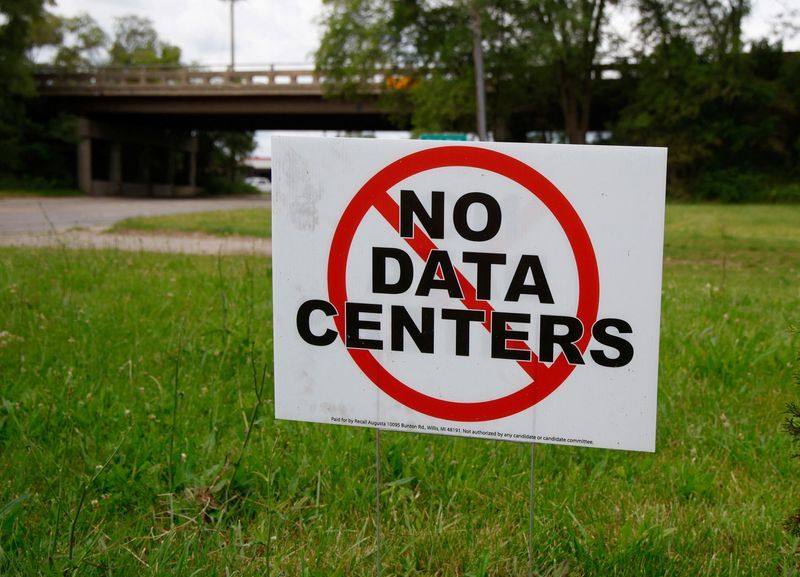
The push to build massive data centers across America has ignited a rare moment of political unity, as opponents plan coordinated demonstrations in over 125 locations nationwide. The Saturday protests represent the first nationwide mobilization against the explosive growth of AI infrastructure development, which has increasingly dominated local political conversations and divided communities over environmental and economic concerns. This marks a significant escalation in what began as scattered municipal resistance into a movement that observers believe could reshape the political landscape in coming elections.
The movement is being orchestrated by HumansFirst, a grassroots organization founded by Amy Kremer, a veteran activist who previously helped lead the Tea Party movement during its emergence in 2009. Kremer has drawn deliberate parallels between the current data center backlash and that earlier populist uprising, characterizing both as grassroots revolts against what participants view as unaccountable corporate expansion and government neglect of citizen welfare. However, she has been careful to emphasize that opposition to data centers transcends the traditional left-right political divide, distinguishing this movement from partisan causes that typically mobilize along ideological fault lines.
The stated grievances of HumansFirst focus on what the organization describes as an "unaccountable" development process and an "unacceptable infringement on our liberty." Communities have watched as major technology corporations—including Meta, Alphabet, Amazon, Microsoft, and Elon Musk's xAI—have pursued data center projects with minimal public input. In numerous cases, local officials have signed non-disclosure agreements with developers, effectively silencing discussion of proposed projects even as residents voice opposition and communities lack adequate regulatory oversight. This opacity, combined with the scale of these undertakings, has bred deep resentment among residents who feel excluded from decisions that will fundamentally alter their neighborhoods.
Public sentiment strongly favors these protesters. According to a June Reuters/Ipsos poll, just one-third of Americans approve of the current pace of data center construction nationally. More strikingly, only 14 percent of survey respondents would support building a data center in their own community to power artificial intelligence initiatives for technology firms. This dramatic gap between abstract tolerance and personal acceptance reveals the true depth of public concern—voters understand the national significance of AI infrastructure but overwhelmingly reject having it nearby. Such sentiments typically translate into powerful electoral motivation, particularly when voters feel their voices have been ignored by decision-makers.
Geographic distribution of Saturday's protests reveals the breadth of opposition. Texas, the nation's Republican stronghold and increasingly a focal point for data center development, planned the most demonstrations with 16 scheduled protests. Georgia, a crucial swing state in national elections, had organized 11 events, while California, Florida, and Pennsylvania—spanning the political spectrum—each hosted seven. This geographic spread underscores how data center expansion has become a truly national phenomenon, affecting red states, blue states, and purple states alike, and generating opposition among diverse voter bases.
Specific concerns vary by region but cluster around three primary issues: water consumption, energy demands, and environmental degradation. In water-stressed regions, these fears take on acute urgency. Ivan DelSol, a left-leaning activist organizing protests in Imperial County, California, highlighted the dystopian scale of the problem: a proposed data center project could consume 260 million gallons of water annually from the already-stressed Colorado River. This is not theoretical environmental impact but a direct threat to agricultural viability, municipal supplies, and long-term regional sustainability. The data center industry counters that its water consumption pales beside agricultural and manufacturing sectors, yet this technical argument carries little weight among residents watching precious resources diverted to power algorithms.
The activism extends across generational and demographic lines. Eva Cardona, a 31-year-old first-time activist who describes herself as a political nomad, is organizing a Texas protest after becoming alarmed by stories of unregulated artificial intelligence expansion and its rapid growth trajectory. Her decision to channel frustration into street-level activism rather than social media engagement reflects broader recognition that traditional complaints have gone unheeded. Such conversion of passive concern into active participation, particularly among younger voters, signals substantial political volatility ahead.
Cremer has predicted that data centers will become a defining electoral issue in both the 2028 presidential race and preceding national elections. She has also publicly criticized Republicans for providing technology companies with what she terms a "free pass" on development, suggesting that neither major party has adequately addressed constituent concerns. This criticism of both parties by the movement's leadership indicates that the issue transcends traditional partisan frameworks—politicians from both sides risk voter backlash if perceived as too accommodating to tech interests.
Interestingly, movement organizers have explicitly rejected certain policy solutions despite their partisan origins. While some Democratic-controlled states like New York have implemented moratorium approaches to data center approvals, HumansFirst and allied groups have declined to endorse such broad prohibitions. Instead, organizers advocate for transparency in the development process, genuine environmental and resource protections, community benefits packages including union jobs with living wages, and enforceable mechanisms to hold developers accountable when they fail to deliver on promises. This nuanced position suggests a movement seeking reform rather than simple obstruction—activists want development conducted responsibly rather than prevented entirely.
The Data Center Coalition, the industry's main trade association and lobbying organization, has maintained studied silence on the upcoming protests. Previously, the group has asserted that data centers are committed to being responsible corporate citizens within their host communities. This defensive posture suggests industry recognition that it faces a credibility deficit among the general public. No amount of voluntary pledges appears sufficient to address the perception that communities lack meaningful control over projects that will reshape their physical infrastructure, increase their energy costs, and deplete their resources.
The convergence of these protests represents a potential inflection point in American political discourse. For years, artificial intelligence has been framed primarily as an economic opportunity and technological imperative. The grassroots mobilization now forces a reckoning with the actual, localized costs of that infrastructure. Voters are signaling that enthusiasm for AI advancement does not extend to personal sacrifice, particularly when benefits accrue to distant corporations while burdens fall on immediate communities. Southeast Asian nations watching these developments should take note: similar tensions between development and community welfare are likely to emerge as AI infrastructure expands regionally, and the political lessons from America's data center wars may prove instructive for how governments manage the social contract around technological transformation.

