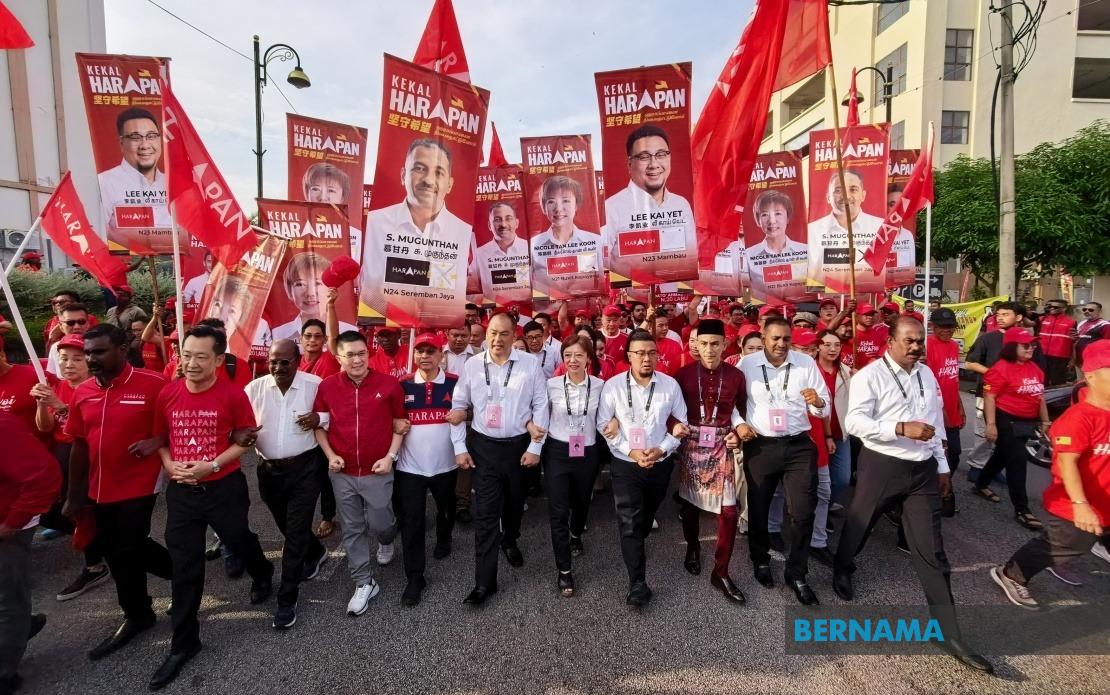
The Rahang state seat in Negeri Sembilan will see one of the most contested battles in the upcoming August 1 election, with Pakatan Harapan incumbent Siaw Meow Keong facing a challenge from three rival camps. Siaw, who has represented the constituency since his 2023 victory, was officially nominated alongside his opponents during ceremonies held at Seremban City Council Hall following the close of the nomination process this morning.
The nomination of candidates revealed a fragmented contest that reflects broader fault lines within the political landscape of the state. Siaw, who serves as treasurer of the DAP's Negeri Sembilan chapter, will encounter Yap Siok Moy representing Barisan Nasional as the MCA Wanita chief from Rasah, S. Thinagaran contesting under the socialist banner of Parti Sosialis Malaysia, and Tang Jay San fielded by the Bersatu party. Returning officer Mohamad Najib Mustafa presided over the candidate registration, with all four aspirants submitting their nomination papers within a tight window between 9.06 and 9.13 this morning.
The competitive nature of the Rahang contest underscores the shifting dynamics within Malaysia's electoral politics, particularly the emergence of challenges to PH's hold on constituencies it captured in the 2023 state elections. That Siaw must defend against not merely the traditional BN opposition but also splinter parties reflects how Bersatu's departure from government has fractured what was once the dominant coalition's electoral machinery. For DAP, retaining this seat becomes significant both for maintaining its foothold in Negeri Sembilan and for validating its partnership strategy under the PH umbrella.
Beyond Rahang, the Negeri Sembilan state election presents a mixed picture of competitive dynamics across the state's constituencies. In Bukit Kepayang, Nicole Tan Lee Koon, who leads DAP's women's wing in the state, holds a clearer path to victory with a straight two-cornered fight against Perikatan Nasional's Lee Boon Shian. This binary contest contrasts sharply with other battlegrounds and suggests that in some areas, the three-way splits involving Bersatu have not fully materialised, or that PN has chosen to concentrate its efforts selectively.
Three additional constituencies will witness three-cornered contests that pit PH candidates against both traditional and new opposition forces. In Labu, PH's Datuk Ahmad Faez Abdul Razak confronts both Bersatu's Mohamad Hanifah Abu Baker and Barisan Nasional's Siti Nur Umaira Hasim, creating a scenario where opposition votes may be effectively split if neither BN nor Bersatu emerges as the clear challenger. The Mambau seat will see PH's Lee Kai Yet navigate a similar environment against Bersatu's N. Sarawanan and PN candidate Eric Michael, while the Seremban Jaya constituency puts PH's S. Mugunthan in a three-way tussle with BN's Datuk T. R. Thinalan and Bersatu's R. Mahendran.
These electoral configurations carry implications for how Malaysian politics continues to evolve post-2023. The persistence of three and four-cornered contests, rather than the simpler BN versus opposition dynamics that dominated earlier decades, demonstrates the fragmentation now embedded in the country's political system. This fragmentation can benefit incumbent parties like PH if opposition votes split effectively, yet it also creates unpredictability and places greater emphasis on ground-level campaign mechanics and voter sentiment toward local candidates rather than national narratives.
For Negeri Sembilan specifically, the state remains a significant testing ground given its history of alternating between BN and opposition control. The state's electorate has shown itself willing to switch allegiances when dissatisfied, making these elections less predictable than might be assumed in states with entrenched voting patterns. PH's performance across these contested seats will provide early indicators of whether the party can consolidate its 2023 gains or whether backlash and opposition fragmentation will erode its position.
The emergence of Parti Sosialis Malaysia as a contesting force in Rahang represents another noteworthy element of this political landscape. While socialist movements have historically played limited roles in Malaysian electoral politics, PSM's decision to field candidates suggests either growing organisational capacity or a strategic decision to contest specific constituencies where organisers perceive openings. Whether such contests prove symbolic or portend a shift in Malaysia's political makeup remains to be seen.
Bersatu's presence across multiple constituencies reflects its repositioning as an independent force rather than merely a splinter faction. Having exited federal government and then PH, the party is now attempting to carve out electoral space, particularly in Selangor and Negeri Sembilan where it retains some organisational presence. The party's ability to genuinely threaten incumbent candidates or whether it primarily fragments opposition votes against BN will become clearer following the August 1 balloting.
The Election Commission has structured the campaign period tightly, with early voting scheduled for July 28 and election day set for August 1. This compressed timeline compresses candidates' ability to conduct extensive ground campaigns, potentially disadvantaging less well-resourced challengers while favouring incumbents with established machinery and media presence. For Siaw and other incumbent PH representatives, this shortened timeframe may prove advantageous.
The Negeri Sembilan results will feed into a broader narrative about whether PH can maintain its 2023 momentum and whether the coalition faces internal strains given DAP's need to contest multiple seats. The state election also occurs before federal parliamentary elections, making it a potential bellwether for national political trajectories. How voters respond to the choices presented in constituencies like Rahang may signal broader shifts in Malaysian electoral preferences and the durability of the PH coalition structure.

