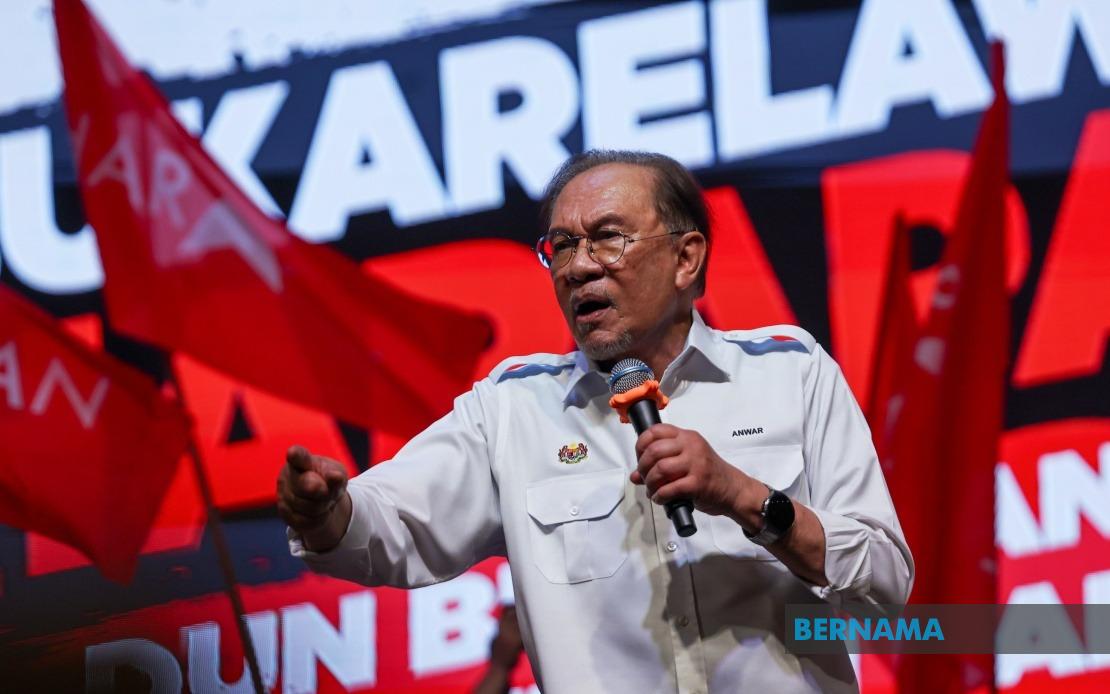
Prime Minister Datuk Seri Anwar Ibrahim has moved to quell narratives portraying the Democratic Action Party as hostile to Malay interests, asserting instead that the multiracial coalition partners have consistently respected constitutional protections for the community. Speaking during a public engagement in Muar, the Pakatan Harapan chairman cited concrete evidence of DAP's acceptance of Malay-focused initiatives, including the gazetting of 20.23 hectares of land in Bandar Malaysia as Malay Reserve Land, to demonstrate the party's compatibility with existing constitutional frameworks governing indigenous rights.
The prime minister's remarks represent a strategic effort to neutralize political criticisms that have dogged the Unity Government coalition since its formation. Opposition narratives frequently position DAP as a threat to Malay-Muslim privileges, a potent rhetorical weapon in Malaysian politics where sensitivity to communal rights remains acute. By presenting specific instances of DAP's acquiescence to Malay-centric policies, Anwar attempted to reframe the debate from ideological opposition to practical governance. His emphasis that DAP "has never objected" to Malay Reserve designations serves as a preemptive counter to such accusations, shifting focus toward demonstrated actions rather than partisan suspicions.
Anwar articulated a governing philosophy centred on equitable distribution of state resources and economic benefits across demographic lines. He outlined his administration's commitment to expanding support mechanisms for Bumiputeras through institutions like Perbadanan Usahawan Nasional Berhad, while simultaneously directing resources toward disadvantaged segments of other communities. This dual-track approach reflects the practical challenge facing any Malaysian government attempting to honour constitutional commitments to Bumiputera privileges whilst maintaining legitimacy among non-Malay constituencies who form significant portions of urban and economically active populations.
Critically, Anwar distinguished between programmatic support for specific communities and principled governance frameworks applicable to all. His statement that "poor Chinese should be helped, poor Indians should be helped, the majority of poor Malays should be helped" articulates a needs-based rather than ethnicity-based approach to welfare, a framing that attempts to broaden appeal beyond communal constituencies whilst respecting existing constitutional arrangements. This nuanced position addresses a core tension in Malaysian politics: how to maintain constitutional protections for particular groups whilst building inclusive governance models that prevent any single community from experiencing systematic disadvantage.
The prime minister connected economic policy to broader developmental outcomes, emphasizing that national growth must translate into tangible improvements in housing, infrastructure, and educational quality across all communities. His remarks suggest frustration with economic expansion that concentrates benefits among elites rather than diffusing prosperity downward through inclusive development. This reflects broader sentiment in Malaysia where rapid GDP growth has not consistently reached lower-income households, fuelling discontent regardless of ethnicity and creating political space for appeals centered on shared material interests rather than communal identity.
Anwar's characterization of political power as a public trust rather than personal enrichment opportunity reveals awareness of corruption narratives that have damaged public faith in Malaysian institutions. By explicitly rejecting the instrumentalization of state power for individual gain, the prime minister positioned the Unity Government as distinct from predecessors whose leaders faced allegations of systemic plunder. This moral framing serves multiple audiences: it reassures voters concerned about governance integrity whilst signalling to coalition partners that state resources are administered according to consistent principles rather than factional preferences.
The broader context involves contested interpretations of Malaysian constitutionalism. Opposition parties argue that any deviation from strict communal allocation frameworks threatens Bumiputera protections, whilst the government contends that inclusive governance and constitutional rights are compatible. Anwar's approach attempts to demonstrate this compatibility through both rhetorical assertion and policy evidence. His willingness to cite DAP's acceptance of Malay Reserve designations suggests confidence that such examples will persuade audiences that non-Malay parties can operate within constitutional constraints without compromising those protections.
The timing of these remarks during the Johor state election campaign carries particular significance. Johor, Malaysia's second-largest state, remains strategically important for both Pakatan Harapan and opposition coalitions. Election contests in this Malay-majority state necessarily involve intense scrutiny of each coalition's racial credentials, making Anwar's intervention a calculated effort to frame the election narrative. His emphasis on DAP's reliability on constitutional issues aims to undermine opposition efforts to mobilize Malay voters through concerns about non-Malay political dominance.
For Southeast Asian observers, Anwar's positioning illuminates the persistent challenges facing multiethnic democracies attempting to balance constitutional protections for particular communities with inclusive governance frameworks. Malaysia's constitutional settlement, establishing Bumiputera privileges in exchange for extending citizenship to non-indigenous populations, creates ongoing tensions when applied to contemporary policy questions. Whether ethnicity-based or needs-based allocation frameworks should predominate remains contested, with Anwar attempting to argue that both approaches can coexist within proper constitutional interpretation.
The prime minister's insistence on fairness across communities reflects political necessity rather than ideological conviction, as any Malaysian government must maintain sufficient support among both Malay-Muslim and non-Malay populations to sustain parliamentary majorities. His framing suggests that such balance remains achievable through careful calibration of resources, consistent application of constitutional principles, and explicit repudiation of zero-sum narratives suggesting that one community's advancement necessarily diminishes another's interests. Whether this equilibrium can survive sustained political pressures remains uncertain, particularly as economic growth slows and resources available for distribution contracts.

