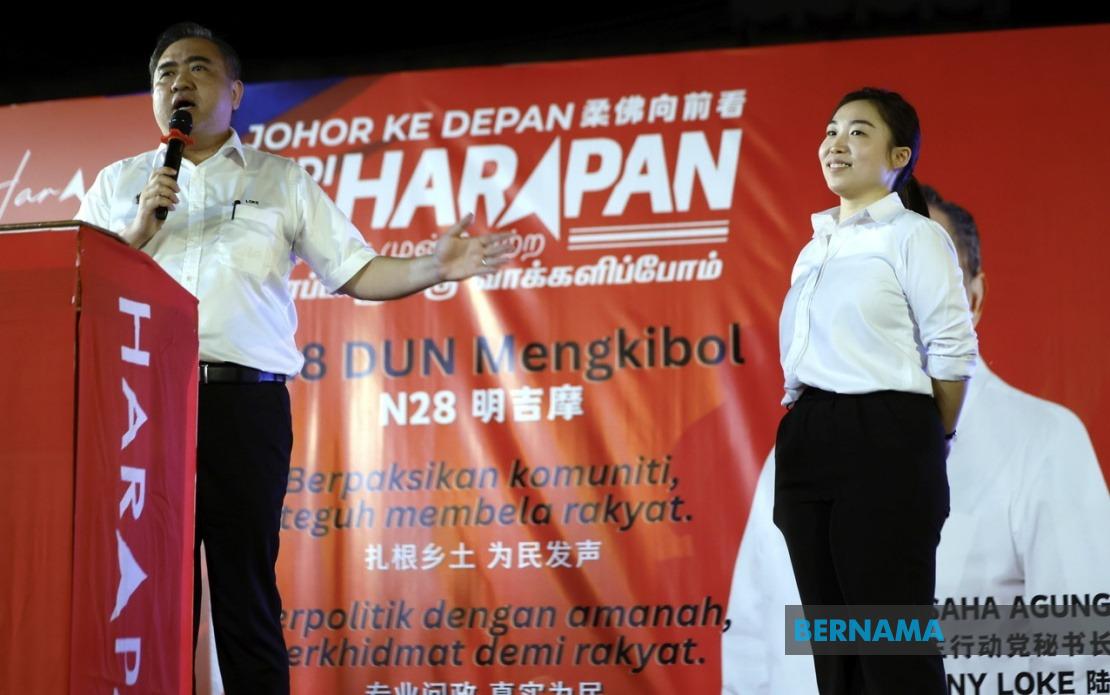
The Democratic Action Party has unveiled Chu Poh Yee, a 33-year-old legal professional, as its standard-bearer for the Mengkibol assembly seat in the forthcoming Johor state election. The announcement on June 18 marks a strategic shift for the party in this constituency, where it will transition leadership to a fresh candidate with a background in legal services.
Chew Chong Sin, the sitting assemblyman who has represented Mengkibol for two consecutive terms, will step aside to pursue a higher office. Party secretary-general Anthony Loke confirmed that Chew has been identified as a strong prospect for the Labis parliamentary constituency in the next federal election. This move becomes feasible following the announcement by current Labis MP Pang Hok Liong that he will not defend his seat at the general election, creating an opening for DAP to field a new candidate in that traditionally competitive parliamentary division.
Loke's decision to promote the Mengkibol assemblyman reflects internal party calculations about maximizing electoral gains across multiple levels of government. By repositioning Chew to contest Labis—a parliamentary seat that carries greater influence in the national legislature—DAP appears to be leveraging its two-term incumbent in a broader strategic consolidation. This approach demonstrates how state and federal election cycles, though often held separately, factor into long-term party planning across West Malaysia's competitive political landscape.
Chu's nomination signals DAP's explicit commitment to expanding women's representation in elected office, a priority the party has increasingly emphasized. Her selection followed unanimous approval from the party leadership, based on credentials that party officials believe make her electable in this demographic. Loke highlighted her substantial background in legal aid work, noting her experience assisting local representatives navigate cases requiring specialized knowledge of the law. This background in supporting community members with legal matters positions her as someone with demonstrated commitment to constituent welfare, a conventional benchmark for judging candidate suitability.
Beyond professional credentials, Loke stressed that Chu possesses multilingual capabilities and educational qualifications that enhance her appeal to Mengkibol's diverse voter base. Equally significant, according to Loke, she maintains established connections within the constituency itself, suggesting familiarity with local issues and networks. The combination of professional standing, community ties, and demographic representation appears designed to present a competitive candidacy against opposition rivals.
DAP's overall strategy for the Johor election encompasses a total of 17 state seats. This allocation breaks down into three categories: ten seats currently held by DAP incumbents including Mengkibol, four constituencies previously lost where the party intends to recapture ground, and three additional seats representing expansion targets. This distribution suggests the party believes it can both consolidate existing strongholds and penetrate new electoral territory, though the latter carries inherently higher risk.
The sequencing of candidate announcements follows a deliberate timeline. Loke confirmed that four additional names for Tiram, Johor Jaya, Senai, and Bukit Permai would be revealed the following Saturday, June 23. The remaining DAP candidates, alongside the full slate from Pakatan Harapan coalition partners, would be disclosed the subsequent Monday by Malaysia's Prime Minister. This coordinated announcement structure reflects the coalition's desire to maintain narrative control and prevent premature speculation about contested nominations.
For Malaysian observers watching Johor politics, DAP's candidate selection carries implications beyond simple seat allocation. The party has historically competed most effectively in urban constituencies and areas with significant Chinese-majority populations, though recent election cycles have shown increasing multi-ethnic appeal. Chu's nomination for Mengkibol, paired with DAP's targeting of 17 seats, suggests confidence in contesting diverse constituencies. The choice of a woman candidate in a seat previously held by a male incumbent also reflects generational and gender dynamics increasingly visible in Malaysian political competition.
The Pakatan Harapan coalition's synchronized announcement strategy indicates the broader opposition grouping's attempts to project unity and systematic planning. By sequencing announcements across multiple dates rather than releasing all candidates simultaneously, coalition leadership can manage media cycles and maintain public attention. This tactical approach carries particular importance in Johor, where political competition remains volatile and every announcement becomes subject to intense scrutiny from rival coalitions.
Chu's professional background in legal services and legal aid work distinguishes her from candidates with purely business or grassroots organizing experience. In Malaysian constituencies increasingly attentive to service delivery and constituent support, a lawyer's capacity to assist citizens navigating bureaucratic and legal complexities holds genuine appeal. This positioning may prove decisive in a competitive race, particularly if opposition candidates lack comparable credentials in targeted community assistance.
The transition of sitting Mengkibol assemblyman Chew to higher office also illuminates how Malaysian state assemblies function as recruitment grounds for parliamentary candidates. Strong state-level performers, particularly those with electoral credibility across multiple contest cycles, naturally become candidates for federal positions. Chew's elevation after two terms suggests DAP assessed him as capable of competing in a parliamentary division, validating the party's development of talent through lower offices.
Looking forward, Chu's campaign will likely emphasize continuity in servicing Mengkibol residents while signaling fresh leadership and renewed energy. Her gender, age, and professional identity contrast with traditional political stereotypes, potentially appealing to younger voters and those favoring modernization in governance. DAP's investment in her candidacy reflects broader calculations about women's electoral viability in Malaysian politics, an area where regional variations remain pronounced.

