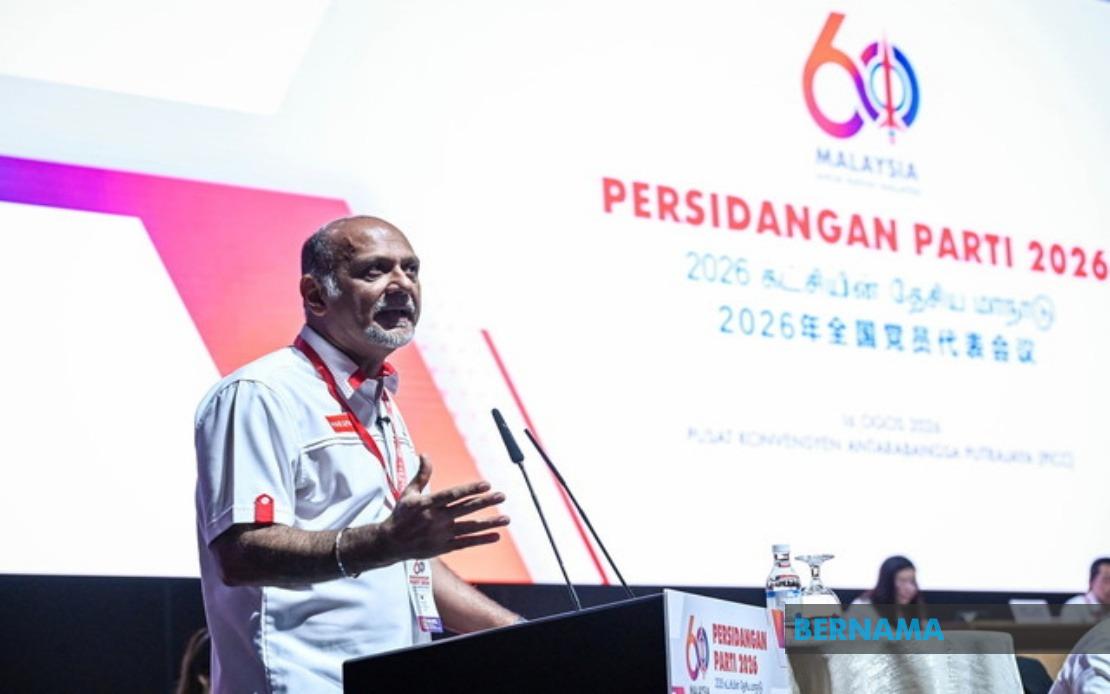
The Democratic Action Party is at a critical juncture, compelled to recalibrate its strategic priorities in response to recent electoral setbacks that have exposed the limits of its influence within Malaysia's fragile ruling coalition. Speaking at the DAP Party Conference 2026 held at the Putrajaya International Convention Centre, national chairman Gobind Singh Deo articulated an uncomfortable truth: after more than three years participating in the Unity Government, the party must now evaluate both what it has accomplished and where it has fallen short before mapping its next steps. This frank assessment represents a significant moment for the party as it grapples with the gap between electoral promises and the messy realities of multi-party governance.
Gobind's remarks signal an acknowledgement that DAP's approach to reform must undergo fundamental revision. Rather than maintaining ambitions to implement its comprehensive manifesto unilaterally, the party will henceforth concentrate on legislative and institutional changes that command support across the coalition's various partners. This pragmatic recalibration reflects the inherent constraints of coalition politics, where ideological purity often yields to the arithmetic of compromise. The party leadership recognises that securing agreement on a narrower set of substantive reforms is preferable to pursuing an expansive agenda that fragments the government and diminishes the party's actual ability to effect change.
A centrepiece of DAP's revised reform programme involves convening a special parliamentary session to debate and enact amendments to several cornerstone pieces of legislation. The Security Offences (Special Measures) Act 2012, commonly referred to as SOSMA, stands foremost among these targets, alongside the Peaceful Assembly Act 2012. These laws have long been criticised by human rights advocates and opposition figures as affording excessive discretionary powers to the executive. Additionally, DAP has championed structural innovations designed to constrain executive authority, including the formal separation of the Attorney General's office from the Public Prosecutor's function—a distinction that would introduce clearer institutional boundaries and reduce the concentration of prosecutorial discretion in a single office. The party is also pushing for constitutional term limits on the Prime Minister's tenure, restricting any individual to two consecutive terms.
These institutional reform priorities carry substantial implications for Malaysia's governance architecture and democratic health. In a region where executive dominance has historically characterised political systems, even incremental steps towards institutional dispersal of power represent meaningful progress. For Malaysian observers and investors alike, the success or failure of these reforms will signal whether the Unity Government possesses genuine commitment to strengthening institutional checks on executive power, or whether such rhetoric merely masks continuity with prior patterns of centralised authority. The visibility and credibility of these changes will profoundly influence both public confidence in government and Malaysia's attractiveness as a destination for foreign capital, which increasingly incorporates governance quality into investment calculus.
The conference proceedings introduce an element of high political drama through the motion Anthony Loke will table regarding DAP's continued participation in the government coalition through the end of the 16th Parliament's term. Over four thousand delegates representing eligible party branches will cast secret ballots on this consequential question, transforming internal party dynamics into a barometer of grassroots sentiment. The secret ballot mechanism ensures that rank-and-file members can express their genuine preferences without fear of reprisal, thereby generating an authentic measure of party opinion. Should delegates vote to withdraw, the government's parliamentary majority would face immediate structural pressures, potentially precipitating the coalition's collapse. Conversely, a decisive mandate to remain signals internal consensus around the pragmatic coalition strategy that Gobind articulated.
Gobind's economic commentary reflects the party's attempt to reposition itself as responsive to the material struggles that animated public discontent in the recent state elections. He emphasised that government must demonstrate concrete understanding of prevailing economic hardships and implement tangible mitigation measures. Simultaneously, he articulated the paradoxical truth that Malaysia's capacity to address these challenges depends heavily on maintaining the political stability necessary to attract foreign direct investment. This tension—between immediate relief and long-term structural development—captures a fundamental dilemma confronting any government attempting to govern during periods of economic strain. The party appears to be signalling that it recognises this complexity and will advocate for policies that balance short-term palliatives with investments in competitiveness and employment generation.
The broader context of DAP's repositioning within the Unity Government reflects shifting Southeast Asian political dynamics. Malaysia's experiment in multi-party, ideologically heterogeneous governance represents an alternative to both one-party dominance and the sectarian polarisation that has characterised recent electoral contests elsewhere in the region. DAP's willingness to accept coalition constraints and moderate its ambitions suggests that the party has internalised lessons about the relationship between political sustainability and incremental reform. Whether this represents mature democratic pragmatism or an abandonment of transformative vision remains contested among the party's membership and supporters.
The conference's timing, coinciding with the party's sixtieth anniversary, imbues these deliberations with additional symbolic weight. DAP's six-decade trajectory spans eras of authoritarian governance, democratic opening, and the complex hybrid systems characterising contemporary Malaysian politics. The party's evolution from a primarily opposition voice to a ruling coalition participant represents extraordinary political transformation, yet one accompanied by persistent internal tensions between those advocating fundamental change and those accepting incremental progress. This anniversary moment thus functions as both celebration and reckoning, prompting reflections on whether the party's participation in government advances the democratic vision that animated its founding principles.
The composition of DAP's leadership visible at the conference—including secretary-general Anthony Loke and vice-chairmen representing the party's geographic and factional diversity—underscores that this strategic reassessment emerges from collective deliberation rather than individual whim. The presence of party advisers Lim Guan Eng and Tan Kok Wai, both veterans of DAP's pre-government opposition years, adds further symbolic resonance, connecting present calculations to the party's historical experience. These elder statesmen presumably offer perspectives informed by decades of advocacy for democratic reform outside the constraints of ministerial office, thereby providing ballast against the potential for coalition participation to erode the party's core commitments.
For Malaysian observers and regional analysts, DAP's recalibration carries implications extending beyond party-specific politics. The party's demonstration that coalition participants can maintain ideological integrity while accepting governance compromise offers a potential model for multi-party arrangements elsewhere in Southeast Asia, where democratic movements frequently fragment between maximalist demands and practical power-sharing arrangements. DAP's experience suggests that productive middle ground exists between uncompromising principle and complete absorption into prevailing power structures. Whether the party can sustain this balance through the 16th Parliament's remainder, and whether such an approach ultimately strengthens or weakens democratic governance, will command close attention from regional observers monitoring Malaysia's continuing political evolution.

