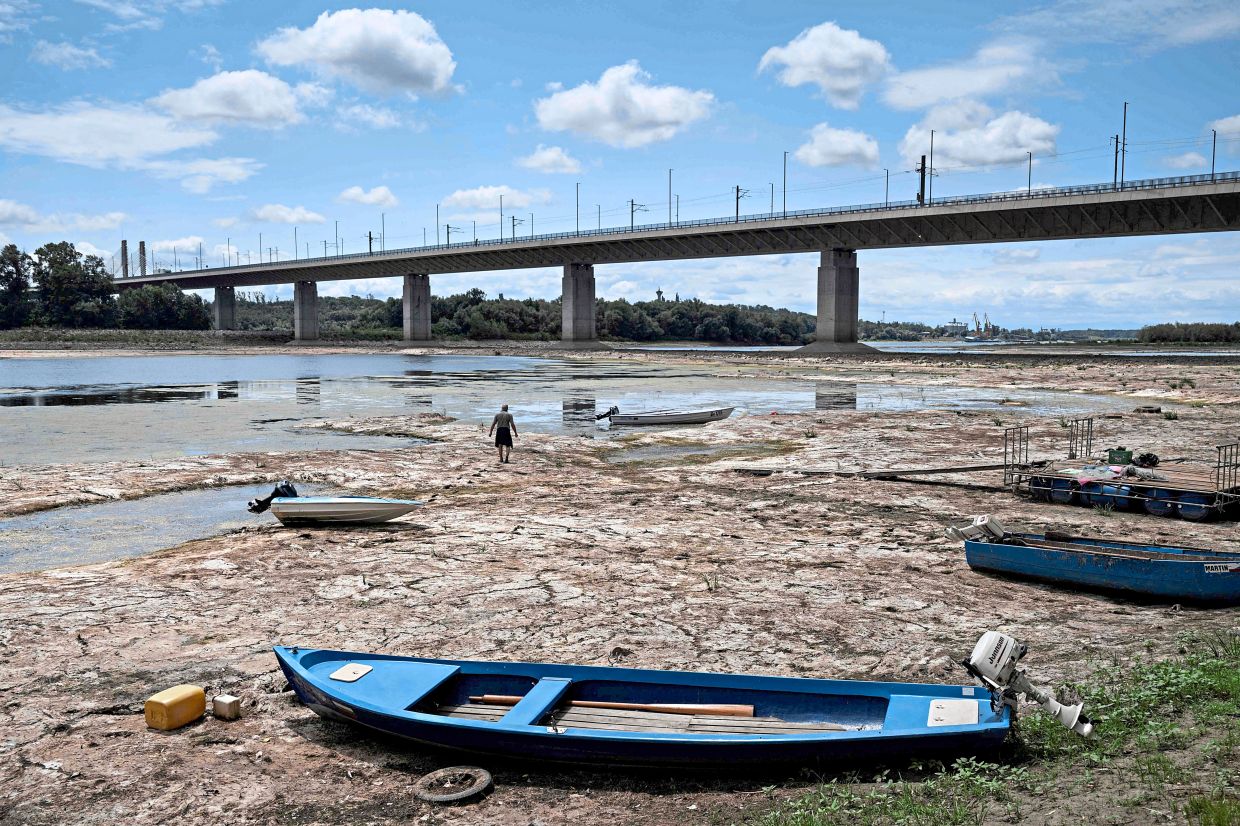
Central Europe faces an unfolding environmental crisis as the Danube River, one of the continent's most vital waterways, has plunged to record-low levels that authorities and residents never anticipated would be reached. The river, which traverses ten countries from southwestern Germany through to the Black Sea, now exposes previously submerged geological features and archaeological remnants that serve as stark reminders of how dramatically conditions have shifted in recent years. In Budapest, Hungary's capital city, national water authorities recorded a measurement of just 23 centimetres on July 29, obliterating the previous record minimum of 33 centimetres that had stood since 2018—a gap that underscores the accelerating severity of the current situation.
The immediate cause of this crisis stems from a combination of prolonged drought conditions that have persisted throughout much of Central Europe over the year, coupled with successive heat waves that have dramatically increased evaporation rates across the entire region. The Hungarian Meteorological Service has documented that ninety-day precipitation totals across nearly the entire country currently sit between 80 and 130 millimetres below established multi-year averages, painting a picture of systematic water deficit. Forecasts offer little relief, with no meaningful rainfall expected in the coming days and temperatures projected to exceed 38 degrees Celsius across the region—conditions that promise to intensify the dewatering of the Danube and other water systems further.
The visual evidence of this transformation has become impossible to ignore for residents and visitors alike. Photographer Gabor Kertesz captured images at the base of Budapest's Margaret Bridge, a location that normally remains submerged beneath several metres of water. He described his shock at witnessing exposed bedrock and sand bars that frame the bridge's supporting pillars, phenomena that few people alive have witnessed before. His observations reflect a broader existential anxiety gripping the region: without understanding the full trajectory of climate change, residents cannot predict whether current conditions represent a temporary anomaly or a permanent shift in the Danube's hydrological character.
The economic consequences are cascading across multiple sectors that depend on the river's navigability and volume. Tourism operators have been forced to fundamentally restructure their operations, with popular cruise ship companies now required to dock considerably upstream of Budapest, preventing the seamless passenger transfers that typically characterise the lucrative sightseeing industry. More severely, cargo shipping has essentially ceased operations along much of the river, according to Hungary's Ministry of Transport and Investment, effectively severing a critical transport corridor for goods movement across Central and Eastern Europe. The financial implications extend far beyond individual shipping companies, as the Danube serves as an essential artery for trade connectivity across the Danube Commission's ten member states.
The human cost of these conditions became graphically evident when Bulgarian police evacuated 186 tourists from the Viking Ullur cruise ship on July 28 after the vessel ran aground on a shallow sandbar near the port city of Vidin. The situation deteriorated such that the ship's passengers exhausted available food and water supplies, unable to reach the intended port of Vidin to resupply—a scenario that few shipping companies had contemplated as a realistic operational risk. The ship's 52 crew members faced an indefinite period confined onboard, with their ultimate fate dependent on refloating attempts that remain contingent on unpredictable water level changes and navigation conditions.
In Serbia, the crisis has stranded hundreds of small recreational vessels and dozens of cargo ships along the northern city of Novi Sad, where the exposed river bank presents a haunting landscape of abandoned watercraft. Radovan Segrt, who operates river excursion services aboard his own boat, reported that the Danube has receded between fifteen and twenty metres from its normal shoreline—a retreat of such magnitude that it has effectively eliminated the summer tourism season for small-scale river operators who depend on steady passenger numbers to sustain their livelihoods.
Beyond tourism and shipping, the drought threatens energy security across multiple nations that rely on the Danube for cooling nuclear reactors essential to their electricity grids. Romania has been forced to shut down reactor units at the Cernavoda power plant after water flow in the Danube declined to approximately 1,630 cubic metres per second—roughly one-third of typical July averages—creating unsafe conditions for reactor cooling systems. Hungary's Paks nuclear facility, which supplies nearly half of the country's total electricity generation, began progressively reducing power output at multiple reactors beginning July 29, following two consecutive days of curtailment across other units. These shutdowns, if sustained or expanded, threaten to create energy shortages that could cascade across Central European economies during a period when cooling demand peaks due to the intense heat wave.
The exposed river bed has also revealed historical hazards buried beneath decades of sediment and water. Budapest authorities closed the Margaret Bridge after discovering an unexploded World War II-era bomb exposed by the receding water levels—a reminder that the Danube serves as the final resting place for numerous dangerous remnants of twentieth-century conflict. Simultaneously, treasure hunters have seized upon the extraordinary conditions to recover artefacts from the riverbed, using powerful magnets to extract metal objects including old radio equipment and ammunition casings from successive world wars. Zsolt Horvath, a local treasure seeker, articulated the paradox confronting the region: while the extreme drought creates unprecedented opportunities for archaeological and historical recovery, these same conditions represent an unambiguous curse for the region's broader economic, energy, and environmental wellbeing.
The Danube crisis illuminates the interconnected vulnerabilities now exposed across Europe's integrated economy and infrastructure as climate change intensifies. What begins as a hydrological phenomenon cascades through tourism, shipping, energy production, and historical management—touching virtually every dimension of life for the millions of people living along the river's course. For Southeast Asian observers and policymakers, the Danube situation offers an instructive case study in how climate-driven water stress can simultaneously disrupt multiple critical systems, a scenario that increasingly resembles the vulnerabilities facing major river systems throughout Asia, including the Mekong, Brahmaputra, and Irrawaddy.

