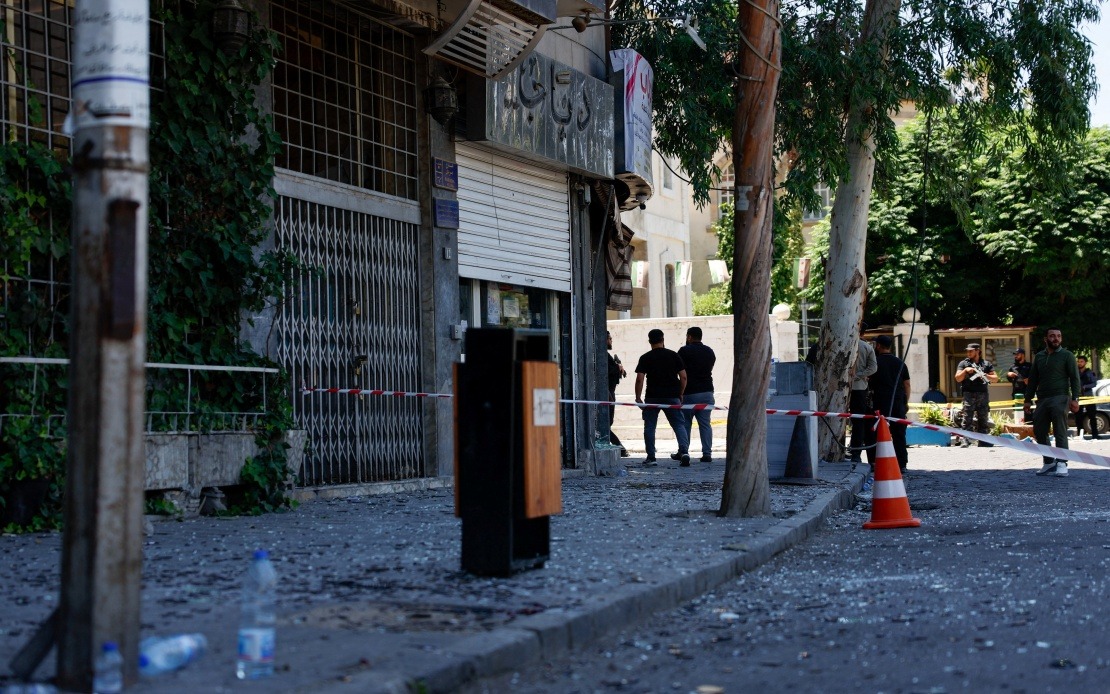
Two consecutive explosions rocked Damascus on Tuesday, wounding at least 18 individuals including four members of the security forces, according to the Syrian Interior Ministry. The coordinated detonations involved improvised explosive devices and unfolded rapidly, with witnesses and monitoring organisations reporting that a first blast was succeeded almost instantaneously by a more powerful secondary explosion. The blasts occurred in close proximity to the hotel accommodating French President Emmanuel Macron during his landmark visit to Syria, though officials confirmed that the French leader remained safe throughout the incident.
The timing of the explosions underscores the security challenges facing Syria even as diplomatic engagement from Europe resumes. Emmanuel Macron's arrival in the country on Monday evening marked a significant moment, with his visit becoming the first by any EU leader since 2010. This development signalled a potential shift in international relations toward Damascus following years of geopolitical isolation. However, Tuesday's incident immediately tested the stability of the operating environment and raised questions about security arrangements for high-level foreign delegations.
The Syrian Observatory for Human Rights, the UK-registered human rights monitoring organisation, provided on-the-ground corroboration of the incident's severity and sequence. The group's reporting indicated that the second explosion carried considerably greater destructive force than the first, suggesting a deliberate tactical design. Security analysts often interpret such patterns as indicating planning or coordination, though immediate attribution of responsibility remained unclear in early reports from Damascus.
Paris moved swiftly to reassure the international community regarding Macron's wellbeing. The Élysée Palace released a statement confirming that the French President had sustained no injuries and that his delegation remained secure. The presidential statement also indicated that Macron had remained at the presidential palace throughout the incident, where substantive negotiations between French and Syrian government delegations were proceeding. This separation between his location and the explosion site provided an additional layer of security insulation.
Emergency response protocols activated immediately following the blasts. Ambulances and emergency medical personnel converged on the affected areas within minutes, operating under coordination from Syrian authorities. The rapid mobilisation suggested that contingency planning for security incidents remained in place, despite the country's years of civil conflict and instability. First responders prioritised casualty assessment and extraction, while security personnel established perimeter controls around the blast zones.
Local residents in the Syrian capital experienced considerable alarm following the dual explosions. The sudden violence disrupted what had otherwise been a carefully choreographed diplomatic event, introducing unpredictability into a visit that officials in both Paris and Damascus had framed as an opportunity for normalisation. For ordinary Damascenes, the incident served as a reminder of the security vulnerabilities that persist in the country's urban centres, even as the acute phases of conflict have diminished.
Security forces established cordoned zones encompassing the blast sites and surrounding neighbourhoods, restricting public movement and securing the area against further incidents. Such immediate lockdown procedures reflected professional security management, though they also disrupted daily life for residents in central Damascus. The establishment of these perimeters prevented unauthorised access while investigators began their preliminary assessments.
Macron's visit itself carried substantial political significance for the region. The French President's decision to travel to Damascus represented a notable departure from the Western policy of isolation that had characterised the preceding years. Such engagement signalled potential acceptance of the Assad government's international rehabilitation, a position that remained controversial among certain segments of the international community but reflected pragmatic engagement with Middle Eastern geopolitics. Malaysia and other Southeast Asian nations, which have historically maintained measured relations with the Syrian government while supporting humanitarian concerns, would be monitoring the trajectory of European diplomatic engagement closely.
The incident highlighted the persistent security risks that complicate diplomatic missions in the Middle East. Even within capital cities of countries where active conflict has subsided, explosive devices can be deployed by various actors with differing motivations. These might include opposition remnants, criminal elements, or regional actors seeking to disrupt diplomatic normalisation. The investigation into Tuesday's explosions would likely focus on identifying the perpetrators and determining whether the attack was directed specifically at the French delegation or represented a broader security challenge.
The juxtaposition of high-level diplomatic engagement and sudden violence underscored the fragile stability characterising contemporary Syria. Macron's visit represented an attempt to engage constructively with the Syrian government, yet the security incident demonstrated the complex terrain through which such normalisation must navigate. For observers in Southeast Asia monitoring developments in the broader Middle East, the Damascus bombing illustrated how political transitions and diplomatic openings remain vulnerable to disruption by violence, even when security measures appear robust.

