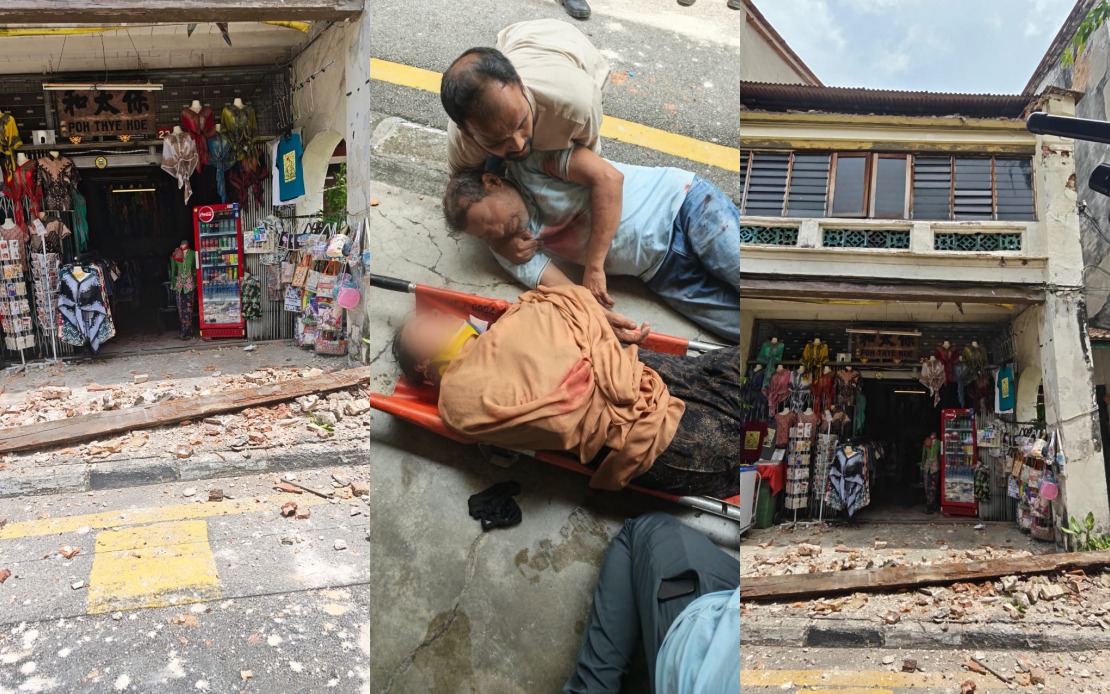
Two visiting tourists from Sri Lanka sustained injuries on Monday afternoon when debris suddenly detached from a heritage building along Armenian Street in George Town, raising fresh concerns about the structural integrity of Penang's iconic historic district. The incident, which occurred at approximately 1.11 pm, drew immediate emergency response from firefighting teams stationed at the nearby Lebuh Pantai station, who discovered that stone fragments and timber from a compromised first-floor beam had struck the visitors without warning.
The two injured parties, identified as Mohamad Ammtar, 66, and Fatimah, 55, received preliminary medical attention from Health Ministry staff deployed to the location before being transported to Penang Hospital for comprehensive evaluation and treatment. According to Penang Fire and Rescue Department operations assistant director John Sagun Francis, the couple had been exploring the neighbourhood as part of a tourism itinerary and were preparing to depart Malaysia for their home country the following day—a departure now complicated by their medical conditions. The affected property operated as a mixed-use structure, with commercial grocery operations occupying the ground floor whilst the upper storey appeared vacant at the time of collapse.
The incident has triggered an immediate policy response from the Penang state administration, which recognises the vulnerability of its heritage portfolio to similar structural failures. Wong Hon Wai, chairman of the State Tourism and Creative Economy Committee, visited the scene and subsequently issued directives requiring George Town World Heritage Incorporated and the Penang Municipal Council to systematically communicate safety inspection recommendations to all heritage property proprietors throughout the state. This administrative action represents acknowledgment that heritage preservation, whilst culturally valuable, demands rigorous contemporary safety standards to protect both residents and the tourism industry upon which much of the region's economy depends.
The timing of this incident carries particular significance for Penang's tourism sector, which has worked steadily to position George Town as a premier destination within Southeast Asia. The Armenian Street locality itself functions as a magnetic draw for international visitors seeking authentic colonial-era architecture and cultural immersion. When accidents involving tourists occur at heritage sites, they generate ripple effects across multiple dimensions: immediate diplomatic considerations arise when foreign nationals require consular support, insurance and liability questions demand resolution, and broader perceptions of destination safety become subject to rapid international dissemination through digital channels and travel review platforms.
Wong's public statements emphasised that investigations must determine the root cause of the structural failure before drawing final conclusions about remediation pathways. However, he made explicit that the state government was treating the matter with considerable seriousness—not merely because of the human injury involved, but because the incident exposed vulnerabilities in a precinct that receives constant foot traffic from domestic and international visitors. The distinction is important: heritage areas function as public spaces with inherent duty-of-care obligations that differ from typical commercial or residential properties. Buildings that line tourist thoroughfares must meet contemporary safety benchmarks whilst maintaining their historical character, a balance that requires investment, expertise, and sustained municipal oversight.
Coordination with Sri Lankan diplomatic representation has commenced to ensure the injured visitors receive appropriate consular assistance and that their medical treatment proceeds smoothly. The state government has indicated willingness to extend support to the couple as they navigate recovery and logistics. Such gestures, whilst humanitarian in intent, also serve diplomatic purposes by demonstrating Malaysia's commitment to visitor welfare and crisis response—factors that influence regional diplomatic relations and future bilateral tourism cooperation.
The broader implication of this incident extends beyond the immediate location. George Town's designation as a UNESCO World Heritage Site in 2008 created obligations and opportunities but also exposed the challenge of maintaining ageing infrastructure to contemporary standards whilst preserving historical authenticity. Hundreds of buildings within the heritage zone date to the nineteenth and early twentieth centuries, predating modern building codes and structural engineering practices. Many have undergone minimal renovation or maintenance over decades. The debris incident serves as a stark reminder that heritage conservation cannot focus exclusively on aesthetic and cultural dimensions—structural safety audits must occur systematically and remediation must proceed with adequate funding and skilled oversight.
Malaysia's heritage tourism market represents significant economic value across multiple states. Incidents like this inevitably invite scrutiny from international travel agencies, tourism boards, and potential visitors evaluating destination choices. Social media amplification of safety incidents can generate disproportionate reputational damage, particularly in competitive regional tourism markets where alternative destinations abound. Penang's prompt administrative response—immediately commissioning safety assessments and offering support to injured visitors—demonstrates awareness of these dynamics and attempts to contain reputational harm through visible corrective action.
The broader safety inspection initiative that the Penang government has mandated through Wong's directives will likely reveal numerous properties requiring urgent intervention. Heritage building restoration and reinforcement projects typically involve substantial expense, technical complexity, and coordination between municipal authorities, conservation specialists, structural engineers, and property owners who may lack resources for major renovations. Balancing preservation requirements against financial constraints represents an ongoing challenge for heritage management throughout Southeast Asia, where rapid urbanisation and aging building stock create competing pressures on limited municipal budgets and expertise.
Looking forward, this incident may catalyse development of more systematic heritage building maintenance frameworks in Penang and potentially influence policies in other Malaysian heritage zones. Risk assessment protocols, mandatory inspection schedules, and tiered intervention requirements based on structural condition could emerge from the current investigations. Whether such frameworks receive adequate funding and enforcement will determine whether they meaningfully reduce future incidents or remain largely symbolic responses that fail to address underlying infrastructure vulnerabilities.

