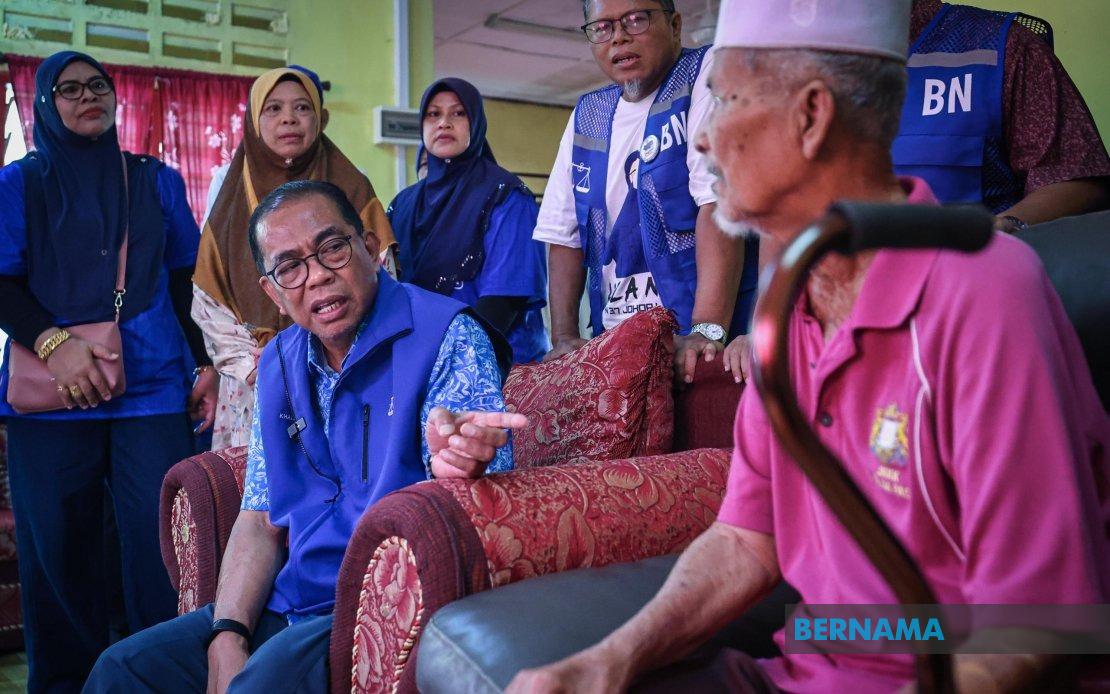
With polling day just two days away in Johor, Defence Minister and UMNO vice-president Datuk Seri Mohamed Khaled Nordin sought to reassure voters that constitutional protections would safeguard intergovernmental cooperation regardless of which political coalition controls the state and federal levels. Speaking at the Ziarah Kasih programme in Felda Pasak on July 9, Mohamed Khaled emphasized that institutional checks and procedural frameworks built into Malaysia's constitutional architecture would prevent partisan interests from destabilising the relationship between Kuala Lumpur and Kota Iskandar.
The Defence Minister's comments come as the 16th Johor state election enters its final countdown, with 2,727,926 registered voters preparing to cast ballots for 56 state seats across 172 candidates. Barisan Nasional, seeking to consolidate its 2022 victory when it secured 40 of 56 seats, is fielding candidates in every single constituency. Mohamed Khaled's message appears calculated to address latent voter concerns about what might happen if the electorate chose to split its mandate—a scenario increasingly plausible in competitive Malaysian electoral contests.
Central to Mohamed Khaled's assertion is the principle of constitutional separation and enumeration of powers. The Federal Constitution delineates distinct spheres of authority between the federal government and state governments, he explained, with each tier bound by law to respect the other's legitimate prerogatives. This constitutional scaffolding, he argued, functions as an automatic stabiliser, preventing whichever faction controls Parliament from instrumentalizing federal machinery to punish or undermine a state government controlled by political rivals. The framework operates independently of electoral outcomes or coalition preferences.
Mohamed Khaled invoked recent statements by UMNO president Zahid Hamidi to buttress his argument, noting that party leadership has publicly acknowledged the Constitution's dual-government design. According to this interpretation, both tiers possess positive obligations toward development and public welfare that transcend partisan considerations. A federal government must grant state administrations the necessary cooperation and resources to function, while state governments must reciprocate by accepting federal authority in its constitutionally prescribed domains. Neither can legitimately obstruct the other merely because they fly different political colours.
The timing of these assurances reveals underlying anxieties within the Barisan Nasional camp. While the coalition retains structural advantages—incumbency, administrative machinery, financial resources—the political landscape has become fragmented since 2022. Voter sentiment may have shifted, and sophisticated electorate segments increasingly regard split-level governance as preferable to single-party dominance. By proactively addressing fears of federal-state conflict, Mohamed Khaled attempts to neutralize a potential tactical argument opponents might deploy: that voting for opposition parties at state level invites federal retaliation.
This constitutional reassurance strategy reflects broader patterns in Malaysian politics. As federal hegemony weakens—evident in Selangor, Penang, and Kelantan's sustained opposition rule—governing coalitions must construct legitimacy narratives that transcend electoral victory. Constitutional fidelity offers such a narrative. By anchoring his message in legal provisions rather than party interests, Mohamed Khaled positions Barisan Nasional as the guardian of institutional stability rather than a faction seeking permanent power consolidation. This framing appeals to institutional-minded voters who value predictability and rule-of-law consistency.
However, the constitutional argument contains implicit vulnerabilities. While the Federal Constitution does enumerate separate powers, numerous policy domains involve overlapping jurisdictions or federal preeminence. Land, Islamic affairs, and local government formally rest with states, yet federal intervention occurs frequently through constitutional mechanisms like emergency powers or financial leverage. The federal government controls taxation, subsidies, and development funds that profoundly shape state-level prosperity. Historical precedent shows that constitutionally prescribed cooperation can be strained when genuine political hostility exists—witness Penang's and Selangor's recurrent tensions with successive federal governments over resource allocation and development approvals.
Regarding Barisan Nasional's electoral prospects, Mohamed Khaled expressed confidence tempered with Islamic invocation. The coalition's track record in Johor remains formidable; winning 40 of 56 seats in 2022 provided substantial legislative cushion. However, three years of national political turbulence, economic pressures on ordinary Malaysians, and evolving demographic preferences have reshaped electoral mathematics. By the coalition's own assessment, retaining all 56 seats requires mobilizing not merely existing supporters but converting marginal voters—a challenging proposition in polarized times.
For Malaysian and Southeast Asian observers, this election illustrates the region's ongoing democratic maturation. Where electoral systems remain competitive, incumbent coalitions must defend their records rather than rely on coercive machinery. Mohamed Khaled's constitutional appeal reflects this pressure: if Barisan Nasional believes it can govern competently and fairly regardless of which voters choose to support it, then the electorate should feel confident empowering it through democratic choice. Conversely, the very necessity of such reassurances hints at residual anxieties about whether constitutional commitments would truly constrain a dominant federal government inclined toward partisan behaviour.
The Johor election ultimately tests whether Malaysian voters have genuinely internalized constitutional principles of federalism and mutual respect, or whether they remain primarily motivated by tribal allegiances and zero-sum perceptions of political competition. Mohamed Khaled's message assumes the former; the actual voting patterns will reveal whether that assumption reflects voter sentiments or remains merely aspirational rhetoric.

