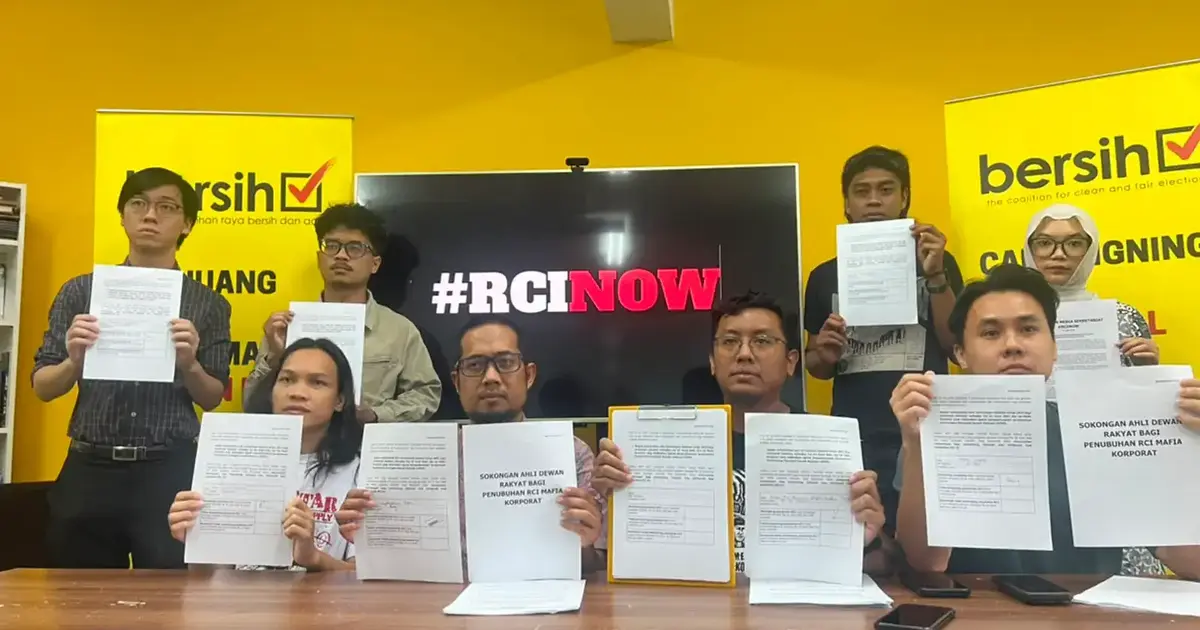
The electoral watchdog Bersih has declared that it has secured backing from 34 members of parliament for the establishment of a royal commission inquiry to investigate what it describes as corporate mafia activities. The cross-party coalition of support spans multiple political organisations, demonstrating the issue's resonance across Malaysia's fractured parliamentary landscape and suggesting growing concern about the alleged nexus between business interests and political power.
The 34 MPs come from diverse party affiliations, including PKR, PAS, DAP and Umno, indicating that the proposal to scrutinise corporate misconduct transcends the usual fault lines of Malaysia's polarised politics. This breadth of support reflects the degree to which concerns about corporate accountability and the entrenchment of business elites have permeated different sections of parliament. The fact that legislators from both government and opposition benches have pledged their backing suggests that public and parliamentary pressure on governance issues continues to mount despite Malaysia's political instability.
Bersih's move represents a deliberate escalation of the electoral reform coalition's engagement with parliamentary leadership. Rather than limiting itself to grassroots activism and public demonstrations, the organisation has invested time in building legislative alliances. This strategic pivot acknowledges the reality that meaningful institutional change in Malaysia requires sustained engagement with elected representatives, notwithstanding widespread public scepticism about parliament's willingness to challenge entrenched power structures.
The concept of a corporate mafia—loosely referring to interconnected networks of large businesses, their executives, and political patrons operating beyond transparent regulatory frameworks—has become increasingly discussed in Malaysian political discourse. Citizens and observers alike have voiced concerns about monopolistic business practices, opaque corporate governance, and the apparent immunity certain conglomerates enjoy from normal legal constraints. These anxieties have been amplified by cases involving major corporate failures and financial irregularities that implicated well-connected individuals.
A royal commission inquiry would represent a formal governmental mechanism for investigating systemic corporate misbehaviour. Such commissions typically possess broader investigative powers than regular parliamentary committees, can compel testimony and document production, and generate findings that carry significant political weight. For Bersih and its parliamentary supporters, securing a royal commission would constitute a symbolic victory demonstrating that institutional mechanisms can be mobilised to address elite-level wrongdoing.
The timing of Bersih's announcement coincides with broader public frustration concerning corporate transparency and accountability. Recent years have witnessed increased awareness among Malaysian voters about conflicts of interest, nepotism in business appointments, and the concentration of wealth among politically-connected families. This groundswell of concern has created political space for initiatives that frame themselves as anti-corruption and pro-accountability, even as implementation remains uncertain.
However, the path from parliamentary backing to actual royal commission establishment remains politically complicated. Initiating such an inquiry requires government approval, and the sitting administration's willingness to investigate corporate networks may depend on whether those networks include politically sensitive figures. The composition of the commission, the scope of its investigations, and the transparency of its proceedings would all become subjects of intense political bargaining. Historical precedent in Malaysia suggests that inquiries into high-level misconduct often face bureaucratic obstacles and incomplete implementation.
The involvement of MPs from Umno—traditionally associated with preserving elite business interests—is particularly noteworthy. It suggests either genuine conviction among certain Umno parliamentarians regarding corporate accountability or alternatively strategic positioning ahead of potential future electoral competition. Either interpretation reveals something significant about the current political climate: even parties traditionally protective of established business interests cannot entirely ignore public demands for greater oversight of corporate power.
For regional observers, Bersih's campaign reflects broader patterns across Southeast Asia. Multiple countries in the region grapple with similar challenges concerning corporate governance, elite networks, and the relationship between big business and political power. Malaysia's experience with building cross-party support for investigating these matters offers both inspiration and caution for reformers elsewhere in the region working to strengthen institutional accountability.
The coming months will test whether the announced parliamentary support translates into concrete governmental action. Bersih will need to maintain pressure on MPs to convert their stated backing into sustained legislative initiative. The organisation's track record of mobilising grassroots sentiment combined with parliamentary allies could prove effective, though powerful interests committed to maintaining the status quo will undoubtedly mount counterarguments about regulatory overreach and economic disruption.
Ultimately, the success of this initiative hinges on whether Malaysian society and its institutions can align to prioritise corporate accountability over the protection of established elites. The declaration of 34 MPs' support represents progress toward that goal, but considerable distance remains between parliamentary sentiment and governmental action.

