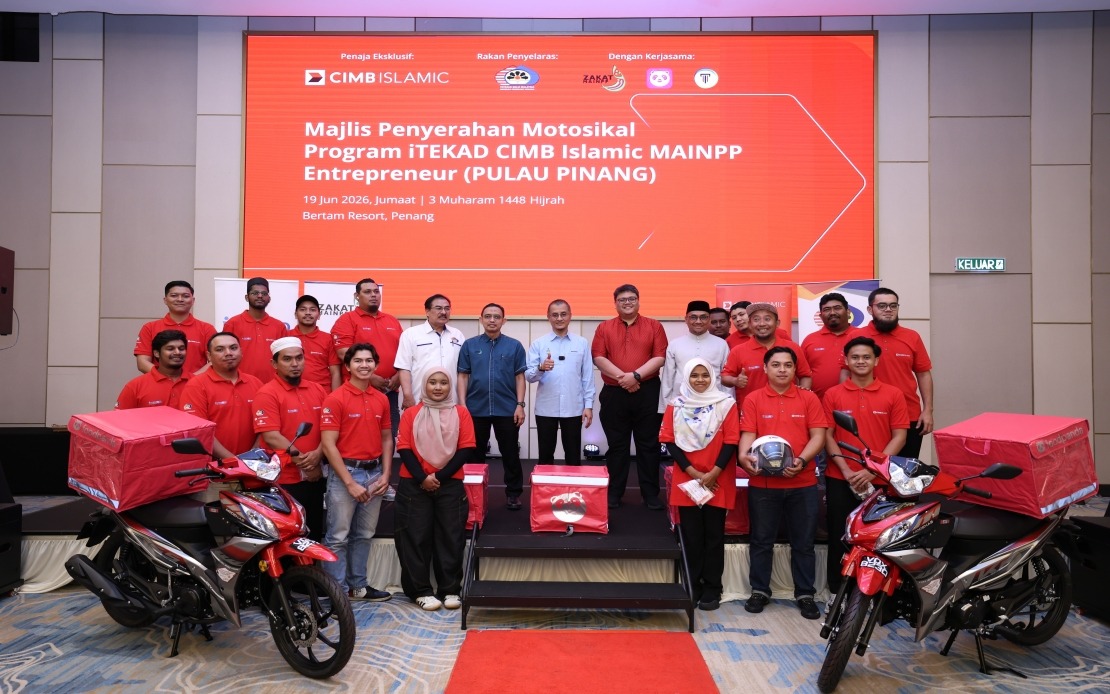
Twenty entrepreneurs from Penang's asnaf community have received motorcycles as part of an integrated business support programme designed to lift participants out of poverty through structured employment opportunities. The initiative, unveiled at a ceremony in Kepala Batas, represents a coordinated push by CIMB Islamic Bank Berhad and the Penang Islamic Religious Council (MAINPP) to translate charitable resources into tangible economic empowerment for vulnerable groups.
The iTEKAD CIMB Islamic-MAINPP Entrepreneur programme extends beyond simple asset distribution, incorporating mentorship, financial literacy training, and ongoing support mechanisms intended to establish sustainable income streams. Participants receive not only a motorcycle but also complementary delivery equipment and structured training in fundamental business management, workplace discipline, and entrepreneurial fundamentals. This multi-faceted approach acknowledges that breaking cycles of poverty requires more than capital injection alone, demanding instead comprehensive skill-building and psychological preparation for self-employment.
Penang Deputy Chief Minister I Datuk Dr Mohamad Abdul Hamid, who chairs the Islamic council, emphasized that the programme's success depends on coordinated effort across multiple stakeholders. Beyond CIMB Islamic and MAINPP, implementation partners including the Malaysian Youth Foundation (YBM), Taylor's Community, and foodpanda Malaysia contribute specialized expertise in training delivery, mentorship, and market linkages. This collaborative structure reflects growing recognition within Malaysia's Islamic finance sector that asnaf development demands integration across banking, religious institutions, youth foundations, and private enterprise rather than siloed charitable initiatives.
The programme operates through a RM400,000 seed fund structured as a matching grant, with CIMB Islamic Bank's Wakalah Zakat fund contributing RM200,000 and Bank Negara Malaysia matching that amount with another RM200,000. This funding mechanism demonstrates central bank commitment to supporting Islamic finance institutions' efforts to translate zakat collections into livelihood creation. The grant structure bypasses conventional lending obstacles that typically prevent low-income entrepreneurs from accessing capital, instead positioning funds as development seed money with expectations of sustainability rather than repayment.
Selection of the twenty recipients involved rigorous screening procedures, reflecting organizational intent to maximize successful outcomes through careful participant vetting. Zakat MAINPP initially received 151 applications, indicating substantial interest in the programme but also confirming that quality control through selective admission remains necessary. The screening process included formal interviews and a residential Entrepreneurship Camp (BootCamp) conducted from May 31 to June 3, 2026, during which candidates demonstrated commitment and absorptive capacity for business training.
The motorcycle and equipment allocation ties participants directly to foodpanda Malaysia's delivery ecosystem, creating immediate market access rather than leaving entrepreneurs to navigate customer acquisition independently. This integration with an established e-commerce logistics platform addresses a critical constraint facing informal entrepreneurs—reliable demand channels. By embedding participants within an existing commercial network, the programme reduces the failure risk associated with business formation during early operational phases when cash flow volatility typically proves most precarious.
For Penang specifically, the initiative aligns with the Penang Islamic Religious Development Agenda 2030 (APAI2030), which frames Islamic council engagement beyond religious administration toward comprehensive community welfare encompassing education, economic opportunity, family stability, and youth engagement. This positioning reflects broader Southeast Asian trends toward faith-based institutions assuming development functions traditionally reserved for secular government agencies, particularly in poverty alleviation and social protection programming.
The programme's emphasis on structured income generation rather than consumption-oriented assistance challenges conventional charity approaches in the region. Participants move from potential welfare dependency into productive employment where their asset ownership and business training create measurable economic value rather than merely consuming aid transfers. This reorientation toward productive asset distribution addresses Malaysian policymakers' concerns about welfare sustainability as demographic aging places growing pressure on transfer systems.
Motorcycle-based delivery services remain economically viable across Southeast Asia despite increasing motorization, with last-mile delivery continuing to absorb significant labor even as urban logistics become increasingly sophisticated. The targeting of delivery as the entrepreneurial vehicle acknowledges realistic market demand and technological accessibility—motorcycle operation requires minimal training, maintenance costs remain manageable, and demand for flexible delivery services continues expanding across Malaysia's urban and semi-urban areas.
The programme's success metrics will likely extend beyond immediate employment figures to measure income stability, business persistence beyond initial operating periods, and participant progression toward expanded operations or employment of additional workers. Measuring whether the RM400,000 investment generates sustainable income streams exceeding conventional transfer programming will inform whether similar models warrant expansion across other Malaysian states with comparable Islamic council structures and financial institution partnerships.
For practitioners across Southeast Asia observing Malaysian institutional innovation, the iTEKAD initiative demonstrates how Islamic finance zakat collections can fund livelihood creation when structured through collaboration between financial institutions, religious authorities, youth development organizations, and commercial platforms. This polyinstitutional approach offers a replicable template for translating charitable obligations into economic empowerment within societies where Islamic finance continues expanding as a mainstream banking sector component.

