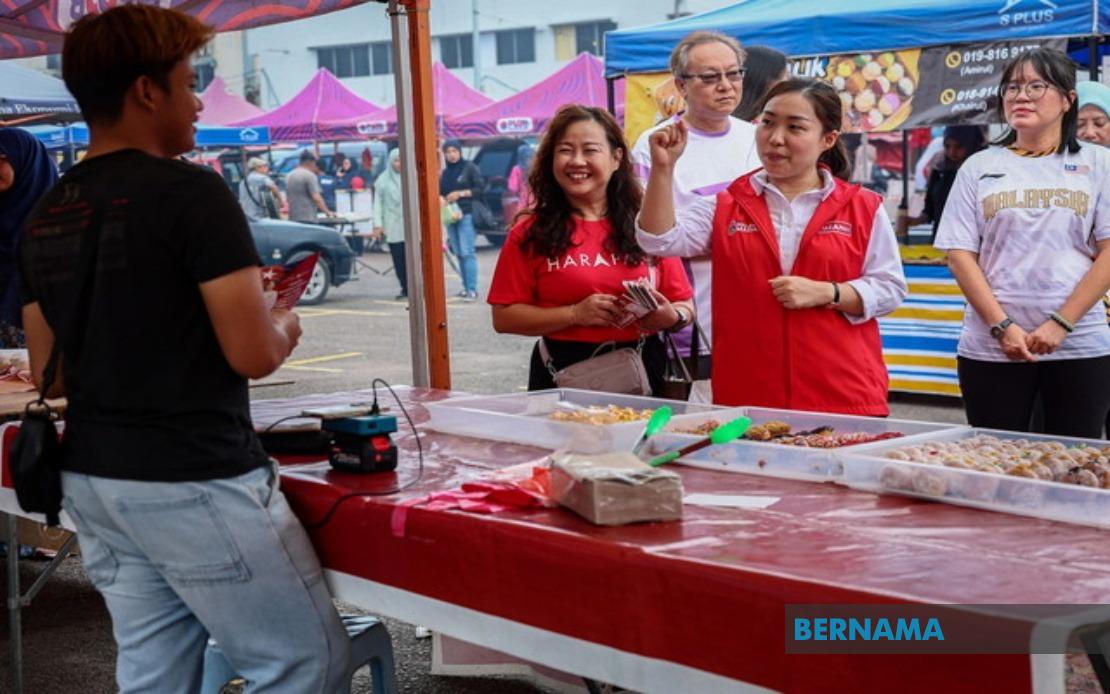
Chu Poh Yee, a young lawyer contesting the Mengkibol state seat for Pakatan Harapan, has positioned her bid for the upcoming Johor election around three interconnected pillars designed to address the constituency's development needs. Speaking in Kluang, she outlined an agenda spanning infrastructure modernisation, economic rejuvenation, and targeted social support—proposals aimed at securing voter backing in the July 11 polling day contest.
The infrastructure component of Chu's platform prioritises the restoration and expansion of local road networks, recognising that inadequate connectivity remains a persistent concern in many semi-urban constituencies across Johor. Beyond conventional transportation, she has emphasised the potential of urban agriculture initiatives, framing community farming projects as a dual mechanism for enhancing food security whilst fostering local economic activity. Such initiatives resonate particularly with residents seeking greener, more sustainable approaches to town planning in an era of rapid urbanisation.
On the economic development front, Chu has identified Kluang's business landscape as fundamentally sound but constrained by missed opportunities in entrepreneurial pathways and quality job creation. Her diagnosis centres on youth outmigration—a phenomenon afflicting numerous smaller towns across Malaysia where graduates depart for metropolitan centres offering superior career prospects. By advocating for expanded entrepreneurship platforms and improved employment quality, she implicitly acknowledges that infrastructure alone cannot arrest economic decline; local communities require tangible avenues for wealth generation and professional advancement.
Chu has leveraged Kluang's existing cultural assets to illustrate her vision. The Kluang Rail Festival, she noted, exemplifies how well-executed community events can catalyse broader economic spillovers, attracting visitors and encouraging local spending. This approach reflects a emerging recognition among Malaysian politicians that township economies increasingly depend upon experiential and cultural offerings alongside traditional commerce. Her emphasis on creative tourism suggests an understanding that smaller towns must differentiate themselves in an increasingly competitive urban hierarchy.
A notable dimension of her campaign addresses women's workforce participation and family-friendly employment structures. Chu has proposed the establishment of properly-resourced childcare centres as a foundational intervention, framing this not merely as welfare provision but as essential infrastructure enabling parental—particularly maternal—economic engagement. This positioning acknowledges Malaysia's persistent gender gaps in workforce participation and reflects growing awareness that family support mechanisms directly correlate with female labour force retention. Such messaging may particularly resonate with professional and semi-professional women in Kluang's middle class.
The campaign environment has not been entirely placid. Chu reported incidents of material vandalism targeting her party's campaign infrastructure at multiple sites, framing these disturbances as provocation rather than substantial obstacles. Her response—emphasising team resilience and unwavering commitment—reflects standard electoral rhetoric yet also signals that campaign intensity remains elevated in competitive constituencies. The Mengkibol seat represents a straight contest between her and Barisan Nasional's Yap Zhi Peng, eliminating the three-way fragmentation characterising some Johor seats and concentrating voter choice sharply between competing visions.
The broader electoral context situates Mengkibol as one of 14 constituencies experiencing unopposed two-candidate races, a proportion suggesting fierce competition in swing territories. Across all 56 Johor state seats, 172 candidates are contesting, indicating robust candidate deployment by major coalitions and smaller parties. This density underscores Johor's significance within Malaysia's political economy; as the nation's second-largest state by population and a pivotal swing ground, its electoral outcomes reverberate across federal calculations.
Chapter-driven electoral dynamics in Johor have shifted substantially since previous contests. Chu's campaign architecture—emphasising incremental local improvements, economic inclusivity, and women's advancement—represents the softer governance narrative that Pakatan Harapan has increasingly adopted in state-level contests. Rather than confrontational opposition politics, her messaging foregrounds solutions to constituency-specific challenges: road degradation, youth joblessness, childcare insufficiency. This pragmatic tone reflects the coalition's evolution as it seeks to position itself as a credible alternative management force.
The timing of Chu's campaign, with early voting scheduled for July 7 and main polling on July 11, compresses the persuasion window. For candidates emphasising granular local improvements rather than sweeping ideological appeals, this compressed timeframe poses particular challenges. Ground-level engagement and personal candidate visibility become magnified in importance when voters have limited exposure windows. Chu's presence in Kluang conducting interviews suggests active community immersion, though whether this translates into proportional electoral conversion remains contingent upon local organisational capacity and broader coalitional momentum.
For Malaysian observers tracking state-level political evolution, the Mengkibol contest exemplifies how electoral competition is increasingly granularised around local development deficits rather than national-scale partisan identities. Chu's three-pronged agenda—infrastructure, economic opportunity, social support—could serve as a template applied across dozens of underperforming constituencies nationwide. Whether this localist approach, when scaled across Malaysia's fragmented municipal landscape, generates sufficient cumulative momentum to shift state legislative balances remains the central question animating the July election cycle.

