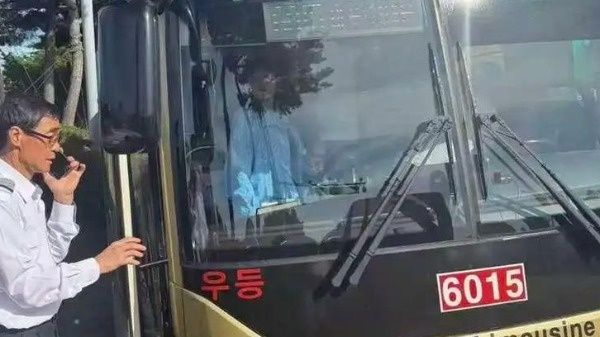
A dramatic rescue on a Seoul highway has won widespread acclaim across East Asia, highlighting how ordinary citizens can respond with extraordinary composure during life-threatening emergencies. On Saturday afternoon, passengers aboard an airport shuttle bound for Incheon International Airport found themselves thrust into a crisis when the driver abruptly lost consciousness, sending the vehicle careening dangerously across lanes. What unfolded over the next critical moments would demonstrate the power of collective action and the instinctive human drive to help others in extremis.
The No 6015 airport bus, carrying more than a dozen people predominantly comprised of Chinese visitors, was navigating the route from central Seoul when the driver collapsed at the wheel. With the vehicle scraping against roadside guardrails and veering unpredictably, the situation threatened to spiral into catastrophe. Among the passengers was Sun Qian, a 35-year-old healthcare professional from Nanjing in Jiangsu province who was in Seoul as part of a learning exchange programme. Positioned in the second row directly behind the driver's cabin, Sun had mere seconds to assess the danger and act. Rather than freeze in panic, she lunged forward to seize the steering wheel, using her physical strength to arrest the bus's dangerous trajectory and keep it from colliding with other vehicles.
Simultaneously, another passenger recognised the gravity of the situation and made the critical decision to locate the bus's emergency braking system. This coordinated response, executed without prior discussion or planning, demonstrated the kind of split-second decision-making that separates disaster from manageable crisis. In recounting her actions to China Daily, Sun described her overwhelming nervousness at wrestling with the oversized steering wheel of the coach, yet she persevered in her efforts to stabilise the vehicle's course. Her neighbour, Du He, aged 33 and also from Nanjing, responded with equal urgency to the unfolding emergency, attempting first-aid measures by applying pressure to the driver's philtrum—a traditional Chinese emergency intervention technique.
Within moments of initial stabilisation, the passengers' focus shifted from preventing collision to attempting to save the driver's life. Du quickly recognised that the driver had ceased breathing and that his complexion had taken on a dangerous purple hue, suggesting severe oxygen deprivation. The passengers organised themselves to perform cardiopulmonary resuscitation in shifts, understanding that sustained chest compressions represented their best chance of reviving their driver before emergency medical personnel could arrive at the scene. Sun, who possessed fluency in Korean, took charge of emergency communications, using the driver's mobile phone to contact Seoul's emergency services in their native language, ensuring clear and immediate communication with responders.
Despite the passengers' valiant and sustained efforts, the intervention proved insufficient to restore the driver's cardiac function. According to South Korea's Yonhap News Agency, the driver was confirmed to be in cardiac arrest when emergency services reached the scene. He was transported immediately to hospital where medical teams continued resuscitation attempts for approximately two hours before declaring him deceased. Medical investigators subsequently opened an inquiry into the precise cause of the collapse, though initial indications pointed toward a catastrophic cardiac event. The tragic outcome weighed heavily on those who had fought so desperately to save him, yet the passengers' intervention had unquestionably prevented a far more disastrous outcome.
The potential magnitude of the tragedy that had been narrowly averted became clearer as Du reflected on the circumstances. The highway section where the emergency unfolded experienced relatively light traffic at that particular time, a fortuitous coincidence that meant the runaway bus did not collide with other vehicles or trigger a chain-reaction accident that could have killed or injured many more people. The passengers, many of whom were ultimately heading to Incheon International Airport for flights, managed to regain their composure sufficiently to flag down another bus and continue to their destination, though the emotional weight of the ordeal did not fully manifest until some time had elapsed.
Both Sun and Du acknowledged that the psychological impact of their experience had been delayed, a common response to traumatic incidents. Du described the moment she arrived at the airport terminal and the reality of what had transpired began to crystallise in her mind, producing waves of fear and trembling. Yet she balanced this acknowledgement with gratitude that their swift action had at least prevented additional casualties and injuries. Sun similarly reflected that the entire episode felt almost surreal, comparable to a dramatic scene from a television programme, with precious little opportunity for conscious deliberation about correct procedures or optimal responses. These candid admissions of fear and uncertainty humanised the women and emphasised that heroism often stems not from fearlessness but from action taken despite genuine terror.
The incident sparked extensive discussion on both Chinese and South Korean social media platforms, with commentators from both nations expressing admiration for the tourists' conduct. South Korean observers particularly remarked upon the women's capacity to remain composed and execute decisive actions whilst operating within a foreign linguistic and cultural context, recognising the additional psychological burden that language barriers impose during emergencies. Chinese social media users who encountered Sun and Du's account on platforms such as Xiaohongshu similarly celebrated their actions as exemplary displays of courage and community spirit.
When confronted with the flood of praise circulating online, Du demonstrated a humility that reflected broader cultural values of collectivism and communal responsibility. She insisted that her actions represented nothing more extraordinary than what any competent person would have done under equivalent circumstances, and that if she had not been present, other passengers would inevitably have stepped forward to assume similar responsibilities. This perspective, whilst modest, also conveyed a profound understanding of human nature and social obligation. Sun reinforced this emphasis on collective endeavour, stressing that the rescue had never been the work of individuals acting alone but rather the product of multiple passengers contributing their respective capabilities towards a shared objective.
The rescue narrative carries particular resonance for Southeast Asian readers and observers, given the region's significant Chinese diaspora and the importance of tourism flows throughout the area. The incident underscores both the vulnerabilities inherent in rapid transit systems and the human capacity for prosocial behaviour during crises. It also illustrates how international incidents involving citizens from different nations can generate cross-border solidarity and mutual respect. The tragedy of the driver's death tempered the celebratory tone of the rescue story, serving as a sobering reminder of mortality and the limits of even the most courageous human intervention. Yet the passengers' willingness to attempt rescue despite knowing the odds remained poor spoke to fundamental aspects of human dignity and the instinctive rejection of passivity when others face mortal danger.

