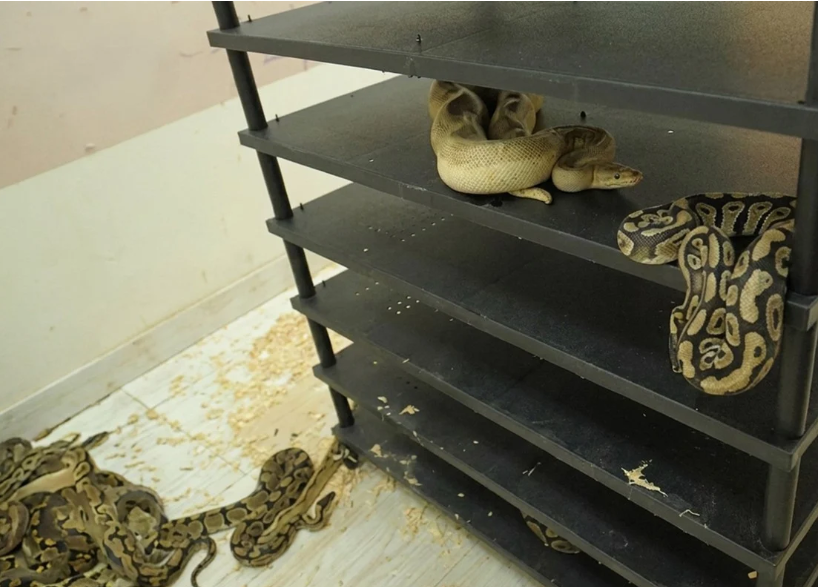
A resident of eastern China has been sentenced to prison following the discovery of an underground operation breeding over 300 pythons in his apartment, authorities revealed through state media CCTV in late June. The case represents a significant enforcement action against illegal wildlife trafficking and demonstrates how unconventional investigative methods can uncover serious crimes against protected species.
The investigation began innocuously in March 2024 when an elderly resident of Taizhou in Zhejiang province stumbled upon a large python near a local mountain and reported it to police. The discovery of a python, as thick as an adult's arm, in a region where such snakes are not naturally found, immediately aroused suspicion among investigators. Officers theorised that the reptile had escaped from captive breeders, noting that wild snakes remain largely dormant during the cold months of March and would not typically be found active in natural habitats during that season.
The breakthrough in the investigation came from an unexpected angle. A professional snake breeder consulted by police explained that pythons are highly dependent on artificial climate control, requiring consistent warmth and humidity maintained between 20 and 30 degrees Celsius. This observation prompted investigators to adopt an ingenious strategy: they examined electricity consumption records of nearby residents, reasoning that an illegal python breeding operation would generate conspicuously high power usage. This approach successfully identified a suspect identified as Guo, a middle-aged man living alone in the area who was unemployed and unmarried.
Once police had identified Guo as the primary suspect, additional surveillance and investigation revealed an accomplice named Di who frequently visited the apartment and collected packages from courier services. These parcels contained small white mice purchased online, which sellers typically marketed to customers keeping reptile pets as food supplies. Police also discovered that Guo had been posting photographs of snakes on social media platforms and making oblique references to selling pythons to interested buyers. Transaction records showed that Di had sold at least two pythons to another individual for 1,000 yuan, equivalent to approximately US$150.
When police executed a search warrant at Guo's residence, they encountered a sight that left them visibly shocked. The apartment had been entirely restructured to accommodate the illegal operation: Guo had consolidated all his personal furniture and living essentials into a single bedroom, converting the two remaining bedrooms and the living room into stacked plastic housing units for the snakes. Officers discovered a total of 309 pythons in the apartment, which were subsequently transferred to a local zoo for safekeeping and care.
In interviews following his arrest, Guo revealed that he had harboured a deep passion for snakes since purchasing his first four pythons in 2014, a decade before his arrest. He described himself as fearless when handling the reptiles and expressed pride in his breeding achievements, claiming he had developed expertise in cultivating pythons of various colour morphs. In one particularly telling statement, Guo declared: "I am capable of cultivating snakes of various colours. I feel like a creature creator." This perspective underscores how personal fascination with an animal species, combined with minimal legal oversight, can escalate into large-scale illegal operations.
The investigation expanded beyond Guo and Di when police identified a third perpetrator: Deng, a shop owner who had sold the initial four pythons to Guo in 2014. Officers discovered 47 additional pythons in Deng's residence, bringing the total number of reptiles seized across all locations to 436 specimens. The operation's scale became apparent when authorities calculated that the seized pythons carried a combined estimated value exceeding 30 million yuan, approximately US$4.4 million. Police records indicated that Guo and Di had successfully sold approximately 80 pythons prior to their arrest, suggesting a substantial black-market distribution network.
Under Chinese law, pythons are classified as Grade Two protected animals, placing them in a category reserved for rare and endangered wildlife species. Regulations explicitly prohibit the unlicensed buying, selling, breeding, and transportation of such species without obtaining proper governmental authorisation. The seriousness with which China's regulatory framework treats such violations is reflected in the Criminal Law provisions applicable to the case: individuals convicted of violating protections for Grade Two protected animals face maximum prison sentences of five years, though specific sentence lengths for Guo, Di, and Deng were not disclosed in official reports.
The case carries particular relevance for Malaysia and Southeast Asia, where wildlife trafficking remains a persistent regional challenge. Python species are popular in illegal exotic pet markets throughout Asia, and enforcement mechanisms targeting breeding operations within private residences remain relatively underdeveloped in many jurisdictions. The innovative investigative technique employed by Taizhou police—using utility consumption data as an investigative lead—offers a potential model for authorities across the region seeking to dismantle hidden wildlife operations. The case also illustrates how individual arrests and seizures, while important, address only the visible portion of underground wildlife trade networks that extend across multiple countries and jurisdictions.
Beyond the enforcement dimensions, this case reflects broader challenges in wildlife conservation within densely populated urban environments where regulatory oversight is difficult to maintain. Guo's apartment operation occurred within a residential building inhabited by other families, raising questions about how such intensive animal breeding could continue undetected for a decade. The incident underscores the necessity for public awareness campaigns encouraging residents to report suspicious activities, combined with improved inter-agency coordination between utility companies, environmental enforcement bodies, and police forces. As Southeast Asian nations grapple with escalating wildlife trafficking pressures, the Taizhou case provides instructive lessons in both investigative methodology and the consequences of large-scale illegal species exploitation.

