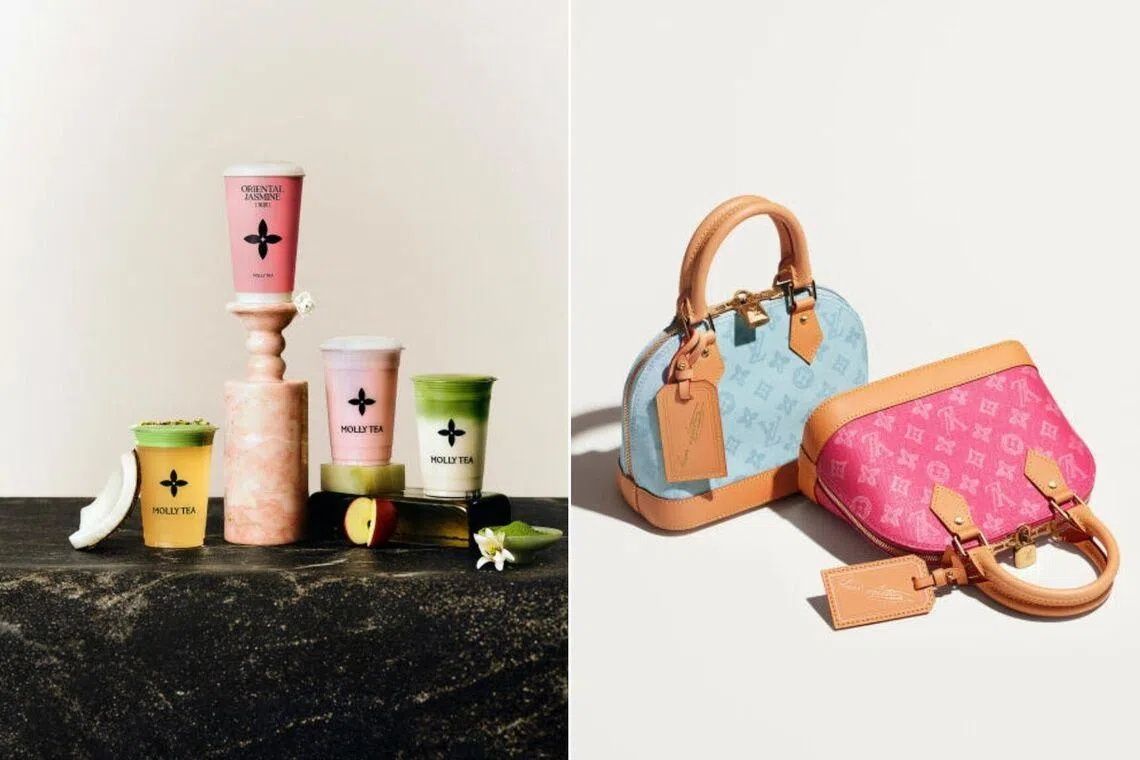
The Suzhou Intermediate People's Court in Jiangsu province has ruled that Molly Tea, a Shenzhen-based milk tea company, must compensate the French luxury giant Louis Vuitton 10.3 million yuan (US$1.5 million) for trademark infringement. The judgment, delivered on June 29 after a lawsuit filed in May 2025, has ignited considerable discussion across Chinese society regarding the boundaries of intellectual property protection, the commercialisation of traditional design elements, and the practical challenges facing domestic brands navigating an increasingly complex trademark landscape.
At the heart of the dispute lies a deceptively simple visual element: a four-petal flower motif. The court determined that Molly Tea's brand emblem bears sufficient similarity to seven of Louis Vuitton's registered four-petal flower graphic trademarks to constitute infringement. Beyond the financial penalty, the ruling requires Molly Tea to cease using the disputed design immediately and to publish a public apology, marking a comprehensive victory for the French brand in a case that has become emblematic of broader tensions within China's intellectual property system.
The case has generated exceptional public engagement on Chinese social media platforms, a phenomenon that underscores how trademark disputes increasingly become cultural flashpoints rather than mere legal technicalities. A hashtag referencing Louis Vuitton's lawsuit against Molly Tea accumulated over 360 million views, while a related topic about the invalidation of the tea chain's trademark design reached 18.7 million discussions. This level of engagement reflects genuine uncertainty among ordinary Chinese consumers and entrepreneurs about where legitimate cultural appropriation ends and unlawful trademark infringement begins.
Public sentiment on the matter remains fractured. Some observers contend that Molly Tea's design unmistakably replicates the aesthetic principles underpinning Louis Vuitton's iconic monogram patterns, making the infringement unambiguous. Conversely, other voices insist that meaningful visual distinctions exist between the two designs and that the brands operate within entirely separate market segments—a luxury fashion house versus an affordable beverage chain—making consumer confusion unlikely. A third faction has questioned whether Louis Vuitton itself possesses legitimate ownership of a four-petal flower motif, suggesting that the design may derive inspiration from traditional Chinese cultural patterns that predate the luxury brand's trademark registration by centuries.
Understanding this controversy requires examining Molly Tea's broader trademark strategy leading up to the dispute. Beginning in March 2024, the company and its affiliated entities submitted numerous trademark applications to the China National Intellectual Property Administration, most featuring floral designs intended to cover restaurants, accommodation services, advertising, and convenience food categories. These applications encountered systematic rejection by the patent office, with only the trademark containing the Chinese characters for "Molly Tea" itself achieving successful registration. This pattern of rejections suggests that intellectual property examiners had already identified conflicts between Molly Tea's proposed designs and pre-existing registered marks, a warning that apparently did not deter the company from operating under the disputed logo.
Kang Lixia, a partner at Beijing Standzer IP Firm, has provided crucial insight into how China's trademark system operates in such circumstances. She explained that trademark law in China adheres to a "first to file" principle, meaning that whichever applicant registers a design first gains exclusive rights, regardless of subsequent claims to originality. Critically, Louis Vuitton's status as an exceptionally well-known and extensively registered brand affords it cross-class protection—a legal mechanism that extends its trademark rights beyond the fashion and luxury goods categories into entirely different commercial sectors. This doctrine has proven particularly challenging for later applicants seeking to use traditional or commonly found design elements in their own branding efforts.
Yet the case also highlights genuine complexities regarding the relationship between intellectual property law and cultural heritage. Liu Bin, an intellectual property lawyer from Beijing Zhongwen Law Firm, has advocated for what he terms a "rational perspective" on such disputes. He points out that the law governing figurative marks does not require an exact visual match to constitute infringement; instead, courts focus on whether consumers are reasonably likely to experience confusion between the two marks when encountering them in their respective contexts. This consumer-confusion test, while ostensibly objective, inevitably involves subjective judgments about how an ordinary person would perceive design similarity.
A particularly contentious aspect of this case concerns the treatment of traditional Chinese cultural motifs as intellectual property. Floral patterns, geometric designs, and other ornamental elements drawn from Chinese artistic traditions represent shared cultural heritage that should arguably remain accessible to all practitioners rather than becoming the exclusive province of whoever successfully registers them first. Liu emphasises that many observers question whether any single commercial entity should possess monopolistic rights over design elements embedded in thousands of years of documented Chinese artistic practice. This philosophical disagreement between those who prioritize commercial brand protection and those who advocate for preserving cultural commons remains largely unresolved within contemporary Chinese jurisprudence.
The distinction between protecting traditional cultural expression and safeguarding legitimate commercial investment represents the core challenge facing Chinese intellectual property law. A four-petal flower exists as a recurring motif throughout classical Chinese art, textile design, ceramic decoration, and architectural ornamentation. Yet when Louis Vuitton or any other company invests substantially in building consumer recognition around a particular visual representation of that motif, does the company deserve legal protection for its commercial application, even if the underlying cultural element remains publicly available? Legal scholars continue debating whether trademark protection appropriately attaches to the original design or rather to the reputation and brand recognition developed through sustained commercial use.
Molly Tea has already signalled its intention to pursue an appeal to a higher court, suggesting that the company believes the judgment warrants reconsideration. The likely success of such an appeal, according to legal experts, depends substantially on whether Molly Tea can furnish persuasive evidence demonstrating that its design possesses genuine originality and distinctive character sufficiently distinct from Louis Vuitton's trademark. Establishing such originality would require demonstrating that the four-petal flower design, as executed by Molly Tea, presents meaningful visual or conceptual differences from the Louis Vuitton monogram patterns, differences sufficiently apparent that ordinary consumers would not reasonably confuse the two marks.
For Malaysian and regional Southeast Asian readers, this case carries implications extending beyond trademark law into questions about how emerging digital economies navigate intellectual property protections. Southeast Asian companies operating across borders increasingly encounter similar situations where their design choices conflict with pre-existing trademark registrations held by international corporations. Understanding how Chinese courts approach such disputes illuminates the likely trajectory of intellectual property enforcement across the region, particularly as countries harmonise their trademark legislation with international standards and bilateral trade agreements emphasising stronger IP protections.
The broader significance of this dispute lies in establishing practical boundaries for trademark protection in an era of globalised commerce and digital information sharing. As consumers increasingly move seamlessly between different product categories and price points through e-commerce platforms, the legal concept of "market confusion" becomes more fluid and context-dependent. A farmer purchasing milk tea from Molly Tea exists in a fundamentally different commercial relationship than a luxury goods consumer contemplating a Louis Vuitton handbag, yet if both parties encounter the disputed four-petal flower design in digital marketing contexts or physical retail spaces, determining whether actual confusion occurs becomes legally ambiguous.
Ultimately, this case reflects China's maturation as an intellectual property regime while simultaneously exposing persistent tensions between commercial protectionism and cultural preservation. As the appeal process unfolds, observers across Southeast Asia will monitor how Chinese courts balance the established principle of trademark protection against legitimate questions about whether monopolistic control over design elements drawn from shared cultural heritage serves broader social interests. The resolution will likely influence how other Asian economies approach similar disputes involving traditional cultural motifs, commercial trademark registration, and the complex relationship between protecting legitimate business investment and preserving cultural commons.

