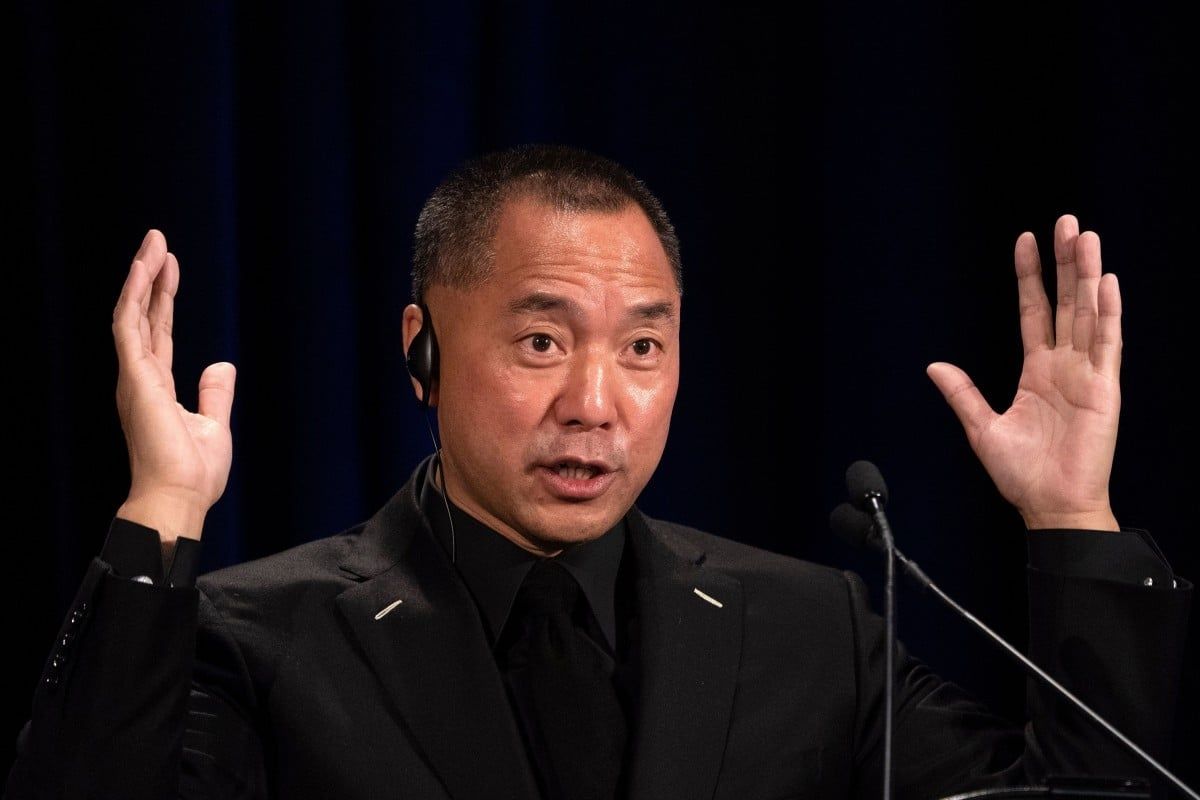
A self-exiled Chinese billionaire once ranked among his country's wealthiest individuals has received a 30-year prison sentence for an expansive financial fraud scheme that federal prosecutors say devastated over 1,000 victims across the globe. Guo Wengui, who fled mainland China a decade ago and reinvented himself as a critic of the Communist Party while based in the United States, was sentenced on Monday, June 30, in Manhattan federal court by Judge Analisa Torres. The judge emphasised that the scheme, which extracted hundreds of millions of dollars from investors, specifically targeted individuals motivated by a desire to bring democratic change to China, exploiting their political aspirations to finance his extravagant lifestyle.
Guo's transformation into a public political dissident marked a striking chapter in his trajectory. After departing China, he cultivated a public persona as an opponent of Beijing's government and built influential connections within conservative American circles. His prominence grew sufficiently that he and political strategist Steve Bannon jointly announced an initiative aimed at overthrowing the Chinese government in 2020. Guo maintained residences befitting his claimed wealth, including a luxury Manhattan apartment overlooking Central Park, and secured membership at President Donald Trump's Mar-a-Lago club in Florida. However, beneath this veneer of political activism and elite American integration lay an elaborate deception orchestrated over five years.
The fraudulent scheme, which operated from 2018 to 2023, centred on soliciting investments in entities controlled by Guo, including his media company GTV Media Group Inc., the so-called Himalaya Farm Alliance, and the Himalaya Exchange. Prosecutors alleged that Guo convinced hundreds of thousands of people to pour more than one billion dollars into these ventures, all while misrepresenting the nature and viability of these investments. The conviction itself reflected the breadth of the deception—Guo was found guilty of nine of twelve criminal charges following a seven-week trial that exposed the systematic nature of his fraudulent operations.
During the sentencing hearing, victims provided haunting testimony about the personal devastation inflicted by Guo's actions. Wei Chen, one victim who testified at trial, described how the fraud "destroyed my life" and that of her family. Judge Torres read excerpts from letters submitted by victims detailing the severe toll—lost life savings, profound anxiety, shame, and fractured family relationships as relatives blamed one another for poor investment decisions. The cumulative effect painted a portrait not merely of financial loss but of shattered lives and fractured communities of trust. Prosecutors characterised the fraud as having left "a wreckage of victims and families who have been devastated financially, emotionally, and psychologically."
The magnitude of Guo's ill-gotten gains fuelled a lifestyle of extraordinary excess that became a focal point of the prosecution's case. Court filings detailed his acquisition of mansions, yachts, racing automobiles, designer clothing, and luxurious furnishings—a gilded existence funded entirely through defrauded investor money. Judge Torres noted that Guo "takes no responsibility for his actions and instead insists incredibly his conduct caused no loss and harmed no one." More troublingly, she highlighted evidence that Guo had instructed supporters to harass and intimidate individuals willing to speak against him, suggesting an attempt to silence victims and potential witnesses.
The judge's sentencing decision resulted in an order for Guo to forfeit 889 million dollars in restitution to victims, though the practical recovery of such sums remains uncertain given the complexity of asset tracing and potential jurisdictional complications. Prosecutors had explicitly requested the 30-year sentence, characterising Guo's conduct as "astonishing" and requesting that he serve at least three decades in federal custody. The sentence represents a substantial punishment, though Guo's defence team had argued that comparable defendants in similar financial crimes received sentences of merely two to four years, suggesting their client faced disproportionate penalties.
Guo's legal representatives constructed a defence centred on allegations of political persecution by the Chinese Communist Party. They claimed their client was a victim of the party's "grand, pervasive, and life threatening" campaign against him and alleged that Beijing had recruited influential figures in American business, entertainment, and political circles to conspire against him. The defence also referenced allegations that Guo had endured physical torture while in China, resulting in scars and disfigurements for which he underwent multiple surgeries between 1993 and 2022. These claims, however, failed to persuade either prosecutors or the court that they constituted justification for the massive fraud perpetrated in the United States.
The defence narrative regarding Guo's motivations for departing China emphasised his exposure of alleged corruption by government officials, which he claimed rendered him a target of state persecution. According to his lawyers, Guo's family had become the largest shareholder of China's largest publicly traded securities company before he became a political liability. After allegedly becoming a focus of government hostility, Guo relocated sequentially to Hong Kong, London, and ultimately New York in 2017. Chinese authorities subsequently accused him of rape, kidnapping, bribery, and other offences—allegations Guo denied as fabrications designed to discredit him.
The international dimensions of this case extend beyond the obvious transnational aspects of the fraud itself. China's Ministry of Foreign Affairs formally acknowledged Guo's sentencing and reiterated that Chinese authorities consider him a wanted criminal, maintaining an Interpol "Red Notice" on him—an international law enforcement request for arrest pending potential extradition. This designation creates significant legal complications for Guo's future, as any international travel or transfer between jurisdictions could theoretically trigger extradition proceedings. The convergence of American criminal convictions with Beijing's international wanted status illustrates how Chinese dissidents operating from Western bases navigate complex legal terrain where multiple sovereignties contest jurisdiction.
The case carries broader implications for Southeast Asian observers and policymakers considering questions of political asylum, financial regulation, and international cooperation on criminal enforcement. Guo's ability to operate a sophisticated, billion-dollar fraud scheme while residing in the United States and maintaining high-profile political connections raises questions about the efficacy of financial oversight mechanisms and the vulnerabilities that allow sophisticated operators to exploit asylum protections. For Malaysia and the region, the case underscores the necessity of strengthening cross-border financial intelligence sharing and regulatory coordination to prevent similar schemes from exploiting loose regulatory environments or asylum frameworks.
As Guo departed the courtroom following sentencing, his supporters applauded and shouted encouragement, reflecting the polarised public perception of his case. Some view him primarily as a dissident whose political activism invited persecution, while others regard him as a sophisticated fraudster who cynically exploited political narratives to legitimise financial crimes. The court's verdict, however, focused narrowly on the empirical reality of the fraud itself—the deliberate deception of investors, the misappropriation of funds, and the tangible devastation inflicted on ordinary people whose savings he plundered. This distinction between Guo's claimed political motivations and his criminal culpability will likely remain contested in political discourse, even as his 30-year sentence takes effect.

