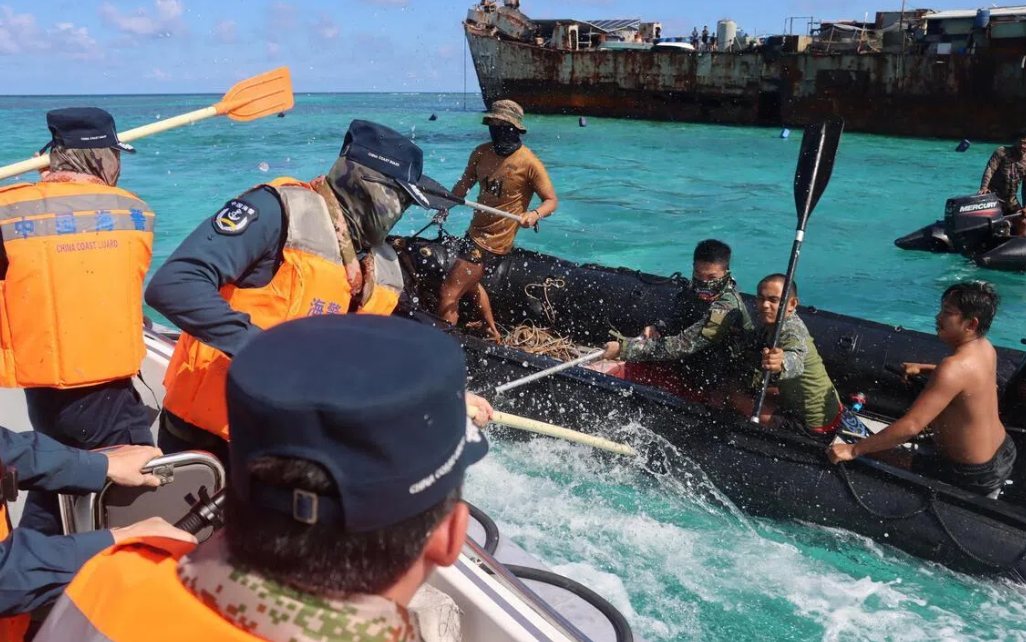
Diplomatic tensions have flared between Beijing and Manila after a physical confrontation in the heavily contested waters of the South China Sea. China's foreign ministry announced on Tuesday that it had urgently called in the Philippine ambassador to deliver formal objections regarding what it described as deliberate provocation by the Philippines at Ren'ai Reef, also known internationally as the Second Thomas Shoal. The move represents Beijing's swift diplomatic response to an incident that has intensified scrutiny on one of Asia's most volatile maritime flashpoints, where competing territorial ambitions collide daily.
According to accounts from the Philippine military, the confrontation occurred on Monday when personnel from the China Coast Guard allegedly wielded batons against a Filipino sailor during an encounter near a grounded vessel that Manila has maintained as a garrison in the disputed zone. The alleged use of force marks an escalation in the pattern of intimidation tactics that have characterised Chinese activity in the region over recent years. Rather than acknowledging the incident, China's foreign ministry responded with counteraccusations, asserting that the Philippine side initiated the provocation and subsequently misrepresented events to international audiences.
The dispute underscores the fundamental disagreement between Beijing and other claimant states over maritime rights in the South China Sea. China maintains expansive sovereignty claims encompassing nearly the entire body of water, a position that contradicts a 2016 international arbitral ruling that found its territorial assertions lack legal standing under international law. Despite this judgment, which was based on the United Nations Convention on the Law of the Sea, China has continued to assert control over strategic features and regulate activities in waters claimed by other nations. The Philippines, Vietnam, Malaysia, Brunei, and Taiwan all maintain overlapping maritime claims in the region, creating a complex landscape of competing interests.
Western powers have swiftly condemned Beijing's conduct in the latest episode. Australia's foreign minister Penny Wong characterised the incident as part of a broader pattern of destabilising and dangerous behaviour by China in contested waters. Her statement carries particular weight given Australia's strategic partnership with the United States and its economic dependence on freedom of navigation through Southeast Asian seaways. The American response proved equally pointed, with the State Department denouncing what it termed aggressive and dangerous actions by China, signalling Washington's determination to maintain its role as a counterbalance to Beijing's expanding assertiveness.
The timing of these developments coincides with high-level diplomatic engagement in the region. US Secretary of State Marco Rubio arrived in Manila on Tuesday to participate in the Association of Southeast Asian Nations summit, bringing with him renewed expressions of American commitment to regional security arrangements. Rubio indicated openness to bilateral discussions with his Chinese counterpart Wang Yi, who is also attending the Asean gathering, though such a meeting has not been formally announced or confirmed by either side. This represents a continuation of recent diplomatic contact between Washington and Beijing, following previous encounters in Kuala Lumpur last year and Munich earlier this year.
Rubio used the occasion to articulate the strategic stakes underlying the maritime disputes. In an opinion piece published in Philippine newspapers on Tuesday, he emphasised America's unwavering dedication to safeguarding freedom of navigation throughout Southeast Asian waters. His commentary carried implicit warnings about the consequences of allowing any single power to exercise hegemonic control over these crucial trade corridors. The secretary of state specifically warned that if these waterways were to become dominated by a state willing to weaponise trade for political purposes, both American interests and the sovereignty and prosperity of Asean nations would face unprecedented jeopardy.
The confrontation at the Second Thomas Shoal reflects ongoing competition over control of strategically significant features in the disputed waters. The grounded vessel maintained by the Philippines at this location serves as a visible assertion of Manila's territorial claims and its determination to maintain a physical presence in disputed areas. China's apparent efforts to prevent Philippine resupply missions and assert control over access to the feature represent a form of incremental pressure designed to progressively marginalise rival claimants from contested territories. These tactics, whether involving coast guard vessels, fishing flotillas, or military assets, have become characteristic of Beijing's approach to managing competing maritime claims.
For Malaysia and other Southeast Asian nations, the escalating tensions present complex policy challenges. As countries that maintain their own maritime claims in overlapping areas, regional states must navigate between maintaining relationships with China as an economic partner and collaborating with allies concerned about security and freedom of navigation. The Philippines has increasingly aligned itself with Western powers in responses to Chinese pressure, creating a potential template that other nations may either follow or deliberately avoid. Malaysia's approach has traditionally emphasised dialogue and restraint, though incidents like the latest clash test the patience of all claimant states seeking peaceful resolution.
The incident also underscores the fragility of existing mechanisms for managing maritime disputes in Southeast Asia. Despite the adoption of a Framework for a Code of Conduct by Asean and China, practical enforcement remains limited and interpretations of what constitutes acceptable behaviour vary dramatically between parties. The voluntary nature of guidelines and the absence of binding enforcement mechanisms mean that enforcement ultimately depends on the political will of individual governments. As incidents accumulate and tensions rise, pressure mounts on Asean to develop more robust frameworks or on individual nations to seek alternative security arrangements.

