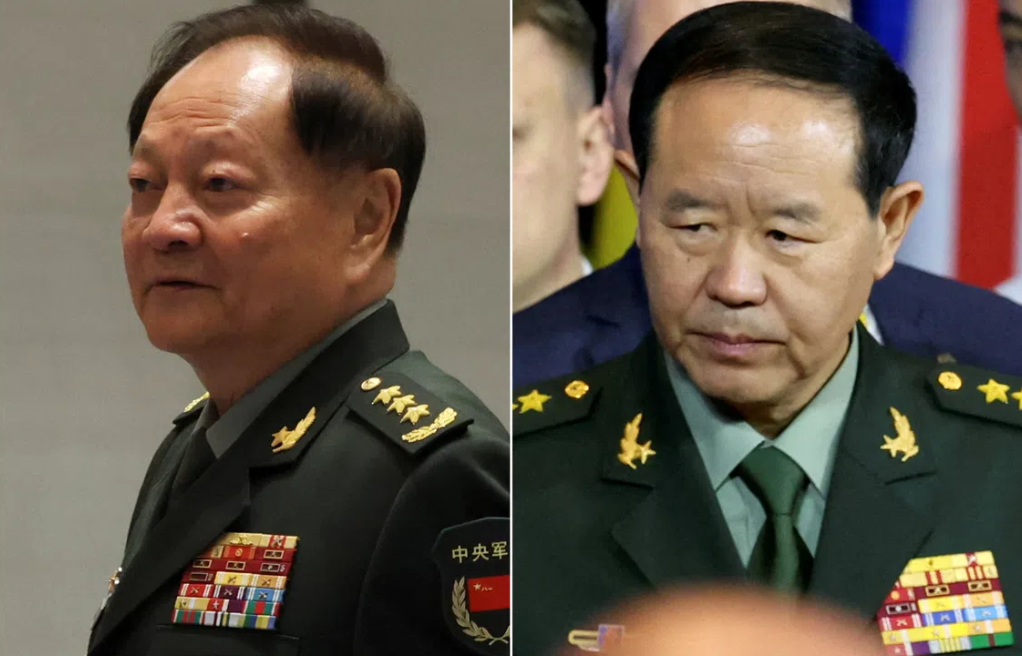
China's government has stripped two prominent military commanders from its highest defence authority, marking another significant escalation in President Xi Jinping's sweeping campaign against corruption and misconduct within the armed forces. The Central Military Commission, China's supreme military decision-making body, formally removed Zhang Youxia and Liu Zhenli on Friday following separate investigations into alleged serious violations of party discipline and law. The move, announced through state media Xinhua, dramatically reshapes the commission's composition and reflects the severity of allegations against both men.
Zhang Youxia held one of the military's most powerful positions as vice-chairman of the Central Military Commission, making him effectively the second-ranking figure beneath Xi Jinping himself. Beyond his military role, Zhang was also a member of the Politburo, the Communist Party's elite decision-making circle, underscoring his significance within China's political hierarchy. Liu Zhenli, while operating at a somewhat lower tier, wielded considerable operational authority as chief of staff of the CMC's Joint Staff Department, essentially overseeing day-to-day military administration and strategic coordination. Their simultaneous removal leaves the formerly seven-member commission with merely two active serving members—a skeletal configuration that raises questions about continuity and decision-making capacity within China's highest military councils.
The anti-corruption offensive targeting the military represents one of Xi Jinping's most sustained and consequential initiatives since his consolidation of power began in 2012. Unlike previous reform efforts that proved episodic or limited in scope, this campaign has methodically identified and removed scores of high-ranking officers and officials through investigations spanning over a decade. The breadth and persistence of these purges suggest systematic problems within the armed forces—whether financial misconduct, abuse of authority, or factional challenges to central control—that Xi regards as existential threats to military effectiveness and party dominance. Last month's reiteration of the anti-corruption message to senior party leaders indicated that momentum behind the campaign remains undiminished despite the passage of years.
The institutional mechanics of China's military leadership structure add complexity to Friday's announcement. China maintains parallel military command structures within both the state apparatus and the Communist Party hierarchy, yet these function as a unified entity in practice. The announced removals concern Zhang and Liu's positions within the state Central Military Commission as determined by the Standing Committee of the National People's Congress. However, official confirmation of their removal from the Communist Party's parallel Central Military Commission structure has not yet been publicly disclosed, suggesting that formal party-level consequences may follow or remain pending.
The announcement came through an updated roster of National People's Congress deputies released by China's legislature on Friday, effectively delisting Zhang and Liu alongside ten additional lawmakers whose parliamentary seats were terminated. This administrative mechanism—removing names from official rosters—represents the formal, technical means by which China's government implements high-level personnel decisions. Beyond the two principal figures, the list included Lieutenant General Zhong Shaojun, formerly directing the CMC General Office, and General Ju Qiansheng, a previous commander of the military's Strategic Support Force, indicating that investigations have ensnared leaders across multiple branches of the armed forces.
Notably, the purge extends beyond uniformed military personnel into the defence industrial complex. Gao Shiwen, named among those losing parliamentary positions, previously served as mayor of Nanchang in southern China before working at China Aerospace Science and Technology Corporation, a massive state-owned enterprise central to China's missile, satellite, and defence programmes. This pattern suggests that corruption investigations increasingly span the boundary between military and civilian defence sectors, addressing procurement irregularities, resource misallocation, or security lapses that may have pervaded these interconnected institutions.
The removals also encompass officers connected to recent military operations and strategic flashpoints. Zhao Zongqi, a former commander of the Western Theatre Command, lost his advisory body membership following his involvement in the 2020 China-India border clashes along the Line of Actual Control. While investigation details remain undisclosed, the timing raises questions about whether his removal relates to operational decisions, resource management during that conflict, or broader disciplinary action following border tensions that killed twenty Indian soldiers and resulted in significant Chinese casualties.
For regional observers and Southeast Asian governments, these developments carry several implications. The weakening of China's military command structure, even temporarily, may create uncertainty about decision-making continuity and predictability at precisely the moment when tensions persist across the South China Sea and beyond. Meanwhile, the systematic dismantling of military leadership networks could reshape factional dynamics and influence distribution within the Communist Party, with consequences for foreign policy orientation and military modernisation priorities. The campaign's intensity also suggests that Xi perceives military institutional weakness as a persistent vulnerability requiring ongoing correction through aggressive personnel action.
Moreover, the pattern of removals demonstrates Xi's willingness to target even the highest echelons of military authority—a striking feature that distinguishes this campaign from historical precedents. Previous Chinese administrations rarely removed serving vice-chairmen of the Central Military Commission, making Zhang Youxia's removal particularly noteworthy. This fearlessness in targeting top-tier figures suggests either enormous confidence in his political position or profound concerns about military reliability that override institutional caution. For Malaysia and other Southeast Asian nations assessing China's strategic stability and decision-making reliability, the continued churn within military leadership compounds existing uncertainties about crisis management and communication during potential conflicts.

