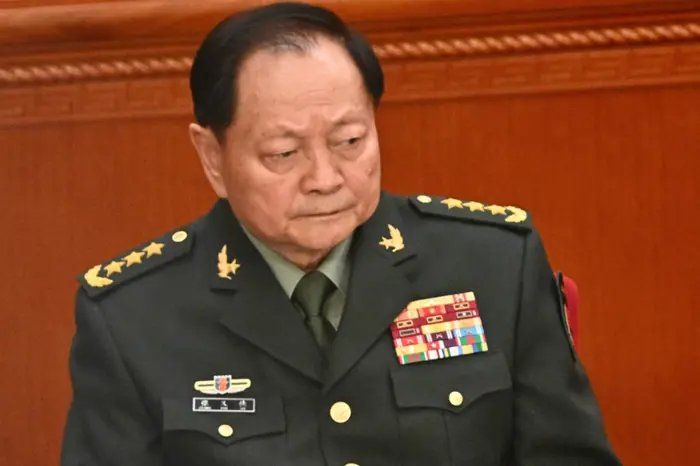
China has removed former general Zhang Youxia from his position as Vice Chairman of the Central Military Commission, according to an announcement from state media on Friday. The action concludes a seven-month investigation that began in January when the defence ministry disclosed that Zhang and another senior military official, Liu Zhenli, were under scrutiny for suspected serious violations of discipline and law—Beijing's standard terminology for corruption allegations. The removal marks a significant personnel shift within China's highest military decision-making body at a time when the country faces mounting strategic pressures in the Indo-Pacific region.
Zhang's departure from the CMC carries substantial symbolic weight within China's military hierarchy. He had occupied the position of Vice Chairman, the more prominent of two such posts, making him the country's most senior general officer. His standing suggested proximity to President Xi Jinping and considerable influence over defence policy formulation and military strategy. The fact that someone of such stature and apparent favour fell under investigation represents a stark demonstration of how thoroughly Xi's anti-corruption campaign penetrates even the highest echelons of military power, where personal relationships and patronage networks have traditionally insulated officials from disciplinary action.
Liu Zhenli, who served as chief of staff of the CMC's joint staff department, has also been removed from his position. The joint staff department carries particular importance as it oversees combat planning and operational coordination across China's armed forces, making Liu's role strategically consequential. His removal alongside Zhang suggests that the corruption investigation may have implicated multiple individuals within overlapping circles of military administration, or that the violations involved coordination across different branches of military bureaucracy.
The timing of these removals deserves scrutiny in the context of Xi Jinping's broader governance approach. Since assuming power in 2012, Xi has weaponised anti-corruption campaigns as a tool for consolidating authority, eliminating political rivals, and reshaping institutional loyalty within the Communist Party and military apparatus. While genuine cases of embezzlement and abuse of power have undoubtedly occurred within China's military, the anti-graft drive has simultaneously functioned as a mechanism for removing officials deemed unreliable or insufficiently aligned with Xi's vision for military modernisation and civilian party control.
The investigation's announcement in January caught many international observers and China analysts off guard, precisely because Zhang's seniority suggested he occupied a protected position. Military reformers within China's strategic establishment had regarded him as a modernisation advocate, and his apparent closeness to Xi made his sudden investigation unexpected. However, the seven-month gap between the announcement of investigation and formal removal from office is consistent with Chinese administrative procedure, allowing time for internal party investigations to conclude and official channels to process disciplinary decisions through appropriate governance structures.
This development carries implications for regional security dynamics across Asia. Military leadership transitions, particularly those involving figures as prominent as Zhang, can influence defence strategy, procurement priorities, and approaches to territorial disputes. China's military has been undergoing significant structural reforms and technological modernisation under Xi's direction, and shifts in top personnel often reflect evolving priorities regarding capabilities development, operational doctrine, and strategic posture. Zhang's removal may signal changing perspectives on defence policy or military spending allocations among those now ascending to senior positions.
For Malaysia and Southeast Asian nations broadly, military leadership changes in Beijing warrant careful monitoring. Malaysia's defence establishment maintains professional relationships with Chinese military counterparts and monitors signals regarding Beijing's strategic intentions through high-level personnel movements. Transitions within the CMC can influence how assertively China pursues maritime interests in the South China Sea and how receptively it approaches dialogue mechanisms with smaller regional powers. The removal of established figures like Zhang creates space for potentially different approaches to regional military engagement, whether toward greater assertiveness or pragmatic restraint.
The broader pattern of high-level military removals under Xi demonstrates his determination to ensure loyalty from defence institutions. Unlike some communist systems where military establishments develop autonomous power bases, Xi has systematically worked to subordinate military leadership to party control and personal political authority. The fall of figures once considered close to the leadership illustrates that no position, regardless of rank or perceived favour, provides immunity from investigation and removal if officials are deemed problematic.
China's state media framed the formal removal through parliamentary standing committee proceedings, lending institutional legitimacy to the personnel change. This procedural formality reflects how the Chinese system, despite its authoritarian character, maintains facades of constitutional process and collegial decision-making. The reliance on parliamentary announcements rather than military declarations underscores civilian party supremacy over defence institutions, a principle Xi has emphasised throughout his tenure despite being simultaneously Commander-in-Chief of military forces.
Looking forward, Zhang's removal completes a significant transition within the CMC's senior ranks. The vacated positions will presumably be filled by officials whose track records and perceived loyalties align with Xi's governance model and strategic vision. These appointments will likely reflect current priorities regarding military modernisation, operational preparedness, and institutional discipline. Observers of Chinese military affairs will scrutinise new appointees for indicators regarding future defence policy directions and the regime's confidence levels in its institutional structures.

