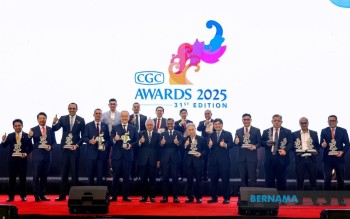
Malaysia's credit guarantee authority has celebrated the achievements of 32 enterprises and financial sector players at its flagship awards ceremony, underscoring the critical importance of business resilience in navigating an increasingly complex economic landscape. The 31st CGC Awards 2025, held in Kuala Lumpur, recognised micro, small and medium enterprises alongside major banking and financial institutions that have championed inclusive growth and adaptive business practices across the domestic economy.
The awards framework spans three distinct categories designed to celebrate excellence across different tiers of the business and financial ecosystem. Recognitions extended to top-performing financial institution partners, both conventional and Islamic banking players, non-banking financial service providers, and deserving SMEs themselves. This multi-layered approach reflects CGC's understanding that enterprise success depends not on any single actor but on coordinated effort across banking, government, research bodies, and corporate supply chains.
Datak Mohammed Hussein, chairman of CGC, delivered remarks positioning resilience as a multidimensional concept extending far beyond simple access to financing. He emphasised that true organisational resilience emerges from the character, discipline and adaptability inherent in business leadership—qualities that help enterprises weather economic downturns, market disruptions and operational challenges. Hussein articulated a systems-level vision of SME sector development, arguing that sustainable growth requires active participation from multiple stakeholders rather than relying solely on banking institutions to shoulder the burden.
Central to Hussein's message was the need for a coordinated ecosystem approach. Governments must establish regulatory and operational conditions that facilitate business formation and growth. Academic and research institutions play a catalytic role in translating technological innovations into commercially viable products and services. Corporations operating mature supply chains should expand access to smaller suppliers, creating wealth distribution effects throughout the economy. Financial institutions, in turn, must deploy capital strategically to unlock growth potential at enterprises lacking conventional collateral or track records.
CGC's commitment to Bumiputera enterprise development emerged as a significant theme throughout the awards ceremony. The corporation disbursed RM223 million in guarantee provisions to 27 Bumiputera-owned companies during the preceding year, demonstrating sustained effort to ensure indigenous entrepreneurs access the financial tools necessary for business expansion. This targeted support reflects broader national policy objectives around inclusive economic participation and wealth creation across diverse community segments.
Environmental, social and governance-linked financing represented another strategic priority area. CGC's guarantee products tied to ESG frameworks reached RM1.2 billion in committed value, exceeding the initial RM1 billion target. This performance indicator signals growing alignment between Malaysian financial institutions and global sustainability standards, positioning domestic enterprises for participation in increasingly ESG-conscious international supply chains and investment flows.
Alliance Bank Malaysia Bhd and CIMB Islamic Bank Bhd jointly captured the Best Financial Partner award, recognising their role in channelling guaranteed credit toward qualifying enterprises. OCBC Al-Amin Bank Bhd earned specific recognition for its work supporting Bumiputera SMEs, while Maybank Islamic Bhd received special commendation for advancement of indigenous business participation. The distribution of awards across conventional, Islamic and development-focused financial institutions underscores the diversity of credit channels now available to Malaysian enterprises seeking growth capital.
The awards ceremony provided the platform for launching two new guarantee schemes jointly developed by Bank Negara Malaysia and CGC, representing a cumulative commitment of RM10 billion in guaranteed financing capacity. The Portfolio Guarantee and Portfolio Guarantee-i programmes are engineered to facilitate access to credit for approximately 12,100 MSMEs across key economic sectors. These schemes operate through a risk-sharing model whereby participating financial institutions originate loans while CGC assumes a portion of default risk, thereby reducing the perceived credit risk that previously constrained lending to smaller enterprises.
The financing mechanisms embedded within these schemes target multiple strategic objectives simultaneously. Business expansion initiatives receive support through facility structures tailored to growth capital requirements. Productivity enhancement investments—encompassing technology adoption, process automation and workforce development—qualify for guarantee coverage. Sustainability transition financing, increasingly critical as global supply chain partners demand environmental compliance credentials, benefits from dedicated programme components. Overall competitiveness improvements across operational, financial and technological dimensions receive explicit support through scheme design.
CGC's strategic framework through 2030 positions financial inclusion and sustainable economic development as core organisational mandates rather than peripheral corporate social responsibility activities. The corporation intends to deepen its engagement with MSMEs through expanded guarantee products, enhanced collaboration with established financial institutions, strengthened partnerships with government agencies pursuing inclusive growth objectives, and direct support for entrepreneur development initiatives. This multipronged approach acknowledges that enterprise growth requires sustained engagement across business lifecycle stages rather than one-off interventions.
For Malaysian enterprises, particularly those in the Bumiputera classification or early-stage development phases, the expanded guarantee capacity and refined scheme structures offer genuine pathways toward accessing growth capital previously constrained by stringent collateral requirements or limited operating history. The RM10 billion commitment, while substantial, remains modest relative to total MSME financing needs, suggesting that competition for guarantee allocations may intensify. Enterprises demonstrating clear expansion strategies, solid financial management and alignment with priority sectors identified within scheme documentation will likely experience superior outcomes in accessing these guarantee-backed facilities.
The regional implications deserve consideration as well. Malaysia's continued investment in MSME support infrastructure, particularly through mechanisms explicitly addressing indigenous entrepreneur participation, reinforces the nation's position as a leader in inclusive financial policy across Southeast Asia. Neighbouring economies tracking Malaysia's approach to guarantee schemes, ESG-linked financing and financial inclusion may themselves adopt comparable frameworks, creating competitive pressures that could ultimately benefit the broader regional enterprise ecosystem through knowledge transfer and policy convergence.

