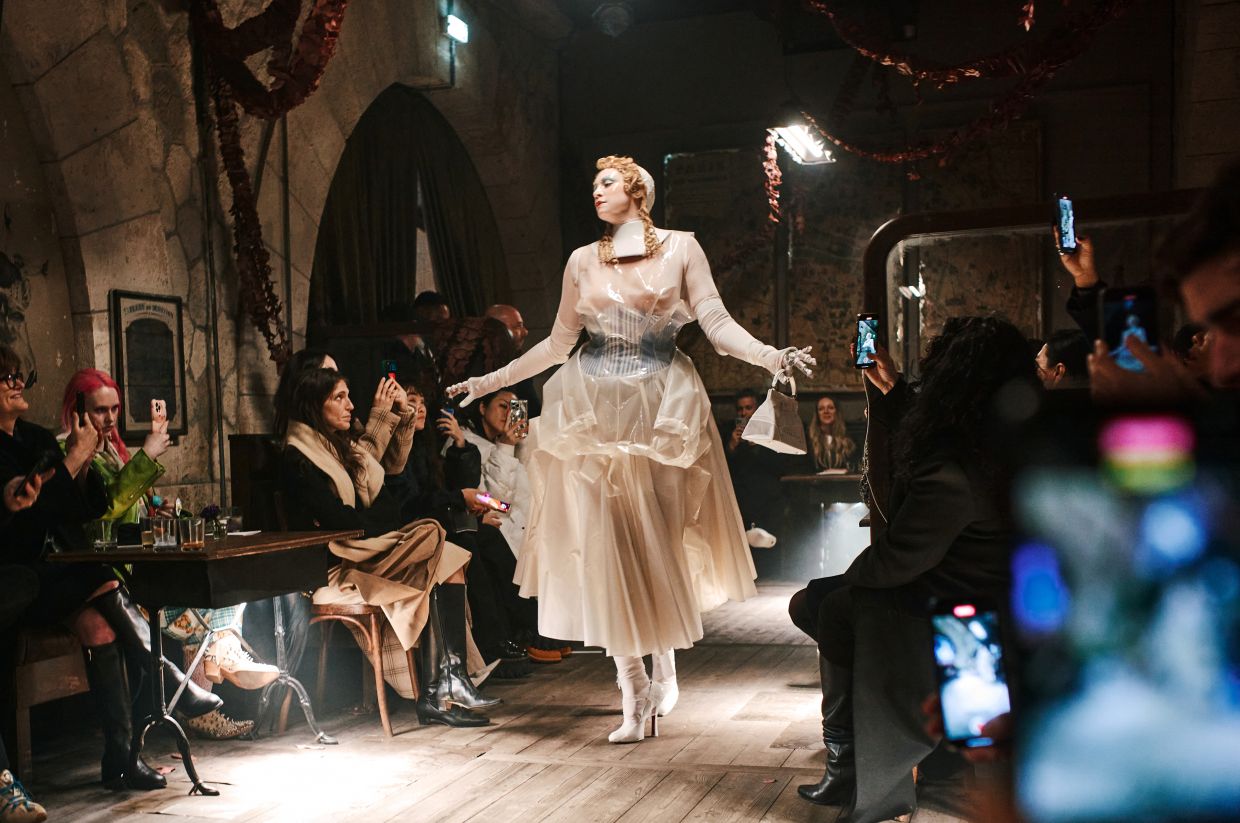
The Metropolitan Museum of Art convened an unusual gathering at its Manhattan headquarters in May, bringing together prominent figures including Anna Wintour to address a delicate institutional dilemma: whether to proceed with a major retrospective devoted to John Galliano, one of contemporary fashion's most celebrated yet most controversial figures. The closed-door sessions represented months of deliberation with Jewish community leaders as the museum navigated the minefield of celebrating a designer whose career has been fundamentally shaped by both extraordinary creative achievement and a profound moral transgression. This convergence of artistic excellence and personal reckoning has become unavoidable as the Met prepares for what would be an unprecedented honour in the fashion world.
Galliano stands as one of the industry's transformative visionaries, a designer whose tenure as creative director of Christian Dior from 1996 to 2011 transcended conventional fashion to create immersive theatrical experiences. His mastery of the bias-cut silhouette and his gift for elaborate world-building established him as an architect of haute couture who fundamentally altered Dior's trajectory from a respected French heritage house into a globally dominant fashion juggernaut. Yet this accomplishment has become inseparable from the circumstances that nearly ended his career. In 2011, a video surfaced capturing Galliano making deeply offensive antisemitic remarks, including statements praising Hitler, recorded during an evening in a Paris bar. The revelation prompted immediate professional consequences: his dismissal from Dior, a hate crime conviction in French court, and the beginning of what would become a lengthy process of personal reckoning and rehabilitation.
The proposed exhibition carries immense symbolic weight within the fashion establishment. Should it proceed, Galliano would become only the third living designer to receive a solo exhibition at the Met, joining the legendary Yves Saint Laurent and Rei Kawakubo—a distinction representing perhaps the highest institutional validation available to a contemporary fashion creator. This recognition would cement his historical legacy precisely at a moment when antisemitism has resurged across North America and globally. Jewish leaders in New York remain particularly sensitive to such cultural moments, especially following high-profile hate crimes including a recent stabbing of individuals outside a Manhattan Jewish community centre prosecuted as a hate crime. The convergence of these factors explains why museum director Andrew Bolton and the institution's board determined that proceeding with the exhibition required extensive community consultation rather than proceeding with conventional exhibition planning.
The meetings undertaken by the Met reflected a recognition that this was not merely a curatorial decision but a cultural statement with implications extending far beyond the fashion world. Rabbi Rick Jacobs, president of the Union For Reform Judaism in North America, participated in the May discussions and later recalled his impressions of Galliano's engagement with community leaders. Jacobs emphasized the designer's apparent sincerity and directness, noting that Galliano spoke without relying on prepared statements or corporate talking points, instead addressing concerns with evident transparency. This engagement resonated with participants who invoked the Jewish principle of teshuvah, which emphasizes repentance and the possibility of genuine redemption—a concept that has animated broader discussions about accountability, forgiveness, and second chances in contemporary public discourse.
Jonathan Greenblatt, chief executive of the Anti-Defamation League, offered institutional support for the exhibition, indicating that Galliano's documented efforts to address the damage caused by his statements—including periods spent studying Judaism and the Holocaust with religious leaders and scholars—demonstrated meaningful engagement with the consequences of his remarks. Yet this measured acceptance coexisted with significant reservations about how the museum should present both Galliano's undeniable artistic contributions and the historical reality of his antisemitic statements. Rabbi Joshua Davidson of Temple Emanu-El, located just blocks from the Met, articulated a vision in which the exhibition could serve as an educational opportunity, using Galliano's trajectory to illuminate contemporary antisemitism and foster community dialogue about resisting hatred. This framing represents an attempt to transform what could be a purely celebratory showcase into something more complex and pedagogically valuable.
Bolton disclosed that he had contemplated a Galliano exhibition as early as 2010 but did not seriously pursue it until 2024, suggesting that institutional caution has governed this project from its inception. He attributed the recent decision to move forward to the current historical moment, arguing that the exhibition's relevance has intensified rather than diminished as antisemitism has become more prevalent. This positioning—treating the exhibition as a timely intervention in contemporary discussions about hatred and its consequences—represents a significant curatorial stance. It implicitly argues that avoiding Galliano's work would itself be a form of evasion, whereas engaging directly with both his artistry and his failings could generate productive public conversation.
The museum's approach will centre on what Bolton describes as an "orientation gallery" designed to address what he terms "the rupture" that has defined Galliano's career trajectory. This architectural decision signals an intention to position his antisemitic statements not as an unfortunate sidebar to his artistic legacy but as a central element of his historical significance. Bolton emphasized his commitment to using Galliano's own words rather than filtered institutional language, a choice reflecting lessons learned from his consultations with Jewish community leaders who stressed the importance of clarity and the dangers of euphemistic language that might obscure rather than illuminate difficult historical reality. The curator acknowledged that his responsibility extends beyond representing Galliano's perspective to presenting the most historically accurate account of both his achievements and his transgressions.
The decade following Galliano's 2011 dismissal witnessed a remarkable professional rehabilitation. His appointment as creative director of Maison Margiela in 2014 marked his return to high fashion, and his designs have subsequently become ubiquitous among celebrities and collectors. Awardwinning performers including Zendaya and Amal Clooney have regularly worn his vintage creations on international red carpets, while his historical pieces command record-breaking prices at auction houses. This commercial and cultural rehabilitation demonstrates fashion's willingness to move beyond the designer's past conduct, though it also raises questions about whether such forgetting serves the interests of accountability or merely enables institutional convenience.
The Met's proposal to create an online forum accompanying the physical exhibition suggests an attempt to extend the conversations initiated with Jewish leaders into a broader public space. This digital component could potentially allow for sustained community engagement rather than treating the exhibition as a contained institutional event. However, it also raises questions about how such conversations will be moderated, what perspectives will be amplified, and whether online discussion will generate meaningful understanding or merely reproduce polarized debate. The success of this approach will depend substantially on the Met's willingness to engage seriously with criticism and controversy rather than treating dissent as noise to be managed.
For Malaysian and Southeast Asian observers, this controversy illuminates broader questions about how institutions navigate the relationship between artistic merit and personal moral conduct in an increasingly interconnected world. The exhibition also reflects tensions within contemporary progressivism between commitments to accountability and commitments to redemption, between the impulse to cancel figures who have transgressed and the desire to recognize genuine efforts at change. These questions have particular resonance in societies grappling with historical injustices and contemporary inequalities, where questions of who gets to be remembered, celebrated, and rehabilitated carry profound implications. The Met's engagement with this dilemma, whatever its ultimate resolution, will likely influence how other cultural institutions navigate similar challenges.
The Met Gala that will launch this exhibition represents perhaps the most closely scrutinized fashion event globally, and its hosting of Galliano's retrospective would constitute a significant statement about fashion's values and priorities. The decision to proceed with the exhibition—should it ultimately occur—represents an institutional gamble that substantive engagement with difficult history serves cultural purposes better than avoidance or erasure. Yet this gamble also carries risks, including the possibility that the exhibition could appear to celebrate Galliano without adequately reckoning with the harm his statements caused, or that it could be perceived as offering redemption too readily to a prominent figure whose rehabilitation has been considerably eased by his wealth and professional stature. The coming months will reveal whether the Met's careful community consultations have produced an approach genuinely capable of balancing these competing obligations.

