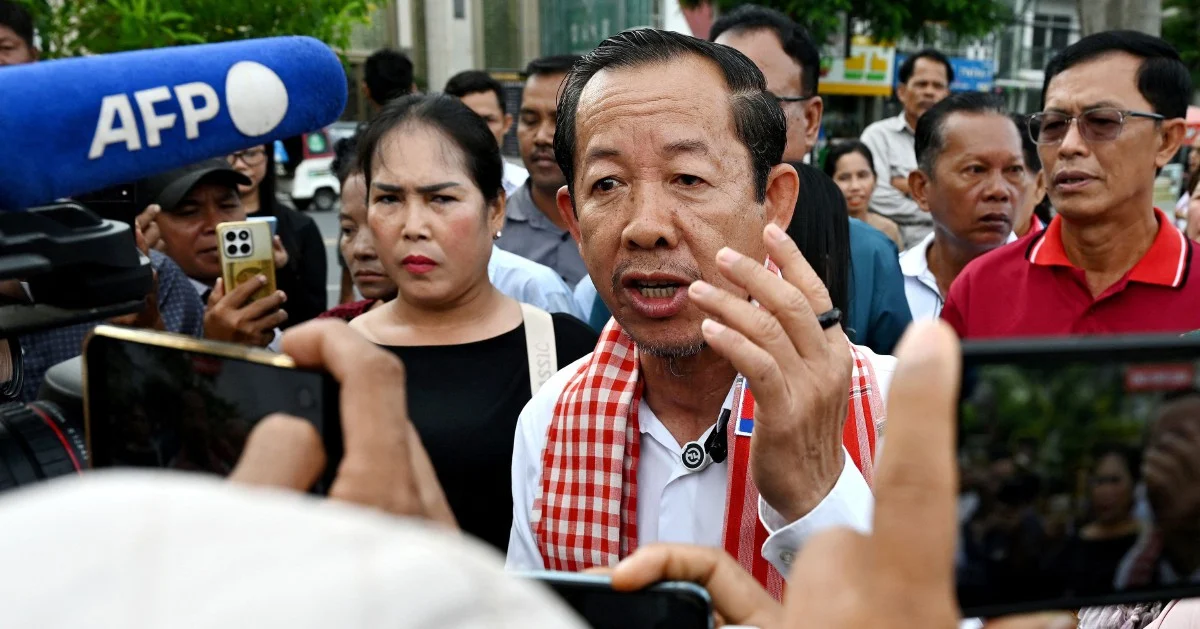
Cambodia's Supreme Court has reached a partial victory for opposition politician Rong Chhun by suspending his prison sentence, though it has upheld the ban preventing him from running for elected office, according to his legal representatives. The Friday ruling emerges at a moment when Cambodia's political landscape continues to narrow for those opposing the ruling coalition, with judicial decisions serving as instruments shaping electoral eligibility across the country.
The suspension of Rong Chhun's custodial punishment represents a modest concession from Cambodia's highest judicial body, yet the maintained election bar constitutes the more consequential outcome. By preserving the restriction on his political participation while lightening the prison burden, the court has effectively removed the opposition figure from the electoral arena without the reputational burden of visible incarceration. This approach allows authorities to sideline opposition voices while presenting a facade of judicial moderation to international observers.
Rong Chhun's situation exemplifies a broader pattern in Cambodian governance where legal mechanisms are deployed to constrain political opposition. Election bans have become increasingly common tools employed against rival politicians, effectively narrowing the field of candidates permitted to contest national and local elections. Such restrictions raise fundamental questions about democratic participation and the principle of universal suffrage in a nation where electoral competition has become progressively limited.
The ruling carries significant implications for Cambodia's political trajectory in coming electoral cycles. With influential opposition figures systematically excluded from candidacy through judicial rulings, the government reduces the possibility of meaningful political competition that could challenge its parliamentary dominance. This approach consolidates power while maintaining the appearance of functioning democratic institutions and a functioning court system.
For Southeast Asia's democratic observers, Cambodia's judicial handling of opposition politicians represents a concerning trend. The region has witnessed various democratic backsliding patterns across different countries, yet Cambodia's combination of prison sentences paired with election bans demonstrates a particularly comprehensive approach to political neutralisation. When courts uphold electoral disqualifications against opposition voices, they become participants in systemic exclusion rather than neutral arbiters of law.
International human rights organisations have repeatedly documented concerns about Cambodia's treatment of political opponents, noting that judicial mechanisms frequently target those challenging government authority. The suspension of Rong Chhun's sentence, while presented as judicial leniency, may be strategically calculated to deflect international criticism whilst preserving the substantive punishment of political exclusion. The practical effect remains the same: removal from electoral competition regardless of the imprisonment status.
The maintenance of election restrictions against opposition figures like Rong Chhun occurs within Cambodia's specific political context, where Prime Minister Hun Sen's ruling Cambodian People's Party has dominated governance for decades. Without significant organised opposition able to contest elections, electoral processes become less meaningful as instruments of democratic accountability. The systematic exclusion of viable alternatives to the ruling coalition effectively determines election outcomes before voting occurs.
For Malaysian observers, Cambodia's political situation offers both cautionary lessons and comparative perspective. While Malaysia's democratic institutions and multi-party system remain more robust than Cambodia's increasingly constrained landscape, Malaysian political watchers recognise the importance of defending electoral access and preventing the erosion of competition through legal or administrative barriers. The international community's relative silence on Cambodia's practices suggests that democratic backsliding can advance incrementally when confronted with limited external pressure.
Rong Chhun's case also highlights the vulnerability of individual opposition politicians when confronted with consolidated state power operating through judicial channels. Even partial victories like sentence suspension come with substantial political costs, as the election ban ensures removal from meaningful political participation. This dynamic discourages opposition participation and signals to other potential challengers the personal risks involved in political opposition within Cambodia's current environment.
The Supreme Court's decision reflects Cambodia's unique position within ASEAN, where the nation maintains formal democratic structures whilst increasingly restricting the political competition those structures supposedly enable. Court rulings become mechanisms for managing dissent rather than adjudicating disputes impartially. The precedent established by upholding Rong Chhun's electoral ban will likely influence future cases involving opposition politicians, suggesting a consistent judicial approach toward limiting opposition electoral participation.
Moving forward, Rong Chhun faces the practical reality of political sidelining despite the suspended prison sentence. His exclusion from electoral contests effectively removes his primary avenue for political influence and constituency representation. Other opposition figures observing this outcome must weigh the costs of political activism against the substantial risks of judicial consequences and electoral disqualification, potentially discouraging broader opposition mobilisation.
The ruling ultimately demonstrates how judicial systems can be utilised to achieve political outcomes without explicit authoritarian declarations or obvious democratic violations. By maintaining election bans whilst suspending imprisonment, Cambodian courts perform a balancing act that accomplishes substantive political exclusion whilst creating superficial impressions of judicial moderation. This sophisticated approach to constraining opposition reflects evolving patterns of democratic deterioration across the region.

