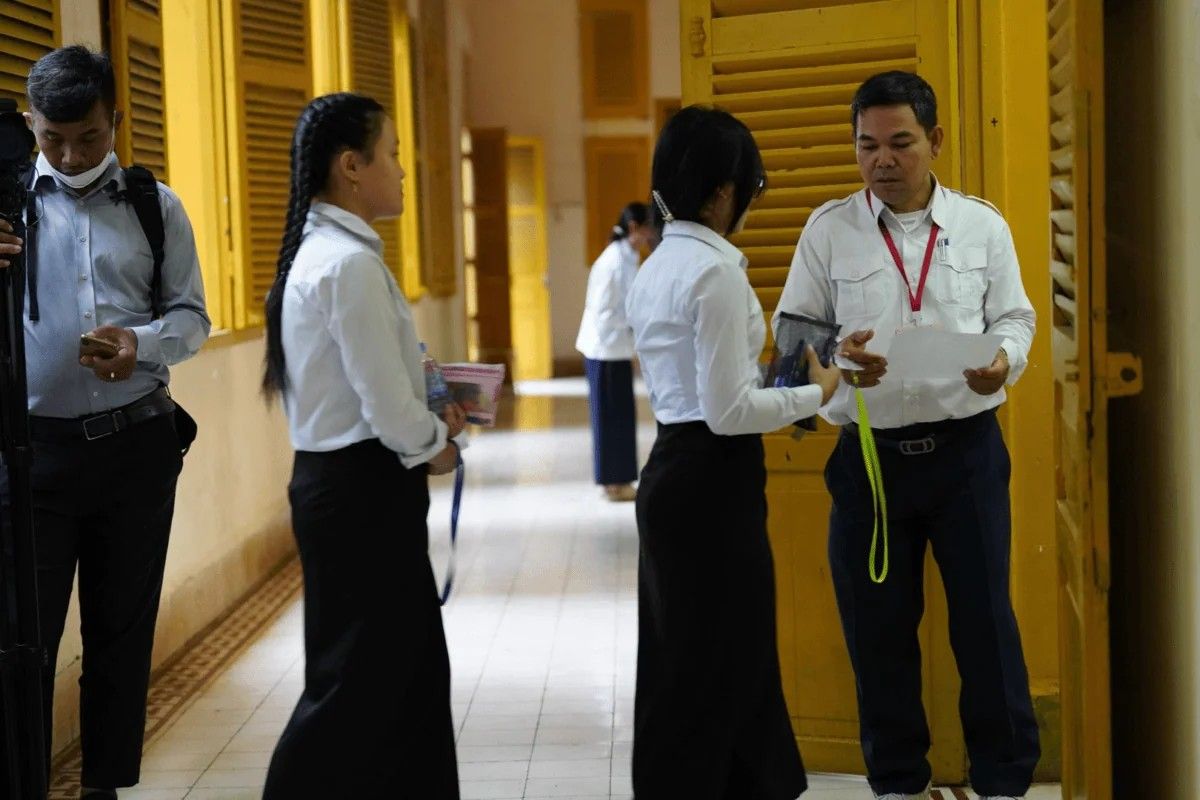
Cambodia's high school graduation examinations commenced on August 10, bringing fresh opportunity for the Kingdom's students even as unresolved territorial tensions continue to disrupt education in frontier regions. The opening of examination centres across the country marked a crucial milestone in the academic calendar, offering a test for more than 150,000 candidates spread across science and social science tracks. Yet the concurrent closure of two dozen schools in border provinces underscores the lingering fallout from last year's military confrontation, creating a two-tier examination experience that starkly divides Cambodian learners along geographical lines.
Education Minister Hang Chuon Naron characterised this year's examination season as notably calmer than its 2025 predecessor, which unfolded amid heightened security concerns. The previous iteration occurred precisely one month after initial armed hostilities erupted along the Cambodia-Thailand frontier, forcing examination organisers to implement contingency protocols while managing logistical disruptions. The minister's observation that this year's environment represents an improvement reflects not merely the passage of time but a deliberate effort to restore normalcy to academic processes that had been shadowed by active conflict.
The scale of student participation underscores Cambodia's commitment to maintaining educational continuity despite regional complications. Over 37,000 candidates sit the science-track examination, whilst the social science stream attracts more than 130,000 participants, indicating substantial weight concentrated in humanities and social disciplines. This distribution mirrors historical enrollment patterns in Southeast Asian education systems, where social science programmes typically absorb larger cohorts of secondary graduates seeking entry into commerce, governance, teaching, and service sectors.
Hang Chuon Naron's remarks drew attention to the extraordinary resilience demonstrated by Cambodian students during last year's examination cycle. He recounted encountering a learner whose family had fled attacks in Oddar Meanchey province, forcing the student to pursue studies whilst displaced alongside relatives who had sought refuge from the violence. Despite such extreme circumstances, the student achieved top academic marks and subsequently gained admission to a prestigious higher education institution. This anecdote encapsulates both the human cost of border instability and the determination of Cambodian youth to advance their futures regardless of external upheaval.
The persistent occupation of educational facilities in frontier territories represents an acute constraint on students' fundamental right to learn within their home communities. Twenty-five schools across border provinces remain inaccessible, their classrooms physically controlled by Thai military personnel following last year's invasion. This situation imposes genuine hardship on affected learners, who must either abandon their studies entirely or relocate to alternative accommodation to continue their education. The Royal Government has demanded that these facilities be returned to Cambodian control, framing the restoration of schooling access as integral to regional stability and diplomatic resolution.
Currently, only Banteay Mean Rith Lower Secondary School in Oddar Meanchey province has established makeshift instructional arrangements, with students attending classes in temporary camps rather than conventional school buildings. This pragmatic solution, whilst enabling educational continuity, falls substantially short of restoring normal pedagogical conditions. Temporary facilities lack the infrastructure, libraries, laboratory equipment, and specialised spaces that permanent schools provide, potentially disadvantaging displaced students who must prepare for examinations under suboptimal conditions.
Examination integrity emerged as a primary concern for Cambodian authorities, reflecting institutional memory of previous irregularities that had undermined public confidence. Last year's examinations were marred by the unauthorised circulation of mathematics examination papers, compromising the validity of assessments and necessitating heightened security protocols for this year's administration. The Anti-Corruption Unit has deployed more than 4,000 monitors throughout examination centres nationwide, matching the observer deployment of the previous year and signalling governmental determination to prevent recurrence of such breaches. This expansion of monitoring capacity reflects broader institutional reforms aimed at ensuring examinations proceed transparently and without manipulation.
Hang Chuon Naron emphasised that systematic organisation, rigorous enforcement of regulations, and transparent oversight by diverse stakeholder representatives would collectively eliminate opportunities for corrupt practices to flourish. The involvement of independent observers drawn from civil society, international partners, and domestic institutions creates multiple layers of accountability that transcend any single governmental authority. This multi-stakeholder approach responds to historical concerns that state institutions alone might lack sufficient independence to prevent compromise of examination processes.
The distinction between examination experiences available to candidates in stable versus conflict-affected regions raises profound equity considerations for Cambodian policymakers. Students preparing in temporary camps or displaced from their communities face psychological, logistical, and academic disadvantages that peers in unaffected provinces do not encounter. Whilst examination content and evaluation criteria remain uniform, the circumstances under which students prepare and sit assessments vary dramatically based on geography and proximity to occupied territories. This structural inequality persists as a reminder that military confrontation produces civilian casualties extending far beyond immediate combat zones.
The examination period also carries diplomatic significance, as Thailand's continued occupation of Cambodian schools perpetuates symbolic and practical reminders of last year's invasion. Each day that students remain unable to return to their classrooms represents an implicit assertion of Thai control over Cambodian territory, complicating efforts to normalise bilateral relations and move forward from previous hostilities. Regional observers view the examination season through dual lenses: academic progress on one hand, geopolitical tension on the other.
Cambodia's examination administration thus stands at an intersection between domestic pedagogical concerns and international relations. The successful completion of this year's examinations without security incidents would constitute a meaningful step toward normalcy, yet the persistence of occupied schools ensures that full restoration of educational normalcy remains incomplete. For the 150,000-plus candidates sitting examinations, however, immediate focus centres on demonstrating academic mastery and securing pathways to tertiary education and professional futures, regardless of the constraining circumstances that define this examination cycle for their counterparts in frontier communities.

