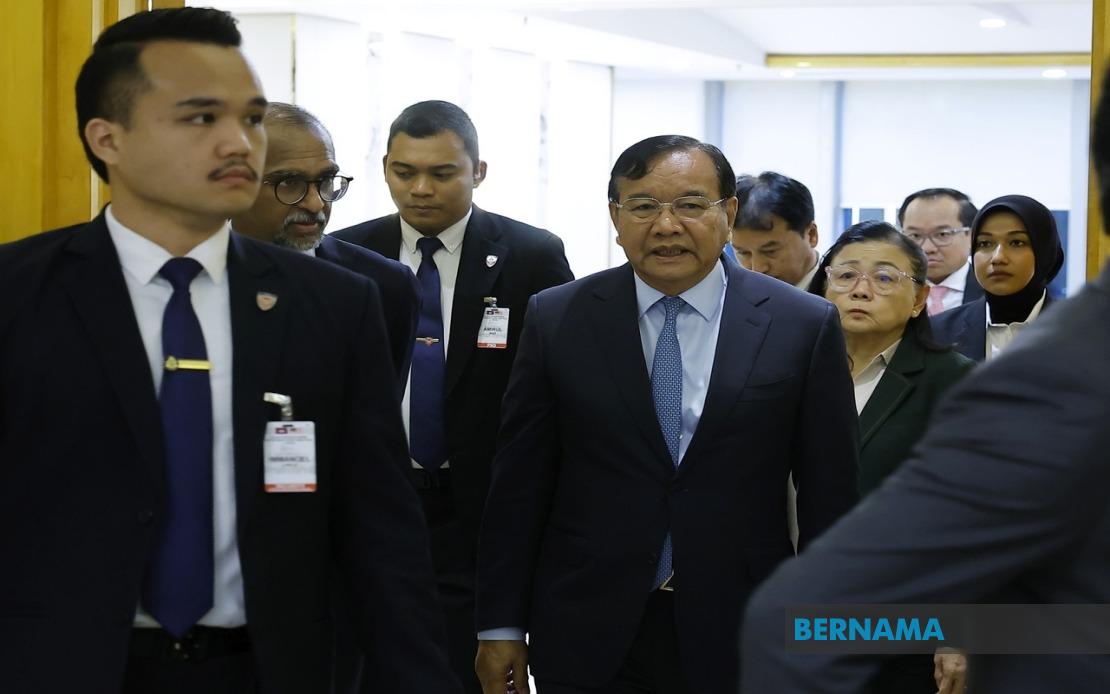
Cambodian Deputy Prime Minister and Foreign Affairs Minister Prak Sokhonn departed Malaysia on August 4, concluding a two-day official visit that underscored the renewed momentum in bilateral relations between the two Southeast Asian neighbours. Sokhonn and his delegation flew out from Kuala Lumpur International Airport Terminal 1 at 4:45 pm on a commercial flight to Phnom Penh, with Malaysian Government chief ceremony officer Datuk Rozainor Ramli present to extend formal farewells to the visiting delegation.
The timing of Sokhonn's mission carried particular symbolic weight, as his visit marked the beginning of preparatory efforts for the upcoming 70th anniversary celebration of diplomatic relations between Malaysia and Cambodia in 2027. This forward-looking gesture indicates both nations' commitment to not merely commemorating past achievements but to building an ambitious shared future grounded in sustained cooperation and mutual benefit.
During his stay, Sokhonn conducted a courtesy call on Prime Minister Datuk Seri Anwar Ibrahim at the Prime Minister's Office, where the two leaders engaged in substantive discussions that reaffirmed the historical foundations of Malaysia-Cambodia relations. The meeting transcended ceremonial pleasantries, with both leaders identifying concrete areas for strategic deepening. Their conversation encompassed the digital economy and artificial intelligence—sectors of critical importance as Southeast Asia navigates technological transformation—alongside the halal industry, where Malaysia's expertise positions it as a potential partner for Cambodia's growing awareness of halal standards and certification. Food security and human capital development also featured prominently, reflecting recognition that stability and prosperity require investment in both tangible resources and people.
The centrepiece of Sokhonn's visit was the co-chaired 3rd Malaysia-Cambodia Joint Commission for Bilateral Cooperation meeting held in Kuala Lumpur, where he worked alongside Foreign Minister Datuk Seri Mohamad Hasan. This gathering carried extraordinary significance: it marked the resumption of the bilateral mechanism after a remarkable 20-year gap, effectively resetting a crucial institutional channel that had fallen dormant. The revival of this formal mechanism suggests that previous impediments to cooperation have either been resolved or deliberately set aside in favour of future-oriented engagement.
The economic dimensions of this revitalised partnership reveal robust underlying momentum. Trade between the two countries expanded dramatically in 2025, with bilateral commerce climbing 27.4 per cent year-on-year to reach RM5 billion, equivalent to USD1.17 billion. This surge was driven largely by Malaysian exports to Cambodia, which totalled RM4.13 billion (USD970 million), while Cambodian shipments to Malaysia amounted to RM880 million (USD200 million). The asymmetry in trade flows reflects Malaysia's more developed industrial base and its positioning as a supplier of manufactured goods and services to Cambodia's growing consumer economy.
Malaysia's investment footprint in Cambodia underscores the depth of economic integration between the two nations. As of 2024, Malaysian cumulative direct investment in Cambodia stood at USD3.20 billion (RM13.07 billion), distributed across 162 registered projects. This investment volume places Malaysia as Cambodia's third-largest foreign investor, behind China and Vietnam, positioning it as a meaningful development partner in Cambodia's economic modernisation agenda. These capital flows fund manufacturing facilities, infrastructure projects, and service enterprises that generate employment and technology transfer throughout Cambodia's economy.
For Malaysian stakeholders, this relationship carries particular relevance. Cambodia represents both a growing market for Malaysian exports and a destination for capital seeking returns in a rapidly developing economy. The region's geographic proximity means that supply chains linking Malaysia to Cambodia remain efficient, while cultural and religious ties—particularly Malaysia's experience with Islamic finance and halal certification—create additional vectors for cooperation that extend beyond conventional trade relationships.
The resumption of formal bilateral mechanisms also carries broader geopolitical implications for Southeast Asia. The 20-year dormancy of the joint commission suggests that Malaysia-Cambodia relations had become strained or neglected, possibly overshadowed by the dominance of relations with Vietnam and Thailand, or reflective of Cambodia's historical gravitation towards Chinese partnership. The deliberate decision to revitalise this mechanism indicates a strategic recalibration, with Malaysia seeking to reinforce its position within the Association of Southeast Asian Nations (ASEAN) network and to deepen ties with a neighbour whose geographic location and developmental trajectory make it increasingly significant to regional stability and prosperity.
The visit also reflects Cambodia's apparent willingness to broaden its international engagement beyond its most prominent partners. While Cambodia maintains robust ties with China and Vietnam, the signals emanating from Sokhonn's Malaysia visit suggest openness to cultivating more balanced and multifaceted regional relationships. This diversification approach benefits Cambodia by reducing dependency on any single power and creates opportunities for countries like Malaysia to contribute meaningfully to Cambodia's development priorities.
Looking ahead, the agreements and understandings forged during this visit will likely take concrete form in subsequent bilateral engagements. The emphasis on digital economy and artificial intelligence suggests that both nations recognise the imperative of technological modernisation as a prerequisite for competitiveness in the coming decades. Similarly, collaboration on the halal industry presents opportunities for Malaysia to export expertise and standards that could become embedded in Cambodia's evolving regulatory frameworks, creating lasting competitive advantages for Malaysian enterprises.
The revival of the Malaysia-Cambodia joint commission represents a turning point in bilateral relations, moving from dormancy towards activation. This reawakening of formal institutional cooperation, coupled with the impressive trade and investment metrics, suggests that Malaysia and Cambodia are positioned to deepen their partnership across multiple dimensions. As the two nations count down to their diplomatic anniversary in 2027, the momentum generated by Sokhonn's visit will likely accelerate preparations for a celebration that reflects genuine progress in advancing shared prosperity and regional stability.

