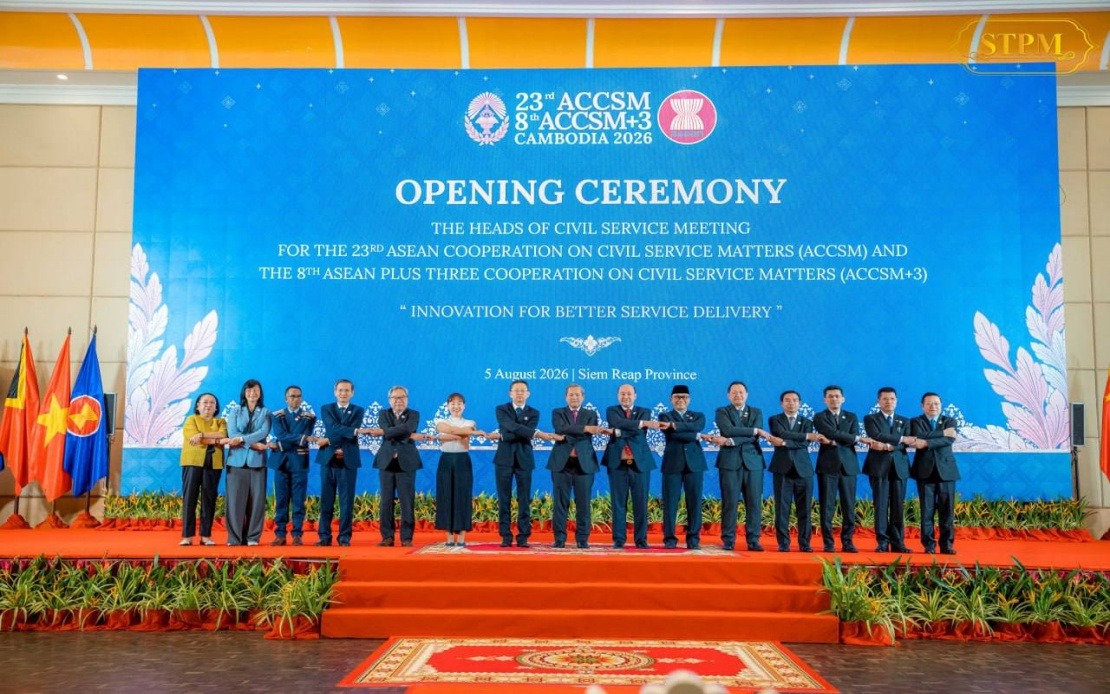
Cambodian Prime Minister Hun Manet has called upon ASEAN member states to strategically harness artificial intelligence and digital innovation as tools for strengthening public service delivery across the region. Speaking at a high-level civil service forum in Siem Reap, Hun Manet emphasised that technological advancement alone is insufficient without a deliberate focus on improving the lives of ordinary citizens and closing persistent development disparities that characterise the diverse economies of Southeast Asia.
The prime minister's intervention at the 23rd ASEAN Cooperation on Civil Service Matters (ACCSM) and the 8th ASEAN Plus Three Cooperation on Civil Service Matters (ACCSM+3) reflects growing recognition within the bloc that digital transformation must serve broader social and economic objectives. Rather than viewing AI adoption as an end in itself, Hun Manet positioned technology as a means to deliver tangible improvements in how governments serve their populations, from healthcare and education to taxation and welfare administration.
A crucial element of Hun Manet's address centred on the need for inclusivity in how ASEAN approaches innovation. He articulated a vision where technological advancement respects the substantial differences in development capacity and digital readiness across member states, ranging from more developed economies like Singapore and Brunei to nations still building foundational digital infrastructure. This acknowledgment carries particular significance for Malaysia and other mid-tier ASEAN economies seeking to balance rapid modernisation with manageable implementation timelines.
Hun Manet stressed that successful innovation cannot be divorced from institutional capability and workforce development. Merely acquiring cutting-edge technologies without simultaneously building the human expertise to deploy them effectively would leave ASEAN vulnerable to implementation failures and inefficient spending. This observation aligns with persistent challenges across Southeast Asia, where governments have sometimes acquired advanced systems only to struggle with optimal utilisation due to skills gaps or inadequate training frameworks.
The Cambodian leader argued that ASEAN's digital transformation agenda must transcend the boundaries of individual nations. Regional challenges—including climate-induced disasters, uneven economic development patterns, and widespread poverty—fundamentally resist purely national solutions. He contended that innovation should encompass not only the internal efficiency gains governments seek, but also mechanisms for knowledge exchange, reciprocal support systems, and coordinated adaptation strategies that leverage collective regional strengths.
This emphasis on regional cooperation carries implications for Malaysia as a major ASEAN economy and aspiring digital hub. Greater harmonisation of AI governance standards, data protection frameworks, and public service protocols could create efficiency gains for cross-border transactions and facilitate the movement of digital workers across Southeast Asia. However, such collaboration also requires balancing sovereignty concerns and ensuring that smaller economies are not disadvantaged by technological standards set primarily by wealthier nations.
The ACCSM framework, which has evolved over more than two decades, represents ASEAN's institutionalised platform for administrative cooperation. Hun Manet positioned this mechanism as essential for facilitating mutual learning and policy harmonisation. For Malaysian civil servants and policymakers, this forum provides crucial channels for understanding how peer nations are implementing AI in tax collection, licensing, permitting systems, and social services—experiences that could inform domestic approaches.
Hun Manet's framing of innovation as fundamentally about service accessibility and responsiveness to citizens' needs reflects a shift from purely technocratic approaches to governance. Rather than focusing exclusively on cost reduction or operational metrics, his vision prioritises whether innovations actually make government interactions simpler, faster, and more equitable for the people being served. This people-centred perspective has become increasingly important as public dissatisfaction with digital government services has emerged in several ASEAN nations.
The timing of these remarks assumes particular significance given the accelerating AI adoption globally. ASEAN governments recognise that falling behind in technological capability could undermine their competitiveness and ability to attract investment. Simultaneously, premature or poorly planned AI implementation could exacerbate existing inequalities, create new forms of digital exclusion, and generate public backlash. Hun Manet's emphasis on sustainable, capacity-conscious adoption provides a framework for avoiding such pitfalls.
For Malaysia specifically, the Cambodian PM's call for collaborative capacity-building aligns with the country's own aspirations to position itself as a regional AI leader while supporting less developed neighbours. Malaysian expertise in financial technology, telecommunications infrastructure, and government digitalisation could contribute meaningfully to regional knowledge-sharing initiatives, though careful attention must be paid to ensuring that solutions remain context-appropriate for countries with different institutional environments and resource constraints.
The emphasis on institutional capacity-building also addresses a frequently overlooked dimension of digital transformation. Many governments prioritise procurement and deployment of new systems while neglecting complementary investments in training, change management, and organisational restructuring. Hun Manet's insistence that innovation must rest on foundations of institutional strength and human resource development suggests a more holistic understanding of successful digital governance than sometimes characterises ASEAN-wide efforts.
Moving forward, the challenge for ASEAN will be translating these aspirational frameworks into concrete cooperative mechanisms. The ACCSM provides institutional architecture for this collaboration, but member states must commit genuine resources and political will to joint capability-building initiatives, harmonised standards, and transparent knowledge-sharing. For Malaysia and other regional powers, demonstrating leadership in these areas could strengthen broader ASEAN cohesion while simultaneously advancing national digital ambitions.

