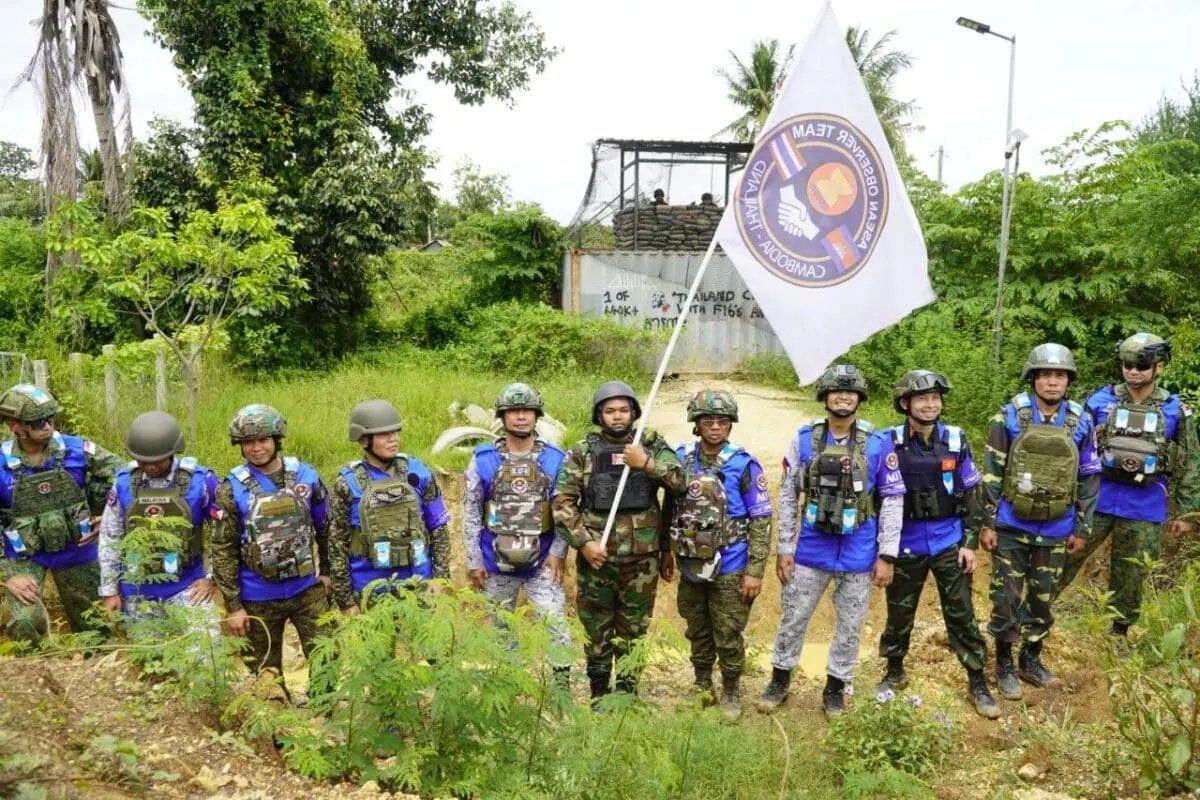
Cambodia is repositioning its approach to the long-running border dispute with Thailand by introducing a powerful new dimension: third-party observers who can verify contested claims on the ground. Information Minister Neth Pheaktra made this strategic pivot clear in his response to Thailand's latest dismissal of Cambodian allegations regarding territorial encroachment, military fortifications and road construction in areas Phnom Penh considers its sovereign territory. Rather than engaging solely in a bilateral exchange of competing narratives, Pheaktra pointed to an expanding international witness list including Asean officials, foreign diplomatic representatives and United Nations observers who have personally inspected the affected zones and documented conditions there.
The immediate trigger for Pheaktra's August 24 remarks was Air Chief Marshal Prapas Sornchaidee, director of Thailand's Joint Information Center, who had rejected Cambodian accusations and reasserted Bangkok's position that its military activities are defensive measures designed to protect troops, civilians and what Thailand considers its own territory. Prapas maintained that Thailand harbours no policy of invading or occupying neighbouring states and argued that fundamental questions of sovereignty cannot be resolved through military presence or control on the ground. Both countries technically agree on this principle—that boundary disputes should be settled through legal mechanisms, historical maps and technical processes rather than faits accomplis. Yet this theoretical alignment masks a profound disagreement about what is actually happening along the frontier.
What marks a notable shift in Cambodia's diplomatic strategy is the emphasis on documentation by entities perceived as neutral. The Asean Observer Team in Cambodia, headed by a Philippine official, has conducted inspections across three locations in Banteay Meanchey province that capture the humanitarian dimensions of the dispute. At Boeung Trakuon in Kouk Romiet commune, monitors documented 44 shipping containers positioned across 14 separate locations, areas where Cambodia asserts that 7,873 residents from 1,869 households remain displaced, including nearly 1,850 children. A second survey at Chouk Chey and Prey Chan villages recorded an additional 72 containers spread across 10 sites. In aggregate, these three areas contain 116 containers at 24 locations, blocking what Cambodia claims are 13,259 people, more than a quarter of them minors, from returning to their homes.
The significance of this documentation strategy lies in its potential to reframe the dispute beyond accusations and counter-accusations exchanged by government officials. When Cambodian authorities alone report such conditions, Bangkok can simply deny or downplay the claims. When independent Asean observers physically inspect the containers, document their locations and numbers, and verify the presence of displaced persons, the nature of the evidence transforms. Pheaktra emphasized this point explicitly: "The eyes of third parties" were now observing these conditions, lending credibility that transcends Cambodia's unilateral assertions. The presence of razor wire barriers, fortified positions and other physical infrastructure supporting Thailand's military presence becomes harder for Bangkok to dismiss as fabrication when documented by multinational teams.
The Cambodian minister also highlighted observations by Tom Andrews, the United Nations Special Rapporteur on human rights in Cambodia, who visited the border region and displaced communities during a July mission. Andrews subsequently reported that approximately 650,000 Cambodians were displaced at the height of the conflict and that over 20,000 remain unable to return to their homes. Critically, Andrews documented testimonies from residents who stated they cannot access their properties because Thai security forces occupy those areas. Such accounts from a UN-mandated human rights monitor carry particular weight in international forums and among regional stakeholders concerned with humanitarian dimensions of the dispute.
Yet it is essential to understand the precise limits of this third-party verification. Neither Asean observers nor the UN rapporteur possess mandates to determine sovereignty or demarcate boundaries. The Asean Observer Team's role is confined to verifying compliance with ceasefire conditions established under the December 27 agreement, while Andrews' mandate addresses human rights situations. Neither body can resolve the underlying legal question of where the international boundary actually lies. Thailand can acknowledge the presence of containers and military infrastructure while maintaining that such measures protect Thai territory and personnel, a position that remains internally consistent even in the face of third-party observations.
Thailand's position rests on a different interpretation of both geography and legality. Prapas stated that Bangkok would continue protecting what it considers its sovereign territory and would not cease security measures simply because Cambodia demands it. This reflects Thailand's view that certain disputed areas are properly under Thai control and that defensive fortifications are therefore entirely legitimate. The fundamental divide is not whether containers and barbed wire exist—both sides now essentially acknowledge the physical presence of such infrastructure—but rather whether they are located on Thai or Cambodian territory. This is a legal and cartographic question that cannot be resolved through photographs of barriers, regardless of who takes them.
Pheaktra's rhetorical flourish captured this impasse: "Shipping containers are not border markers. Barbed wire is not a treaty. Trenches are not boundary maps. Planting a flag is not a title deed to territory." The formulation suggests Cambodia's frustration that Thailand uses security justifications to establish facts on the ground that foreclose future negotiations. Cambodia maintains that the boundary must ultimately be determined through the Franco-Siamese treaties and conventions of the colonial era, historical maps and boundary documents, the 2000 Cambodia-Thailand border Memorandum of Understanding, the 2003 Terms of Reference establishing the Joint Boundary Commission, and the JBC's technical process. None of these mechanisms have produced a final demarcation.
What Cambodia gains from the third-party verification strategy is positioning itself as transparent and willing to submit to international scrutiny while simultaneously characterizing Thailand as obstructive. By inviting Asean monitors, welcoming UN rapporteurs and facilitating diplomatic visits, Phnom Penh creates an appearance of cooperativeness and confidence in its claims. Conversely, any Thai resistance to such inspections can be portrayed as defensive evasiveness. This is valuable in regional forums where consensus and face-saving matter considerably. However, it does not automatically translate into resolution of the underlying boundary question.
Cambodia has also linked the territorial issue to the humanitarian provisions of the December 27 ceasefire agreement, specifically Point 4, which stipulates that affected civilians must be able to return to their homes on their respective sides without obstruction and in safety and dignity. Pheaktra argued that thousands of Cambodians still unable to access their properties behind shipping containers and fortified positions represent a violation of this commitment. From this perspective, the dispute is not merely a technical boundary question deferred to specialists; it is an active humanitarian crisis requiring immediate remedy. Thai security measures and container barriers become not just a sovereignty question but an obstruction to civilians exercising their post-ceasefire rights.
The broader regional context makes this dispute significant beyond the two countries involved. Southeast Asia has experienced repeated cycles of border tension that periodically erupt into conflict, and the Cambodia-Thailand frontier has been particularly volatile. Asean's investment in establishing observation mechanisms and encouraging dialogue reflects concerns that unresolved disputes can destabilize the region. The fact that Cambodia is now successfully invoking third-party verification may establish a precedent that other disputants in the region will either emulate or resist, depending on their respective positions.
For Malaysia and other Southeast Asian observers, the Cambodian strategy of leveraging neutral third-party documentation offers lessons in how smaller or militarily weaker parties can manage territorial disputes with larger neighbours. Rather than matching military capabilities or relying solely on bilateral negotiation where power imbalances favour the stronger party, Cambodia is attempting to internationalise the issue through evidence and observation mechanisms that shift the terrain of contestation toward transparency and documentation. Whether this approach ultimately succeeds in resolving the dispute or merely complicates Thai options remains to be seen, but it represents a sophisticated understanding of how soft power and international scrutiny can constrain options even for a militarily superior adversary.

