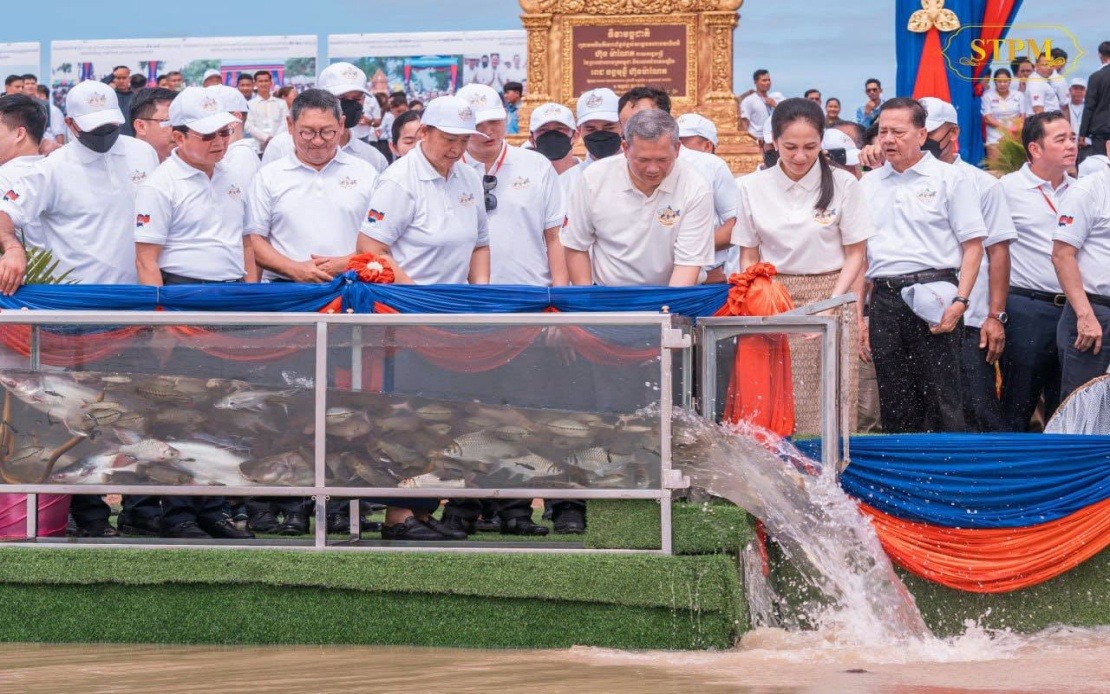
Prime Minister Hun Manet of Cambodia has moved to strengthen enforcement against illegal fishing activities in vital fish spawning grounds, marking an escalation in the government's resource protection efforts. The directive came during the National Fish Day celebration held in Svay Rieng Province, underscoring official concern about the sustainability of the nation's aquatic ecosystems and the survival of fish-dependent communities across the kingdom.
Hun Manet's intervention reflects the acute pressure facing Cambodia's fisheries sector, where illegal and unregulated practices threaten both ecological balance and economic security. The country's fishing industry sustains thousands of households and remains integral to food provision across rural regions. By concentrating enforcement measures on spawning areas—where fish are most vulnerable—authorities are attempting to safeguard breeding cycles that replenish commercial stocks. This targeted approach acknowledges that disrupting reproduction patterns during critical seasons causes cascading damage to entire fish populations.
The Prime Minister specifically mobilised military units stationed around Tonle Sap, Southeast Asia's largest freshwater lake, to intensify patrols and interdiction operations. This deployment reflects a two-year military engagement against natural resource crimes spanning land and maritime boundaries. However, Hun Manet acknowledged a structural limitation: Cambodia's reliance on armed forces to combat fisheries violations stems from a scarcity of trained civil law enforcement personnel specialising in resource protection. The government's aspiration to reduce military deployment in policing roles while expanding civilian capacity suggests recognition that sustainable solutions require dedicated, professionalised enforcement infrastructure rather than military operations.
A particular focus emerged on curtailing large-scale clam dredging operations, which Hun Manet identified as destructive to local fishing livelihoods. Dredging activities disturb seabed ecosystems, resuspend sediments that cloud waters and impede fish feeding, and damage spawning habitats. By ordering an immediate cessation of such commercial extraction, the government signalled its willingness to constrain certain industries in favour of broader fisheries sustainability. This decision carries economic consequences for operators while benefiting artisanal fishers who constitute the majority of the coastal workforce.
Hun Manet positioned fisheries within Cambodia's food security architecture, characterising agriculture as the nation's fundamental sustenance while describing fisheries as its protein backbone. This framing elevates fishing beyond a commercial sector to the status of essential public infrastructure. Given Cambodia's vulnerability to global commodity price volatility and its substantial rural population dependent on subsistence fishing, protecting domestic fish production carries strategic importance. Disruptions to spawning cycles or breeding grounds could compromise household nutrition security, particularly in provinces where aquatic resources represent the primary protein source.
The release of 1.5 million fish and other aquatic species into the Vai Ko River demonstrated commitment to stock enhancement alongside enforcement efforts. Restocking programs serve multiple purposes: they directly increase fish populations, signal political commitment to the fishing public, and provide employment during hatchery and release operations. However, restocking alone cannot substitute for habitat protection and illegal activity suppression. Without simultaneously controlling poaching and destructive fishing methods, restocked populations face immediate harvest pressure, reducing programme efficacy.
Cambodia's struggle against marine resource crimes reflects broader Southeast Asian challenges. Illegal, unreported, and unregulated fishing remains endemic across the region, driven by poverty, weak border controls, and lucrative black markets. Fish populations migrate across borders, meaning that Cambodian efforts must coordinate with Vietnamese, Thai, and Laotian authorities to achieve meaningful conservation. Cross-border trafficking of prohibited species and the infiltration of foreign vessels into Cambodian waters complicate unilateral enforcement, suggesting the need for regional cooperation frameworks.
The staffing deficit Hun Manet identified—insufficient specialists in natural resource law enforcement—afflicts most developing economies in Southeast Asia. Building this capacity requires investment in education, training institutes, surveillance technology, and inter-agency coordination. Malaysia's experience establishing dedicated environmental enforcement units offers potential lessons for Cambodia's institution-building efforts. Regional knowledge-sharing initiatives could accelerate capacity development across countries facing similar constraints.
The timing and venue of Hun Manet's announcement—a national celebration dedicated to fisheries—amplified its political significance. National Fish Day provides a platform to engage fishing communities, celebrate their social importance, and signal governmental responsiveness to sector concerns. By using this occasion to announce protective measures, the Prime Minister positioned his administration as defender of fishing livelihoods against predatory commercial interests and foreign violations. For Malaysian observers, Cambodia's fisheries governance challenges offer comparative perspective on how developing nations balance resource conservation, livelihood protection, and enforcement capacity limitations.

