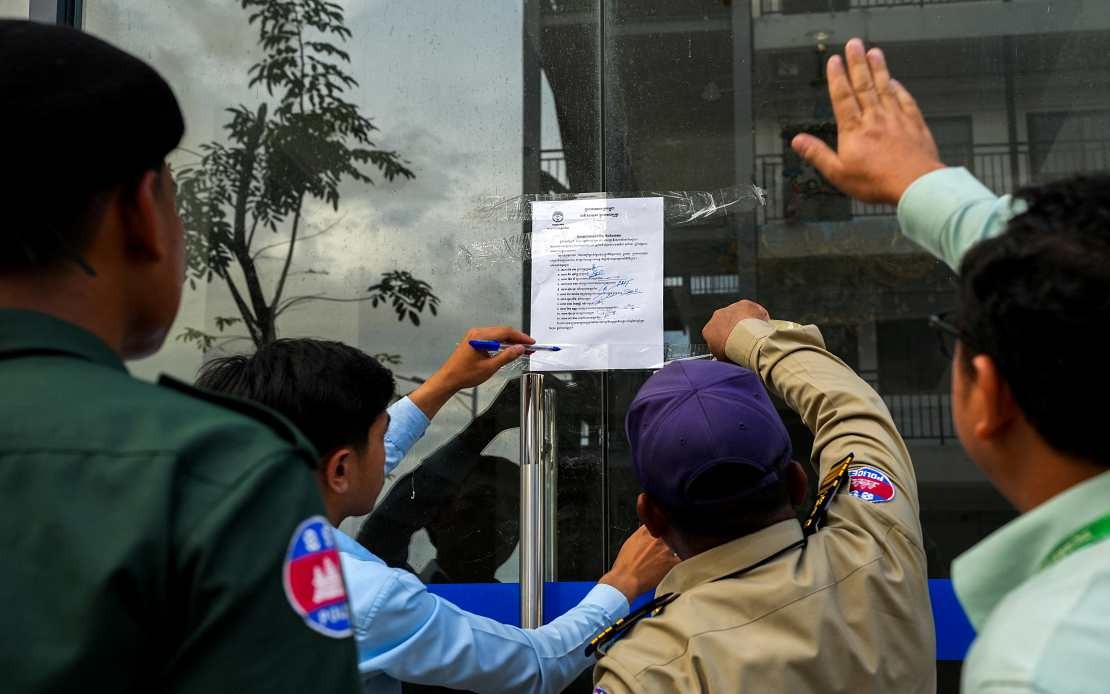
Cambodia has intensified its battle against transnational cybercrime by deporting over 16,000 foreign suspects accused of orchestrating online scams during the first six months of 2026. Police Lieutenant General Sok Veasna, who heads the General Department of Immigration, disclosed the figures at a mid-year review meeting on Tuesday, revealing that the overall expulsion total reached more than 45,000 foreigners, with the online fraud contingent representing a significant portion of enforcement operations since January.
The scale of Cambodia's deportation campaign underscores the severity of the cybercrime crisis that has gripped the Southeast Asian nation. The kingdom's digital crime networks, which have operated with alarming sophistication, have attracted foreign nationals seeking refuge within its borders to conduct large-scale international fraud schemes. By implementing permanent re-entry bans on all deported individuals, Cambodian authorities are signalling their determination to prevent repeat offenders from returning and re-establishing criminal operations.
The timing of these enforcement actions reflects a broader policy shift within the Cambodian government. In April 2026, the kingdom enacted the Law on Combating Online Scams, representing a legislative watershed moment in the nation's fight against digital crime. This new statute introduces substantially harsher penalties for online bosses and ringleaders, moving beyond punishment of foot soldiers to target the command structure of criminal enterprises. The law's provisions signal that Cambodian policymakers recognize the need for graduated enforcement that distinguishes between victims of human trafficking coerced into scam operations and those directing organised criminal activity.
However, analysts caution that mass deportations, while symbolically important and operationally significant, represent only the opening phase of Cambodia's anti-cybercrime strategy. Thong Mengdavid, deputy director at the China-ASEAN Studies Centre of the Cambodia University of Technology and Science, argues that removing foreign suspects from Cambodian territory, though necessary for public safety and reputation management, addresses symptoms rather than underlying systemic vulnerabilities. Cambodia's reputation as a cybercrime hub has suffered considerable international damage, and the deportation campaign serves to demonstrate government commitment to rehabilitation.
Yet Thong's analysis identifies critical structural weaknesses that mass deportations alone cannot resolve. The persistence of cyber-scam networks within Cambodia depends fundamentally on two interconnected elements: high-level kingpins who design and coordinate schemes, and domestic protection networks comprising corruption within law enforcement, judiciary, and administrative channels that shelter criminal operations from prosecution. Without dismantling these local enablement structures, the removal of foreign operatives may merely create vacancies that other international criminals can readily fill.
The human trafficking dimension adds another layer of complexity to Cambodia's enforcement challenge. Many foreign nationals deported as suspected scammers were themselves victims of trafficking schemes designed to exploit economic desperation and visa vulnerabilities. These individuals were often coerced into conducting fraud operations through debt bondage, document confiscation, and threats against family members. Effective anti-cybercrime policy must therefore distinguish between trafficked individuals requiring rehabilitation and genuine criminal organisers meriting harsh punishment.
For Southeast Asian readers, Cambodia's struggle with cybercrime carries wider regional implications. Cross-border criminal networks exploit institutional weaknesses across multiple countries, using loose coordination to evade national law enforcement. Malaysian authorities, already engaged in combating domestic cybercrime networks with international dimensions, can observe Cambodia's legislative and enforcement approaches as both models and cautionary examples. The effectiveness of Cambodia's new legal framework and deportation campaign will provide valuable data on whether hardline tactics can genuinely disrupt transnational fraud operations.
The emergence of Cambodia as a cybercrime nexus during the 2020s reflects broader patterns of criminal adaptation to digital technology and globalisation. Scam networks exploit timezone advantages, language capabilities, and banking infrastructure to target victims across continents. Foreign nationals congregating in Cambodia have accessed cheaper operational costs, lenient visa regimes, and corrupted officials willing to provide protection—factors that explain the kingdom's attractiveness to international crime syndicates.
Moving forward, Cambodia's anti-cybercrime strategy must integrate three complementary elements: sustained enforcement against foreign operatives; institutional reform within law enforcement to eliminate corruption and protect networks; and addressing upstream causes including poverty, trafficking, and limited economic opportunity that render individuals vulnerable to recruitment. Without this comprehensive approach, deportations risk becoming performative gestures that satisfy international pressure without generating lasting security improvements.
The deportation campaign's success will ultimately depend on whether Cambodian policymakers can summon political will to investigate and prosecute domestic facilitators of cybercrime. This proves significantly more difficult than expelling foreign nationals, requiring confrontation with entrenched interests and potential exposure of corruption within state institutions. International partners, particularly ASEAN neighbours and development partners engaged in institutional strengthening, can support Cambodia's efforts through capacity building, information sharing, and technical assistance in investigating sophisticated digital crimes.

