Cambodia is making a calculated pivot toward advanced manufacturing and technology-driven industries, seeking to harness South Korean investment expertise to reshape an economy historically anchored to labour-intensive garment production. Deputy Prime Minister Sun Chanthol's recent investment promotion mission to South Korea, culminating in a major roadshow in Incheon on June 16, represents a coordinated government effort to position the Kingdom as an attractive destination for Korean companies in automotive components, electric vehicle systems, healthcare technology and other value-added sectors.
The roadshow brought together a high-level Cambodian delegation including the first vice-chairman of the Council for the Development of Cambodia, alongside officials from the Ministry of Commerce and representatives from business associations. The diplomatic choreography underscored the government's seriousness: this was not merely a commercial outreach but a coordinated state initiative to signal Cambodia's commitment to facilitating Korean investors through new legal frameworks and economic incentives. Chanthol's declaration that the Royal Government stands "firmly committed and fully prepared to welcome and provide all kinds of facilitation" set the tone for what officials described as a strategic "door-knock mission" targeting specific Korean firms already operating in or exploring Cambodian opportunities.
The delegation's focus on existing Korean manufacturers reveals Cambodia's pragmatic strategy: rather than courting untested ventures, it targets firms with proven track records in targeted sectors. Daejoo KC Group, a major South Korean conglomerate with operations spanning metallurgy, chemicals, logistics, construction, automotive components and energy, exemplifies this approach. The company already operates in Cambodia through two subsidiaries—Camko Motor, which assembles Hyundai vehicles and manufactures automotive wire harnesses for export while generating nearly 500 jobs, and Camko Infracore, which handles vehicle importation and after-sales services. By encouraging Daejoo KC to expand within existing operational domains, Cambodia aims to deepen integration without requiring entirely new market entry investments.
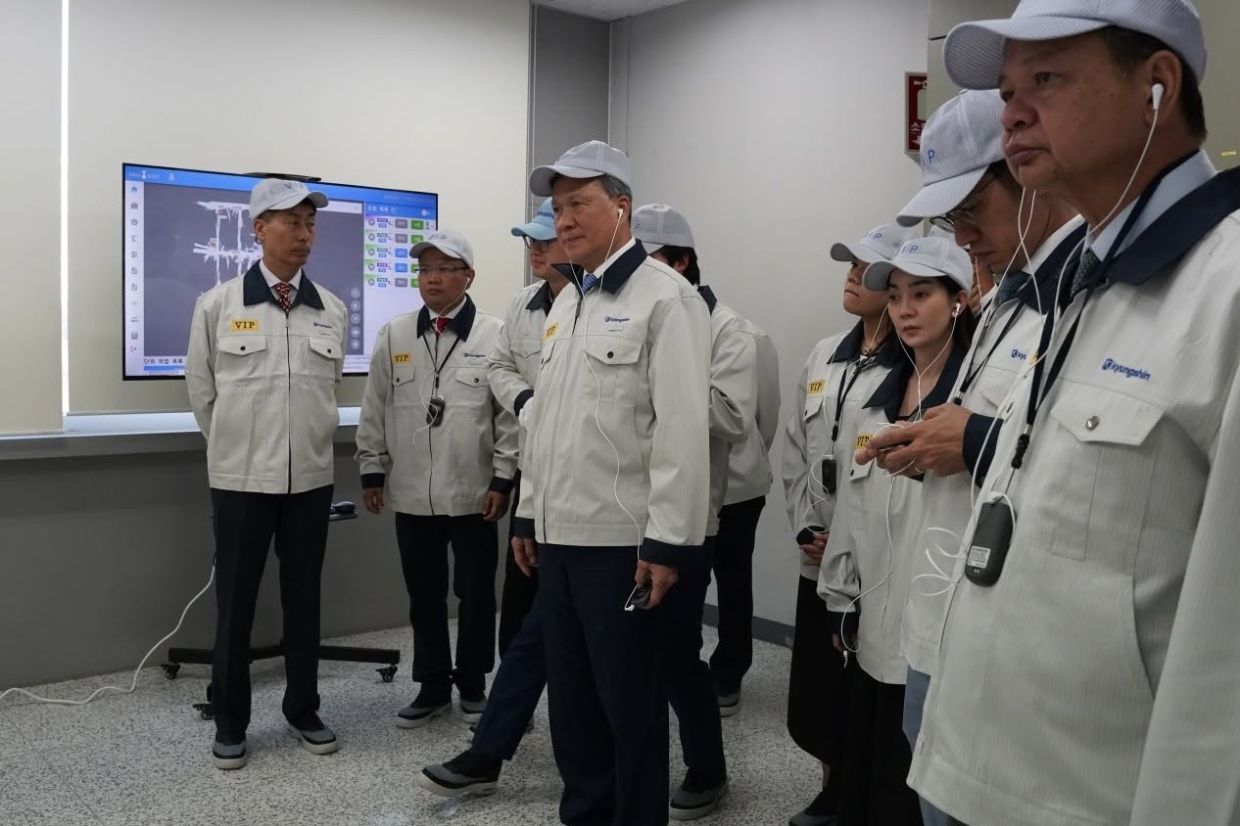
The automotive electronics sector represents a critical focal point in Cambodia's transformation ambitions. Kyungshin Co., Ltd., a company specialising in automotive electronic components and wire harness manufacturing since its 1974 founding, has operated in Cambodia since 2012 through a facility in Kandal province. With approximately US$20 million in capital investment and 1,467 employees, Kyungshin's factory provides Cambodia with a tangible foundation for claiming manufacturing competence in complex automotive technologies. Chanthol's inspection of the facility and subsequent discussions about expansion underscore recognition that such companies serve as anchors for supply-chain clustering and technology diffusion across the broader industrial base.
The global automotive industry's accelerating shift toward electric vehicles and digital systems creates a particular window of opportunity for Cambodia. Rather than remaining locked into conventional light manufacturing, the Kingdom can position itself within emerging EV supply chains by attracting companies developing wiring harnesses, connectors, junction blocks and electrical systems designed for next-generation vehicles. This aligns Cambodia's comparative advantages—cost-effective labour and regional proximity—with growing international demand for EV component manufacturing. Korean firms, already investing heavily in EV technology at home, represent logical partners for establishing regional production bases that can service expanding Asian automotive markets.
Beyond manufacturing, Cambodia's deliberate inclusion of healthcare technology in its investment pitch signals ambitions to develop service-sector sophistication. The delegation's visit to Incheon Baek Hospital, a leading South Korean medical institution, was no mere courtesy call. Chanthol framed healthcare infrastructure and international-standard hospitals as "key priorities" of the Cambodian government, explicitly requesting technical assistance, knowledge transfer and training exchanges between medical specialists. This approach acknowledges that developing economies increasingly compete not only on production costs but on integrated ecosystems encompassing logistics, professional services, technology platforms and human capital development.
Cambodia's new investment law provides the institutional framework undergirding these recruitment efforts. The "Law on Investment of the Kingdom of Cambodia" offers investors incentive packages, fiscal benefits, macroeconomic stability commitments and investment protection mechanisms designed to address traditional concerns about regulatory reliability and property rights enforcement. By embedding promotional missions within clear legal reforms, Cambodia signals that investment facilitation rests on sustainable institutional foundations rather than ad hoc political patronage. This messaging matters particularly for Korean firms accustomed to transparent rule-of-law environments and standardised regulatory processes.
The composition of Cambodia's delegation—including the ambassador to South Korea, CDC officials, Commerce Ministry representatives, and business association leaders—reflects coordinated state-private alignment. When diplomacy, regulatory agencies and business organisations operate in concert around shared objectives, foreign investors perceive reduced transaction costs and clearer pathways to operational deployment. This orchestration distinguishes serious industrial policy from scattered promotional efforts. The involvement of the Korean Chamber of Commerce in Cambodia and the Cambodian Oknha Association further embeds investment promotion within existing bilateral business networks that facilitate deal closure and operational problem-solving.
For regional economies watching Cambodia's trajectory, this investment push carries instructive lessons about industrial evolution. Labour-intensive garment manufacturing, responsible for decades of Cambodian export growth and employment, remains crucial for millions of workers and remains a significant foreign exchange source. However, sector maturation, rising labour costs across Asia, and global supply-chain fragmentation create pressure to develop complementary high-value activities. Cambodia cannot simultaneously abandon garments overnight and retain full employment; instead, it must nurture emerging sectors capable of eventually absorbing displaced workers through training and wage-progression pathways.
The specific targeting of South Korea—a nation that successfully transitioned from labour-intensive manufacturing through investment in automotive components, electronics and healthcare technology—provides a model for emulation. Korean companies possess the technological sophistication, supply-chain discipline and regional network density to anchor industrial upgrading. Moreover, Korean manufacturing culture emphasises quality, process improvement and continuous technological adaptation, attributes that could diffuse throughout Cambodia's industrial ecosystem if investment clustering achieves critical mass.
Yet challenges persist in translating promotional success into sustained manufacturing transformation. Cambodia must ensure that Korean firms are not merely seeking labour-cost arbitrage that could relocate if costs rise elsewhere. Infrastructure quality, electricity reliability, worker productivity, and supply-chain ecosystem maturity remain potential constraints. Additionally, competition from Vietnam and Thailand, which possess more developed industrial ecosystems and deeper historical manufacturing bases, means Cambodia must offer compelling advantages beyond wage differentials. Success requires sustained investment in human capital development, vocational training aligned with automotive and electronics standards, and logistics infrastructure connecting Cambodian factories to regional and global markets.
The diplomatic investment mission to South Korea represents Cambodia's acknowledgment that industrial diversification requires both pulling and pushing—pulling Korean capital and expertise toward Cambodia while simultaneously pushing the economy away from its reliance on single-sector manufacturing. If investment in automotive components, EV systems and healthcare technology achieves even modest clustering effects over the coming decade, Cambodia's employment structure and export composition could begin reflecting the higher-skill, higher-wage characteristics of upper-middle-income manufacturing economies. The government's willingness to embed investment promotion within reformed legal frameworks and coordinated diplomatic engagement suggests that policymakers view industrial transformation as a multi-year, institutional undertaking rather than a short-term commercial matter.