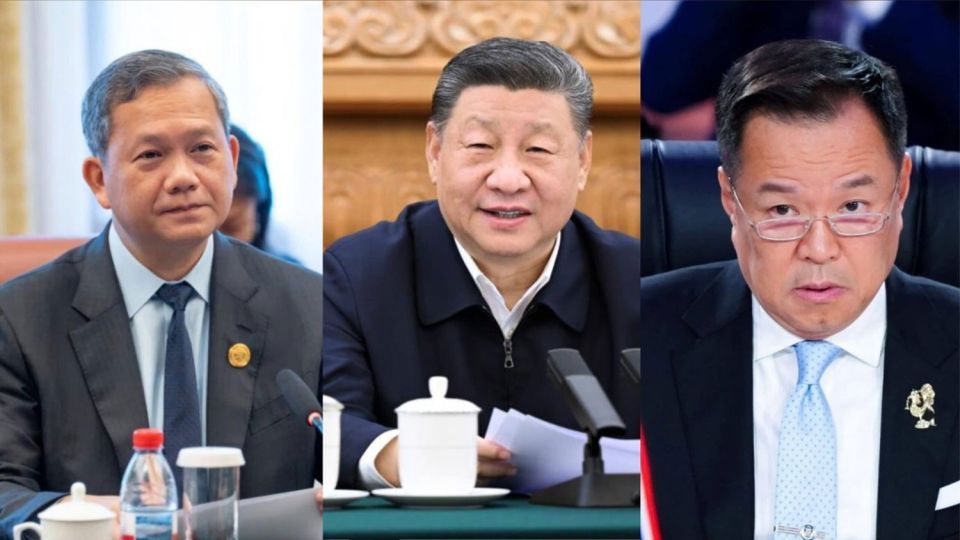
Cambodia and Thailand's prime ministers are travelling to Shanghai this month for a high-profile technology conference, presenting Beijing with an opportunity to intervene in one of Southeast Asia's most intractable territorial disputes. Hun Manet and Anutin Chanvirakul are scheduled to participate in the opening session of the World AI Conference 2026 on July 17 at an invitation from Chinese President Xi Jinping, marking a rare occasion when the two leaders will gather in the same place following months of diplomatic gridlock.
The Cambodian delegation, departing July 15-17, will be substantially sized. Hun Manet will bring Foreign Minister Prak Sokhonn, Defence Minister Tea Seiha, and Sun Chanthol, first vice-chairman of the Council for the Development of Cambodia, signalling the strategic importance both governments attach to the visit. Anutin's entourage is expected to include Thai Foreign Minister Sihasak Phuangketkeow. The prominence of these delegations reflects how seriously both nations view their relationships with China, even as their own bilateral relationship remains fractious.
Both prime ministers are scheduled for separate meetings with Xi and Chinese Premier Li Qiang, underscoring Beijing's role as a principal power broker in the region. For Cambodia, the visit represents continuity in its traditional alignment with China. A foreign ministry statement emphasised the trip as demonstrating "shared commitment" to deepen bilateral friendship and advance Cambodia's Comprehensive Strategic Partnership of Cooperation with Beijing, alongside the Diamond Cooperation Framework aimed at building an "all-weather" partnership. Thailand's foreign ministry released similarly diplomatic language about strengthening the Thailand-China Comprehensive Strategic Cooperative Partnership, though with less rhetorical emphasis on long-standing bonds.
The Shanghai gathering carries particular weight given that Hun Manet and Anutin have not met seriously at the negotiating table since December. Their last significant interaction occurred at the 3rd ASEAN Future Forum in Hanoi in early June, where both leaders appeared before cameras shaking hands in a carefully choreographed moment that suggested diplomatic civility masking underlying tensions. That encounter produced no substantive discussion of the border dispute that continues to destabilise their relationship and displace civilians.
Regional analysts anticipate that China will leverage its substantial economic influence over both nations to catalyse movement on the border question. As the dominant trading partner for both Cambodia and Thailand, Beijing possesses significant leverage to encourage negotiations. China brokered the Fuxian Consensus in December 2025, which outlined principles for peaceful resolution, yet implementation has stalled, particularly on the Thai side. The Shanghai conference may provide the diplomatic space and informal setting where Beijing can press both governments to recommit to dialogue and compliance with previously agreed frameworks.
However, substantial obstacles remain, rooted in Thailand's internal political complexities. According to Kin Phea, director of the Royal Academy of Cambodia's International Relations Institute, the core impediment to resolution lies with those who "actually hold power" in Bangkok. Thailand's military establishment has not implemented measures that the civilian government committed to in bilateral talks with Cambodia. "The Thai military has not implemented the measures that their civilian government agreed with their Cambodian counterparts. They allow the military to arbitrarily carry out their actions, including encroaching on Cambodian sovereign territory," Phea observed, highlighting a fundamental disconnect between Thailand's nominal commitments and ground-level actions.
This civil-military divide in Thailand undermines Cambodia's ability to negotiate effectively. Even when Thai civilian leaders agree to withdraw from disputed areas or resume Joint Boundary Commission discussions, military commanders appear empowered to ignore these undertakings. The mechanism for enforcing compliance remains murky, and Thai institutional fragmentation complicates Cambodia's diplomatic options. Phea advocates for China to adopt a more assertive mediating posture, moving beyond general encouragement toward concrete pressure on both parties.
The human cost of this standoff remains visible on the ground. Approximately 20,000 Cambodian civilians remain displaced from their homes in disputed territories currently under Thai control. These communities exist in a legal and territorial limbo, unable to access their properties or fully exercise their rights as Cambodian citizens. The humanitarian dimension of the dispute—often overshadowed by geopolitical framing—underscores the urgency of resolution. Protracted displacement creates festering grievances that complicate long-term reconciliation, even if a political settlement eventually emerges.
Phea's recommended approach emphasises China's comparative advantage as a respected partner to both nations. Rather than facilitating quiet back-channel discussions alone, China should explicitly "push for both countries to meet for talks and solve the issue peacefully, through diplomatic paths or other consultation effort, based on international law," he argued. China should evolve from passive facilitator to active arbiter with clear expectations for Thai compliance. Specifically, Thailand must be compelled to respect the Fuxian Consensus by withdrawing military forces from occupied Cambodian territory and returning to substantive negotiations through the Joint Boundary Commission without further delay.
For Myanmar and Laos, observers across Southeast Asia are watching whether Beijing's economic weight can overcome Thailand's internal military resistance to civilian-brokered agreements. If China successfully pressures Thailand toward meaningful border resolution with Cambodia, the precedent could reshape how regional disputes are managed. Conversely, if the Shanghai conference produces only ceremonial gestures without substance, it may signal that Thailand's military institutions operate beyond effective external leverage, with sobering implications for regional stability and smaller nations' confidence in multilateral dispute resolution mechanisms.
The July meeting thus represents more than a technology conference. It is a test of whether Beijing's regional influence can translate from economic dominance and friendship declarations into concrete pressure for settling territorial disputes that destabilise its peripheral neighbours. For Cambodia, the presence of senior military figures in Hun Manet's delegation suggests preparations for discussions beyond trade and technology. For Thailand, the composition of Anutin's team may reveal whether Bangkok is genuinely prepared to move toward settlement or merely going through diplomatic motions. The coming days in Shanghai will likely prove revealing.

