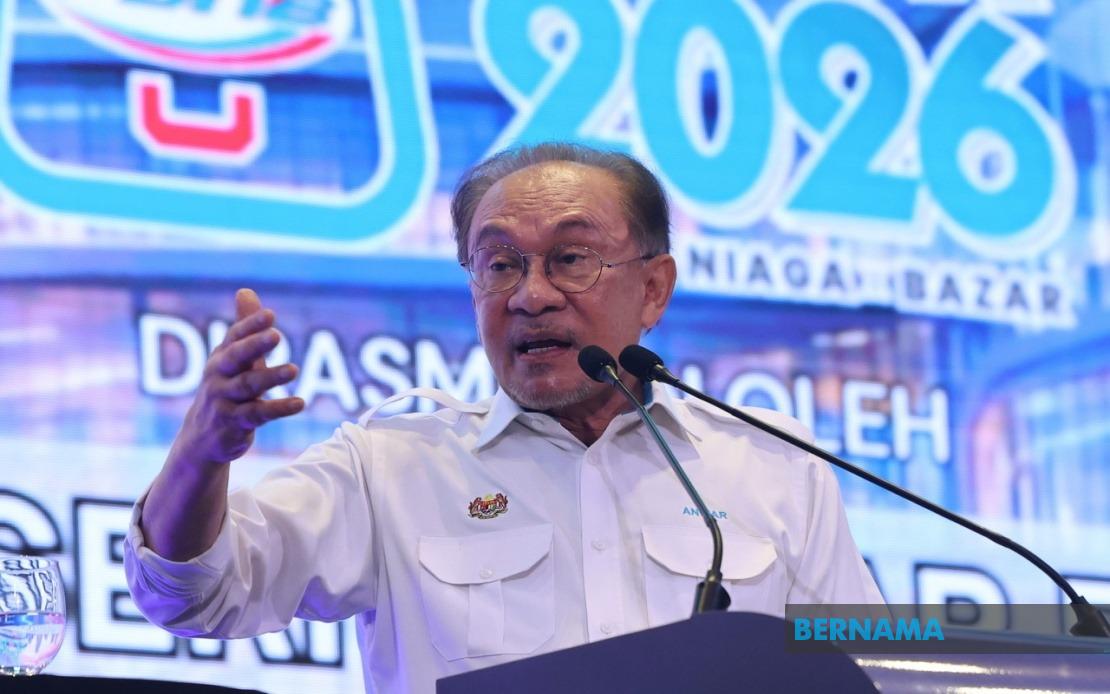
Prime Minister Datuk Seri Anwar Ibrahim has fundamentally reframed how Malaysia approaches Bumiputera economic empowerment, declaring it a shared responsibility spanning the entire government apparatus rather than a specialised function confined to particular agencies. Speaking at the SPaRK 2026 business transformation programme in Putrajaya, Anwar outlined a coordinated strategy that demands every ministry, government agency and government-linked company actively contribute to advancing Bumiputera development objectives. This shift represents a significant departure from historical practice, where Bumiputera initiatives often remained concentrated within dedicated institutions, potentially limiting their broader systemic impact.
The centrepiece of this reorganised approach is the Bumiputera Economic Transformation Plan 2035, or PuTERA35, which serves as the government's comprehensive roadmap for inclusive economic development. Rather than simply announcing targets, the government has established rigorous monitoring mechanisms to track implementation progress. All participating ministries and agencies now face formal requirements to report their contributions and results, creating accountability structures that previously did not exist with such clarity. This framework acknowledges that economic empowerment cannot succeed through isolated initiatives; it demands integration across taxation, education, infrastructure development, procurement policies, and regulatory frameworks that together shape entrepreneurial opportunity.
Crucially, Anwar rejected proposals to establish yet another specialised Bumiputera agency, arguing that institutional proliferation would create duplication and bureaucratic inefficiency. Instead, the government intends to strengthen existing organisations already operating within the Bumiputera space, streamlining implementation pathways and reducing the administrative friction that has historically slowed programme rollout. This pragmatic stance reflects lessons from decades of Malaysian governance, where multiple agencies addressing similar objectives often produced overlapping efforts and diffused accountability. By consolidating function rather than multiplying institutions, the administration seeks to accelerate policy translation into tangible economic outcomes.
The Prime Minister, who simultaneously holds the Finance Ministry portfolio, articulated a deliberate economic philosophy: growth must proceed alongside equitable distribution. This formulation addresses a longstanding tension in Malaysian economic policy, where rapid development has occasionally concentrated wealth rather than dispersing opportunity. Anwar's language emphasises that the government actively facilitates entrepreneurship across frontier sectors including artificial intelligence, quantum computing, digital technologies and energy transition, declining to restrict innovation or penalise commercial success. Simultaneously, however, policymakers maintain explicit commitment to ensuring that prosperity flows across social strata rather than concentrating among existing wealth holders.
This balancing act translates into practical policy language through the twin concepts of "raising the ceiling" and "raising the floor." Elevating the ceiling denotes creating conditions where Malaysia's economy becomes increasingly competitive at global levels, attracting investment and talent while encouraging indigenous innovation. Simultaneously, raising the floor means strengthening safety nets and opportunity pathways for citizens still struggling with economic insecurity, ensuring that aggregate growth translates into improved living standards across communities. For Malaysian readers, this framework directly addresses concerns that development benefits have not always reached disadvantaged populations, particularly in smaller towns and rural regions where Bumiputera entrepreneurs often cluster.
The emphasis on comprehensive ministerial alignment carries particular significance for Southeast Asia's largest Bumiputera population. The Malaysian Bumiputera community, comprising indigenous Malays and other indigenous groups, represents the demographic core of political stability and social cohesion. Previous approaches sometimes treated Bumiputera economic participation as a sectoral concern rather than a fundamental constitutional commitment. Anwar's reframing elevates the issue to state priority level, implicitly acknowledging that inclusive growth represents not merely redistribution but essential nation-building. This positioning has ramifications beyond economics; it signals that Malaysia's diverse political leadership recognises economic empowerment as foundational to democratic legitimacy and social harmony.
The rejection of incremental institutional solutions in favour of comprehensive bureaucratic realignment reflects broader MADANI government philosophy, which emphasises performance-based governance and eliminating redundant structures. Rather than creating a new agency with its own budget, staffing and political constituency, the government channels resources into strengthening existing bodies while demanding that mainstream ministries incorporate Bumiputera objectives into their core operations. This approach requires cultural shifts within institutions historically organised along sectoral rather than distributional lines. Finance ministry officials, infrastructure planners, and education administrators must fundamentally reconceptualise how their policy choices advance or hinder Bumiputera participation.
For regional observers, Malaysia's reorientation toward systematic inclusive growth carries broader implications. Throughout Southeast Asia, governments wrestle with balancing rapid development against equitable opportunity distribution. The MADANI approach, positioning whole-of-government coordination as the vehicle for Bumiputera empowerment, offers an alternative model to both fortress preservation of privileges and laissez-faire approaches relying on market mechanisms alone. Malaysia's experience implementing PuTERA35 will generate lessons regarding whether coordinated multi-agency strategies can effectively address structural disparities in entrepreneurial participation and wealth accumulation.
Monitoring and reporting requirements embedded within PuTERA35 create transparency mechanisms absent from earlier initiatives. By requiring all ministries to publicly account for their contributions to Bumiputera development, the government establishes performance metrics against which officials can be evaluated. This accountability architecture potentially transforms Bumiputera empowerment from a rhetorical commitment into a measurable governance objective. Officials in procurement, licensing, skills training, and credit access must now demonstrate how their decisions support indigenous entrepreneurship, or explain why constraints prevent such support. These reporting obligations make success or failure visible rather than allowing initiatives to proceed without systematic evaluation.
The timing of Anwar's statements carries weight within Malaysia's current political context. The government has simultaneously pursued economic liberalisation measures while maintaining constitutional commitments to Bumiputera privileges. Articulating Bumiputera advancement as a civilisational priority distinct from protectionism helps navigate these competing imperatives. By framing inclusive growth as complementary to competition and innovation rather than antithetical, the government positions Bumiputera empowerment alongside rather than opposed to modernisation. This rhetorical move matters because it potentially defuses tensions between constituencies advocating rapid transformation and those prioritising community preservation.
The comprehensive nature of the PuTERA35 framework suggests recognition that Bumiputera economic participation involves systemic barriers rather than isolated constraints. Access to capital, business networks, regulatory knowledge, technology adoption and market access all influence entrepreneurial success. A coordinated governmental approach theoretically addresses multiple barriers simultaneously, whereas sectoral programmes might remediate one constraint while others persist. Implementation success ultimately depends on whether ministries and agencies translate high-level government commitment into operational changes affecting daily decisions regarding resource allocation and opportunity distribution. Malaysia's experience will demonstrate whether whole-of-government coordination can effectively advance inclusive growth objectives in practice.

