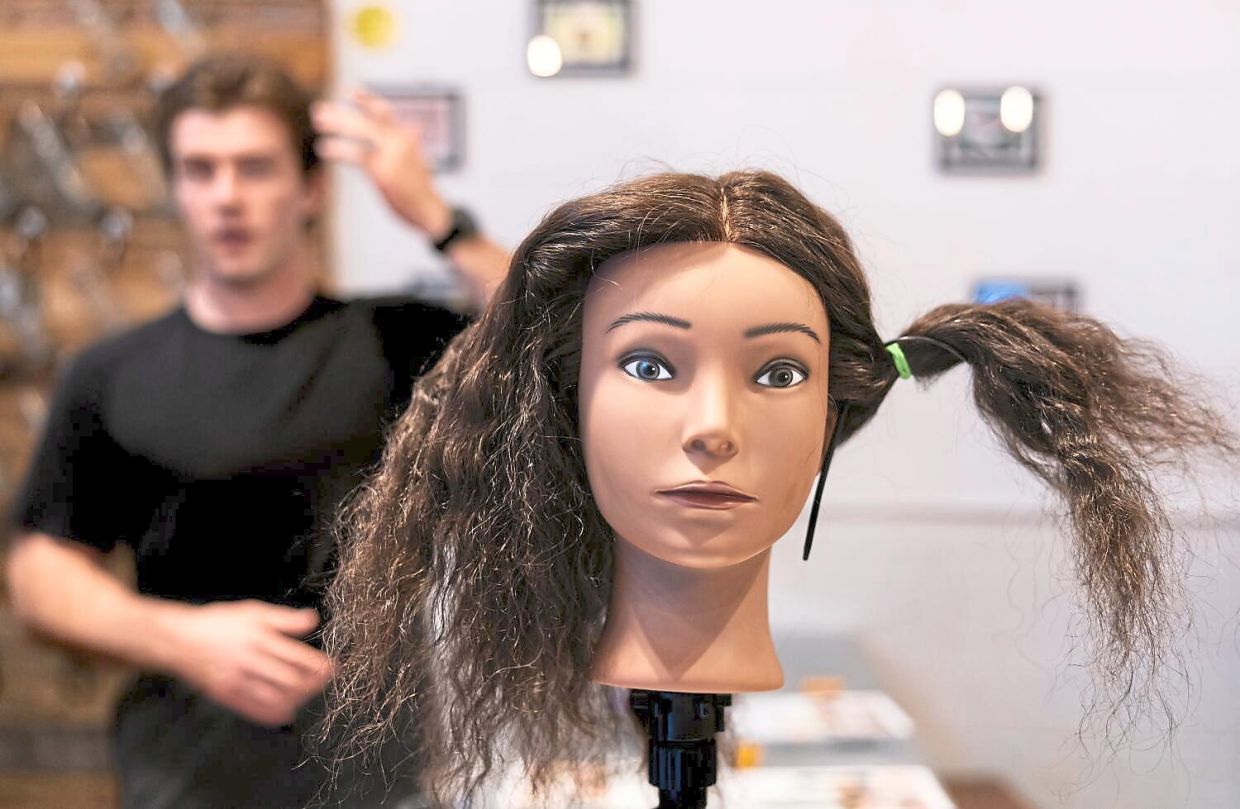
The silence that fell over Captain Fatty's Brewery in Santa Barbara County on a late May evening seemed unusual for a Friday night venue. Yet the 15 men assembled there had gathered for a purpose far removed from typical bar culture—they came to learn how to braid their children's hair. Austin Nieves, who relocated to the California coastal region in April 2025, had organised what would become a sold-out event inspired by the viral British "Pints and Ponytails" concept, pairing expert hairstyling instruction with a decidedly male-friendly atmosphere.
The transformation in the room was striking. Initially apprehensive and sitting nervously at the bar's edges, the men—ranging from age 30 to 60—gradually loosened up after their first drinks and eagerly threw themselves into the practical work ahead. Using salon-quality training mannequins, they practised fundamental techniques in an environment specifically designed for them. What began as an awkward silence evolved into genuine engagement and problem-solving, with participants supporting one another through initial fumbling attempts. This single evening encapsulated something larger that Nieves recognised was missing from the contemporary fatherhood experience: organised community and practical skill-building tailored specifically to men.
Nieves's journey to founding the Santa Barbara Dads group stemmed from stark contrast he observed in his own transition to parenthood. When his wife gave birth to their son, she immediately accessed multiple mothers' groups, parenting classes, and professional networks offering advice, friendship, and structured support. As a first-time father, Nieves found himself relying almost exclusively on his own brothers for guidance—a significant gap that highlighted how unequally parental support networks are distributed. This disparity reflects a broader sociological pattern that researchers have documented for decades. The fundamental challenge facing modern fathers is that as their involvement in childcare has deepened, their social infrastructure has not kept pace with these changing responsibilities.
Academic research underscores the psychological toll this imbalance creates. In their 2006 examination published in the Journal Of Family Issues, researchers Chris Knoester and David J. Eggebeen documented that active fatherhood often triggers "declines in feelings of well-being and participation in social activities" as men substantially reduce time spent with friends. Clinical psychologists Hillary Halpern and Maureen Perry-Jenkins have similarly shown that the transition from single adulthood to active fatherhood frequently involves an emotional rollercoaster, with men experiencing confusion, doubt, and unexpected psychological strain. The Karolinska Institute in Stockholm advanced this understanding through their 2021 research demonstrating that fathers specifically require targeted support during their transition to active parenting. Their findings indicated that fathers' groups represent one of the most effective interventions, with most participants reporting high satisfaction and measurable improvements in relationship quality, personal confidence, and family dynamics.
Nieves's personal experience mirrored this research perfectly. Following Hudson's birth three years earlier, his leisure activities and social focus shifted dramatically—his conversations shifted from entertainment topics to developmental milestones like his infant's ability to lift his head. His friendship group no longer felt aligned with his new reality. This recognition prompted him to take action. In October 2023, while living in Costa Mesa with his wife Katie, Nieves established the Orange County Dads club, organising gatherings at coffee shops and zoological facilities, coordinating holiday music sessions, and arranging CPR training classes. Although explicitly marketed as a fathers' club, the group's expansion was substantially aided by wives and partners sharing Nieves's social media content with their husbands, creating an organic network effect.
Mikhail Alfon, who heads Blue Light Media, a social media strategy consulting firm, brought his son Santos to numerous Orange County gatherings. His perspective articulated precisely why such groups matter: "This is our first child and obviously life changes a lot. Finding peers and friends that are in the same stage of life is great." This sentiment—the need to locate others navigating identical challenges simultaneously—represents perhaps the core value proposition of fathers' organisations. Such groups provide validation that the confusion, exhaustion, and identity recalibration new fathers experience is normal rather than exceptional.
When Nieves relocated to Santa Barbara with his family in April 2025, he quickly faced the prospect of losing the community structure he had built. Rather than accept this, he replicated the model within a month, establishing a Santa Barbara-based iteration of the group with their inaugural meetup occurring in May 2025. The group committed to monthly gatherings, demonstrating that the need for such organisations transcended geography. Austin Jones, a Santa Barbara real estate professional and investor, discovered Nieves through Instagram and immediately recognised the value. Jones articulated the multifaceted pressure contemporary fathers experience: "I'm a husband, a dad and businessman, and it ends up being a lot of hats but very little support, at times. It's nice to find people in the trenches with you."
The appeal of the Pints and Ponytails event resonated particularly with Jones, whose two-and-a-half-year-old daughter Noa presented genuine hair-care challenges through her textured, curly locks. The event provided not merely theoretical instruction but hands-on, confidence-building experience with practical stakes—Jones could see immediate application to his parenting reality. Through focused practice with the training mannequin, he progressed from being "only pretty good at putting on a headband" to achieving actual braiding competency and committing to attempting the technique with his daughter imminently.
For Southeast Asian readers, the emergence of fathers' groups in Western contexts carries particular relevance given evolving gender dynamics in regional societies. While traditional parenting roles remain more entrenched across much of Asia, demographic trends—including lower birth rates, increased maternal workforce participation, and gradual shifts in gender expectations—mirror patterns observed in Western countries two decades earlier. Malaysia, Singapore, and other developed Southeast Asian economies are experiencing similar transitions where fathers increasingly seek greater involvement in childcare, yet lack corresponding social infrastructure. The American fathers' group model offers a potentially scalable solution that could address emerging gaps in male parental support networks across the region.
The implications extend beyond simple social connection. Research indicates that when fathers receive adequate support and develop confidence in parenting skills, family outcomes improve measurably. Children benefit from fathers' increased involvement and confidence, relationships between partners strengthen through shared understanding and reduced isolation-driven stress, and men report enhanced life satisfaction. Furthermore, normalising male participation in parenting-focused communities gradually shifts broader cultural perceptions about masculinity and family responsibility. As more fathers seek and find community among peers navigating similar transitions, the stigma surrounding male emotional vulnerability and parenting anxiety diminishes.
Nieves's grassroots approach also demonstrates how social infrastructure gaps can be addressed through individual initiative and social media amplification. Without requiring institutional funding or formal governmental recognition, he identified a need, created a solution, and replicated it across geographical boundaries. The virality of Pints and Ponytails events suggests appetite for similar initiatives worldwide. The model is sufficiently flexible to accommodate various cultural contexts—hairstyling instruction could easily become cooking lessons, financial planning workshops, or mental health discussions depending on local needs and interests.
Looking forward, the fathers' group movement appears positioned for continued expansion. As generational attitudes toward parenting shift, with millennial and Gen Z fathers expressing greater desire for active involvement and emotional connection with their children, demand for supportive communities will likely intensify. The success of Nieves's Santa Barbara iteration, mirroring his Orange County experience, suggests the model's replicability and sustainability. For fathers across diverse contexts—whether in American suburbs, Malaysian urban centres, or Singapore's diverse neighbourhoods—the fundamental insight remains constant: active parenting need not mean social isolation, and that community built around shared experience provides measurable benefits for individual well-being, family stability, and children's development. The quiet brewery that gradually filled with laughter and mutual support exemplified this potential.

