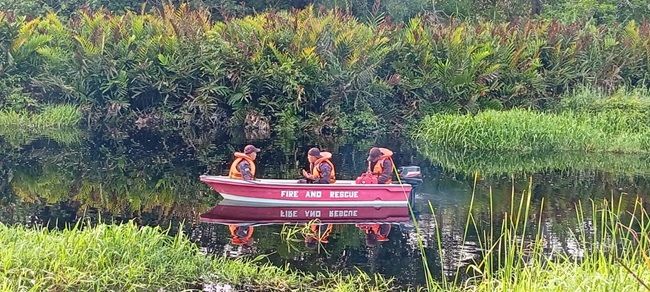
Rescue personnel in Brunei are intensifying efforts to locate a man feared to have fallen victim to a crocodile attack in Kampong Baru Sungai Bera, with the operation now stretching into its third day of continued searching. Despite coordinated efforts spanning water and air, teams have yet to recover any trace of the missing individual, underscoring the challenging conditions and danger inherent in operations involving potentially aggressive wildlife in river environments.
The Fire and Rescue Department (FRD) has deployed a comprehensive search strategy that combines multiple operational approaches. Rescue boats patrol the river continuously, officers systematically search along both riverbanks for any signs of the victim, and unmanned aerial vehicles equipped with surveillance capabilities scan areas from above. This layered approach reflects the difficulty of locating missing persons in densely vegetated river systems where crocodiles present a genuine ongoing hazard to rescuers themselves.
Beyond the FRD's core involvement, the operation benefits from significant multi-agency coordination that demonstrates the seriousness with which Brunei authorities treat the incident. The Royal Brunei Police Force has committed personnel to the search, including specialist officers stationed at Seria Police Station and the dedicated Marine Police unit known as POLMAR. The Wildlife Division has also been engaged, bringing expertise in understanding crocodile behaviour and river habitat patterns that could prove crucial in predicting where a victim's remains might be recovered.
Operations are being directed by Senior Superintendent Amirul Hadi Junaidi, the Commanding Officer of the Operations Branch, indicating the hierarchical importance placed on the search effort. The decision to place the operation under this level of command suggests authorities are treating the case as a matter requiring sustained coordination and significant resource allocation rather than a routine response.
The incident began when the FRD received a distress call on Wednesday, June 24, reporting an attack on a male victim. An initial response team consisting of two fire engines and nine personnel, led by Acting Station Officer Mohd Zulkifli Md Tahir, was immediately dispatched to the river location. This rapid mobilisation reflects standard emergency protocols in Brunei's response procedures.
Upon reaching Kampong Baru Sungai Bera, responders conducted preliminary investigations by interviewing the victim's family members present at the scene. These initial conversations established that the man had been fishing in the river when the crocodile attack occurred, providing crucial context about the circumstances leading to his disappearance. This type of incident, while rare in developed nations, reflects the environmental realities facing communities in Southeast Asia where human settlements and wildlife habitats necessarily overlap.
Following this preliminary assessment, command staff established a Tactical Command Post to coordinate the broader search operation. This command infrastructure allowed for systematic deployment of additional resources and the implementation of a structured search pattern rather than ad-hoc responses. The decision to deploy firefighting assets and drones represented an adaptive response, leveraging available technological capabilities to address the specific challenges of locating a missing person in a river environment.
For Malaysian readers and regional observers, this incident highlights the persistent wildlife risks that populations across Southeast Asia must navigate. Crocodile attacks, while statistically rare, carry high fatality rates when they do occur, and recovery of victims in large river systems is exceptionally difficult. Sungai Bera, despite being located in Brunei, operates as part of the broader Borneo river ecosystem that Malaysian states including Sarawak also inhabit, meaning similar risks exist across regional waterways.
The professional response mounted by Brunei authorities demonstrates the importance of pre-established protocols and inter-agency coordination when wildlife emergencies occur. The involvement of specialist units like the Marine Police and the Wildlife Division reflects how modern emergency services have evolved to address natural hazard scenarios beyond traditional fire and rescue parameters. For neighbouring regions, this operational approach offers a potential model for how cross-departmental collaboration can improve response effectiveness in wildlife-related incidents.
The extended search operation also underscores practical challenges that rescue teams face when dealing with crocodile attacks. The reptiles are powerful predators capable of subduing large prey, and recovery operations in their territory necessarily involve significant safety risks for personnel. As the search continues, authorities must balance the imperative to locate the victim against the hazards posed by the animal and the river environment itself.

