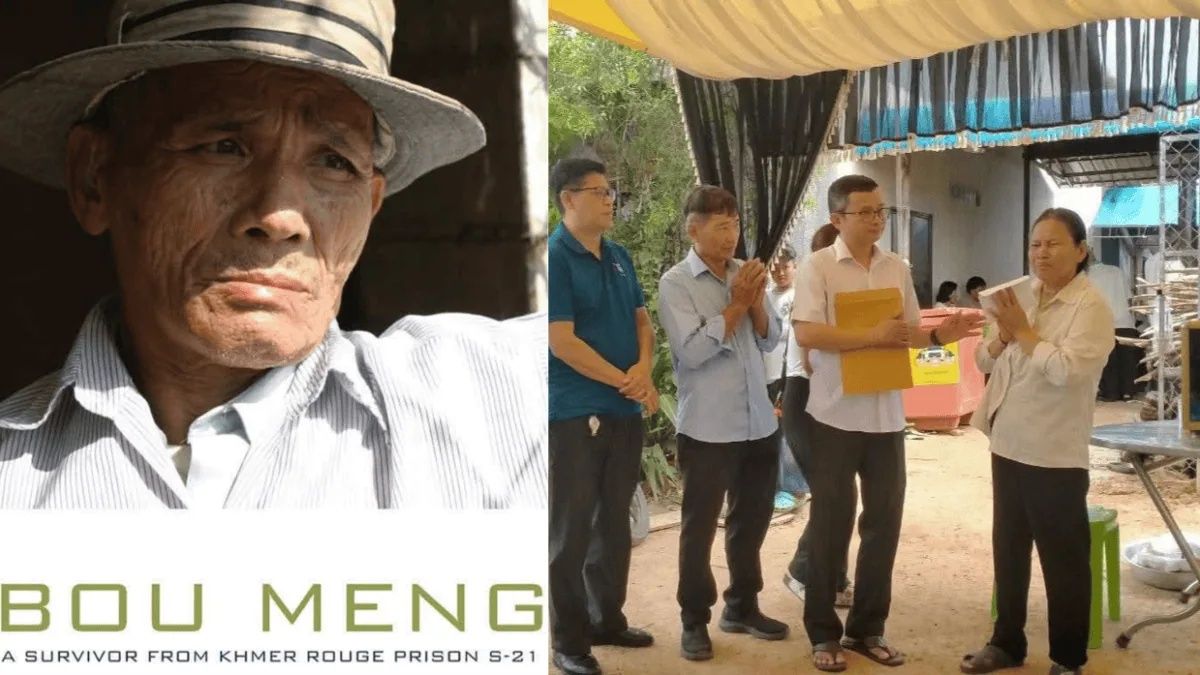
Cambodia has lost one of its most vital links to the horrors of the Khmer Rouge regime with the death of Bou Meng, who survived imprisonment at S-21, the notorious Tuol Sleng torture and extermination centre in Phnom Penh. Meng died at 11pm on Friday, August 14, 2026, at the age of 85, according to an announcement by the Tuol Sleng Genocide Museum, where he had spent his final years as a living testimony to one of the twentieth century's darkest chapters.
The loss carries particular weight because Meng represented an increasingly rare connection to documented atrocities. Among approximately 17,000 people processed through S-21 between 1975 and 1979, only seven are known to have survived. Each survivor's passing diminishes the pool of those who can speak directly about the systematic brutality inflicted within those walls, making Meng's death a significant moment in Cambodia's ongoing process of historical reckoning and memorial preservation. The museum's leadership described him as "a crucial historical witness to the crimes that the Pol Pot genocidal regime committed against the Cambodian people," underscoring his irreplaceable role in documenting institutional violence.
Meng's survival itself was an accident of circumstance rather than mercy. Imprisoned alongside his wife in 1977, he was separated from her immediately upon arrival at S-21; their children were dispatched to labour camps for the young. He would never see any of them again. Most detainees perished within weeks, subjected to interrogation regimens designed not to extract information but to extract confessions justifying their executions. Meng's preservation depended on a single skill: his ability to paint. The prison's commandant, Kaing Guek Eav—known as Comrade Duch—recognized his artistic value and employed him to create propaganda materials and portraits. This grim utility kept him alive when tens of thousands of others faced systematic torture, starvation, and death.
The irony of surviving through such proximity to power was never lost on Meng. He witnessed the machinery of the S-21 system from an unusual vantage point, observing both the bureaucratic precision of the regime's killing apparatus and the psychology of those who administered it. This perspective would prove invaluable decades later when Cambodia finally moved to hold accountable those responsible for the genocide. Meng's journey from prisoner to witness represented a form of delayed justice that extended across the span of his remaining life.
After the Vietnamese invasion ended Khmer Rouge rule in 1979, Meng eventually rebuilt a life from the ruins of his destroyed family and fractured nation. For years, he remained largely unknown outside specialist circles. However, when the Extraordinary Chambers in the Courts of Cambodia (ECCC)—often referred to as the Khmer Rouge Tribunal—commenced trials in the early 2000s, Meng's historical knowledge became crucial. He testified against Kaing Guek Eav, providing eyewitness accounts of the commander's role in orchestrating the prison's operations and the systematic nature of the violence conducted there. His testimony contributed to building the evidentiary foundation for accountability, transforming his survival into an instrument of justice for the victims who did not make it out alive.
Meng's decision to become a public educator represented another chapter in his long engagement with historical memory. Rather than retreating into privacy or the pursuit of personal recovery, he chose to spend his final decades at the Tuol Sleng Museum, receiving visitors and recounting his experiences. He understood that bearing witness extended beyond courtroom testimony; it encompassed a responsibility to ensure that future generations understood what had transpired in Cambodia's concentration camps. Tourism and education at the museum site became secondary channels through which his narrative could reach audiences far beyond Cambodia's borders.
This educational mission assumes particular significance for Southeast Asia more broadly. Cambodia's genocide, orchestrated by a Maoist regime that sought to create an agrarian utopia through radical social engineering, represents a cautionary historical moment studied across the region. Meng's firsthand accounts contributed to international understanding of how state machinery can be weaponized for mass killing, how bureaucratic systems can systematize terror, and how individual survival depends on arbitrary factors rather than justice. His presence at the museum served as a living counterargument to revisionism or forgetting.
The mechanics of Meng's survival also illuminated the human dimensions of atrocity that statistics alone cannot convey. He bore physical and psychological scars from torture; he carried the trauma of loss, having watched fellow prisoners disappear into execution chambers. Yet he emerged capable of translating that suffering into testimony and education. His willingness to engage with thousands of visitors annually, many of them young people with no direct memory of the Khmer Rouge period, suggested a form of resilience that extended beyond mere survival to active participation in constructing collective memory.
Cambodia's relationship with its genocide remains complicated by the incomplete nature of justice and accountability. While the ECCC has convicted several senior figures, including Kaing Guek Eav, who received a life sentence in 2014, many perpetrators have never faced trial. Some survived to old age without ever being held accountable. In this context, witnesses like Meng provided both a moral authority and a temporal connection to events that risk becoming abstracted or distorted through the passage of decades. His voice carried weight precisely because he had been there, had suffered there, and had chosen to remember there.
The passing of Bou Meng marks the closing of another chapter in Cambodia's living history of the Khmer Rouge period. As survivors age and die, the responsibility for preservation of memory and historical transmission shifts increasingly to institutions, archives, and educational frameworks. The Tuol Sleng Museum will undoubtedly continue its work, but it will do so without the irreplaceable presence of someone who could answer questions born from direct experience, who could correct misunderstandings with the authority of a survivor, and who could embody the human cost of ideology taken to its most extreme and destructive form.

