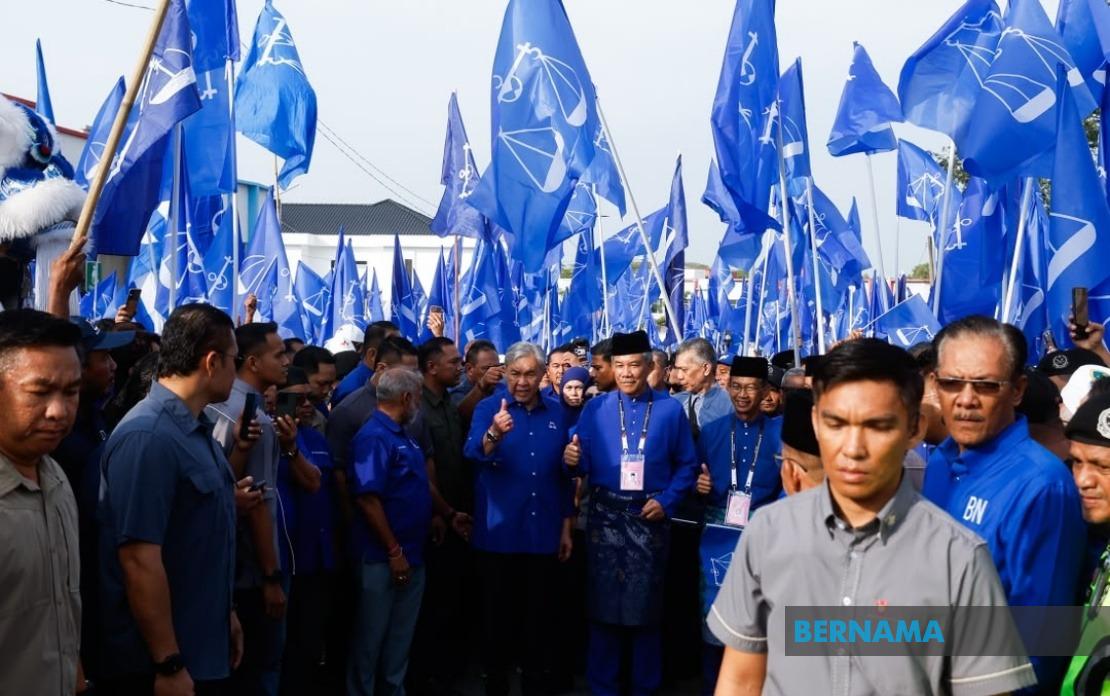
The upper echelons of Barisan Nasional made a conspicuous show of solidarity on Wednesday when they personally escorted their candidates through the nomination process for the 16th Negeri Sembilan state election. The symbolic presence of party heavyweights at nomination centres across the state underscored BN's determination to retain control of the state assembly, setting a tone of organisational discipline and momentum as the campaign begins in earnest.
BN chairman Datuk Seri Dr Ahmad Zahid Hamidi, who doubles as UMNO president, arrived at the Dewan Seri Rembau nomination centre before 9 am alongside his deputy, Datuk Seri Mohamad Hasan. The timing was significant: Mohamad was filing to defend his Rantau seat, which he has represented since 2004. This particular contest draws attention because Rantau has become a bellwether seat in Negeri Sembilan politics, and Mohamad's two-decade tenure suggests deep entrenchment in the electorate. Having Ahmad Zahid physically present at the nomination process communicated that the national party leadership viewed this state election as more than a routine regional affair—it was a test of BN's broader strength and organisational capacity.
The nomination phase itself moved swiftly and uniformly. All eight nomination centres across Negeri Sembilan opened their doors simultaneously at 9 am and concluded business precisely one hour later, creating a compressed window that kept candidates and their entourages in constant motion throughout the morning. This tight scheduling reflected the Election Commission's preference for orderly, tightly managed electoral processes that minimise disruption and maintain procedural transparency.
In Port Dickson, BN secretary-general Datuk Seri Dr Zambry Abd Kadir steered Datuk Mohd Faizal Ramli through the nomination process for the Linggi state seat. Simultaneously, UMNO vice-president Datuk Seri Johari Ghani accompanied Suhaimizan Bizar in Tampin parliamentary constituency, where Suhaimizan contested the Gemencheh state seat. These parallel appearances by different senior party figures across multiple constituencies prevented any single personality from dominating the narrative while distributing party prestige across the broader BN slate.
The most elaborate support operation unfolded in Jempol parliamentary constituency, where UMNO secretary-general Datuk Dr Asyraf Wajdi Dusuki marshalled three BN candidates through their nominations in swift succession. Datuk Mustapha Nagoor filed for Palong, Datuk Mohd Zaidy Abdul Kadir for Jeram Padang, and Chong Fui Ming for Bahau. Asyraf Wajdi's personal involvement with three candidates suggested that UMNO viewed Jempol as strategically crucial—either as a constituency where BN faced unexpected competitive pressure or where the party sought to consolidate advantages against fragmented opposition forces.
Beyond UMNO's machinery, coalition partners also demonstrated their institutional commitment to the nomination process. PAS president Tan Sri Abdul Hadi Awang accompanied Mohd Fairuz Mohd Isa through the nomination for the Serting state seat, signalling that the Islamic party remained an integral component of the BN alliance despite periodic tensions with UMNO over policy and resource allocation. Similarly, Parti Orang Asli Malaysia (ASLI) president Rashid Ka escorted Dayana Dal to nominate for the Jeram Padang state seat, indicating that smaller coalition partners maintained meaningful access to contested seats and retained organisational independence within the broader alliance framework.
The strategic deployment of senior figures at nomination centres achieved multiple objectives simultaneously. First, it demonstrated internal party cohesion at a moment when opposition forces would scrutinise any signs of BN disunity or candidate dissatisfaction. Second, it leveraged the media presence at nomination centres to amplify messaging about party strength and readiness. Third, it served as a morale-boosting exercise for party rank-and-file members who drew confidence from seeing their leaders actively engaged in the electoral process rather than orchestrating operations remotely.
Negeri Sembilan carries particular significance in Malaysian electoral politics. The state has alternated between BN and opposition control in recent decades, and recent years have witnessed tighter contests as both blocs refined their campaign strategies and candidate selection processes. A BN victory would reinforce the ruling coalition's narrative of consolidation and recovery following earlier electoral setbacks, while an opposition breakthrough would inject momentum into the broader movement to displace federal BN dominance. For UMNO specifically, performing strongly in Negeri Sembilan would strengthen Ahmad Zahid's position within the party and validate his leadership credentials ahead of future internal contests.
The Election Commission's scheduling of early voting for July 28 followed by polling day on August 1 compressed the campaign into a brief, intense cycle that favoured well-organised parties with established machinery. BN's visible coordination on July 18 suggested the party had mobilised its institutional apparatus comprehensively, positioning it to dominate the nomination headlines while building momentum into the early voting phase. For opposition parties contesting the same seats, matching this level of orchestrated high-profile support would prove challenging without comparable senior leadership depth or media access.
The Negeri Sembilan State Legislative Assembly had been officially dissolved on June 5 following the Yang Dipertuan Besar's consent, setting in motion the formal electoral process. From that dissolution through to the July 18 nomination day, BN had maintained consistent messaging discipline and candidate focus, suggesting sophisticated campaign management. The party's performance in these opening stages would establish baselines against which observers would measure momentum changes as campaigning intensified toward the August 1 poll.
For Malaysian political observers and Southeast Asian analysts tracking coalition dynamics in established democracies, Negeri Sembilan offered a microcosm of broader power struggles within Malaysia's federal system. How BN performed in this contest would provide early indicators about the health of the ruling coalition's electoral machinery, the effectiveness of recent leadership transitions, and the Opposition's capacity to exploit any perceived vulnerabilities in BN's state-level operations. The nominations on July 18 had thus accomplished their ceremonial function while simultaneously launching the substantive campaign that would determine whether BN could maintain its grip on this strategically important state assembly.

