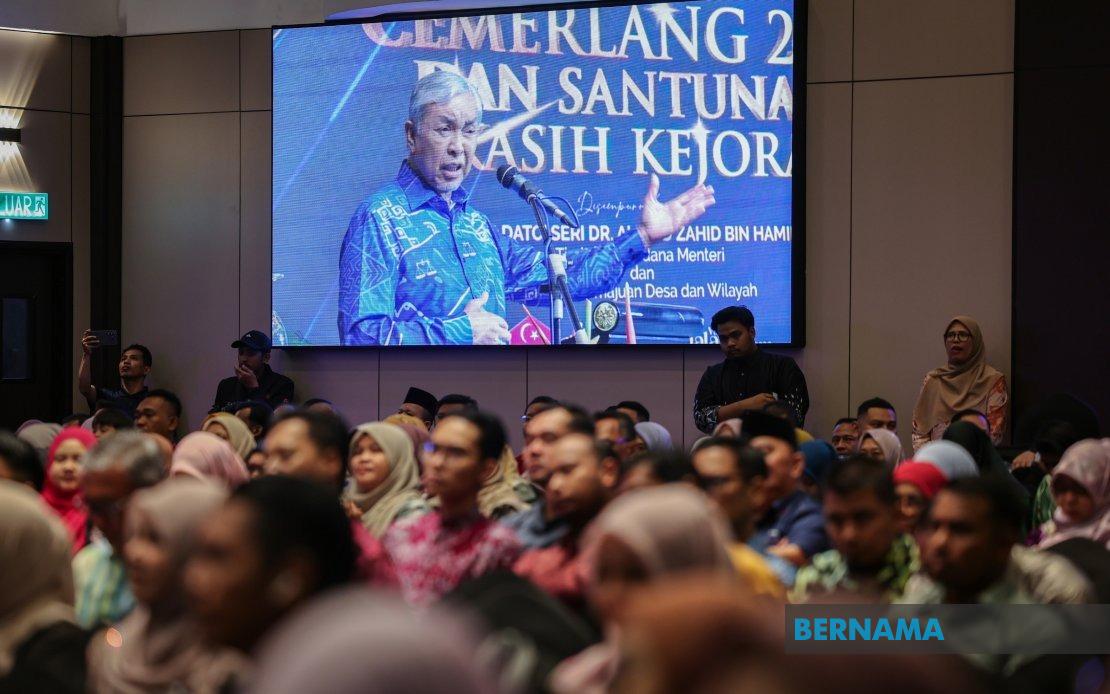
Barisan Nasional's leadership has pushed back against suggestions that its campaign machinery for the Johor state election lacks energy, with coalition chairman Datuk Seri Dr Ahmad Zahid Hamidi asserting that such claims reflect political positioning rather than facts on the ground. Speaking after inaugurating the Southeast Johor Development Authority's Excellent Service Awards in Kota Tinggi on July 2, Zahid reframed the narrative around BN's election strategy, positioning the coalition as operating at full capacity while competing coalitions promote their own assessments.
The timing of these remarks is significant given the intensity of Malaysia's state-level electoral competition. Zahid's comments suggest BN remains confident despite facing a competitive landscape in which Pakatan Harapan fields 56 candidates across the state, mirroring BN's full slate. The assertion that the campaign operates "in full swing" stands as a direct counter to external perceptions, particularly from rival coalitions seeking to capitalise on any perceived momentum gaps. Zahid explicitly acknowledged that rival groups have the right to form their own views, effectively treating such criticism as expected political positioning rather than substantive concern.
A crucial element of Zahid's defence of BN's campaign approach involves addressing potential voter confusion stemming from the federal-level cooperation between BN and Pakatan Harapan under the Unity Government framework. This represents a genuine vulnerability for the coalition in Johor, where traditional BN voters might struggle to reconcile state-level competition with federal-level collaboration. Zahid's response emphasised Johor's institutional distinction: the state government predates the federal Unity Government arrangement, meaning voters face no structural contradiction between state autonomy and federal cooperation. This carefully calibrated distinction seeks to neutralise the cognitive dissonance that might otherwise suppress turnout or split votes.
The Deputy Prime Minister highlighted Johor's fiscal performance as a cornerstone of BN's campaign narrative, citing RM2.26 billion in state revenue during the preceding year—described as the highest among Peninsular Malaysian states. This economic foundation underpins the broader case for returning BN with an enhanced mandate. Under the stewardship of Menteri Besar Datuk Onn Hafiz Ghazi, the state government has constructed a development agenda framed as dependent upon electoral reinforcement. The revenue achievement serves as both a policy accomplishment and a political tool, demonstrating BN's administrative competence while creating a forward-looking justification for expanded electoral support.
BN's strategy for the July 11 polling centres on securing what party leadership characterises as a "resounding victory," language that signals ambitions extending beyond mere retention of control. This framing acknowledges that capturing additional seats would strengthen the coalition's hand for implementing its five-year development programme. The emphasis on mandate expansion rather than bare survival reflects BN's assessment that the electorate remains receptive to its governance record. For Malaysian political observers, this represents a critical test of whether federal coalitional politics undermines state-level BN performance or whether localized governance records can insulate the coalition from broader political shifts.
Zahid's approach to Perikatan Nasional's electoral positioning, particularly Tan Sri Abdul Hadi Awang's directive to supporters to reject Pakatan Harapan outright, reveals interesting strategic differences within the opposition ecosystem. While PAS employs forthright rhetoric against PH, Zahid positioned BN as adopting a more professional stance focused on candidate strength rather than explicit coalition messaging. This distinction hints at BN's confidence that its administrative track record and candidate quality require less aggressive opposition framing. The comment that results on July 11 will provide "the clearest indication" of whose assessment proves accurate suggests Zahid views the election outcome as a definitive referendum on campaign vibrancy and voter engagement.
The electoral arithmetic reveals a fragmented opposition landscape that may work in BN's favour. Beyond BN and PH's 56 candidates each, Perikatan Nasional deploys 33 candidates, while smaller parties including Bersama (15 seats), MUDA (four), plus single candidates from Parti Orang Asli Malaysia, Parti Sosialis Malaysia, and six Independent hopefuls complete the ballot. This fragmentation suggests that even if anti-BN sentiment exists, vote-splitting among multiple alternatives could allow BN to prevail in plurality contests. The distribution of opposition strength across multiple political vehicles rather than consolidated behind a single alternative arguably validates Zahid's assertion that on-ground realities favour the coalition.
For Malaysian readers assessing the reliability of Zahid's campaign claims, context matters considerably. As Deputy Prime Minister and BN chairman, he possesses institutional incentives to project confidence and dismiss criticism. Yet the underlying mechanics of election campaigns—candidate deployment, public event frequency, grassroots mobilisation intensity—remain observable phenomena. Zahid's refusal to engage defensively with the "lacklustre" characterisation, instead reframing it as mere political perspective, suggests calculated confidence rather than desperate reassurance. This rhetorical approach implies internal polling and ground intelligence convince BN leadership that their machinery remains competitive despite external commentary.
The broader implications for Malaysian politics extend beyond Johor's borders. A decisive BN performance would validate the Unity Government's sustainability at state level, suggesting federal-level cooperation does not inevitably poison state elections for component parties. Conversely, if BN underperforms, questions would intensify about whether federal coalition arrangements create voter fatigue or confusion that manifests most acutely in state-level balloting. Zahid's emphasis on Johor's institutional separation from federal politics appears designed to preempt such analysis, establishing an interpretive frame that shields state results from broader federal-level assessments.
Early voting scheduled for July 7 and main polling on July 11 will provide empirical resolution to the competing narratives surrounding campaign momentum. Zahid's assertion of BN's active machinery and confident trajectory rests ultimately on electoral performance. The framing of a "resounding victory" as the objective necessarily means that anything less invites re-evaluation of the chairman's current optimism. For Southeast Asian readers monitoring Malaysian political stability and federalism's functioning, the Johor result carries broader significance as evidence of whether state elections can maintain coherent outcomes despite the complexities introduced by federal-level coalition arrangements.

