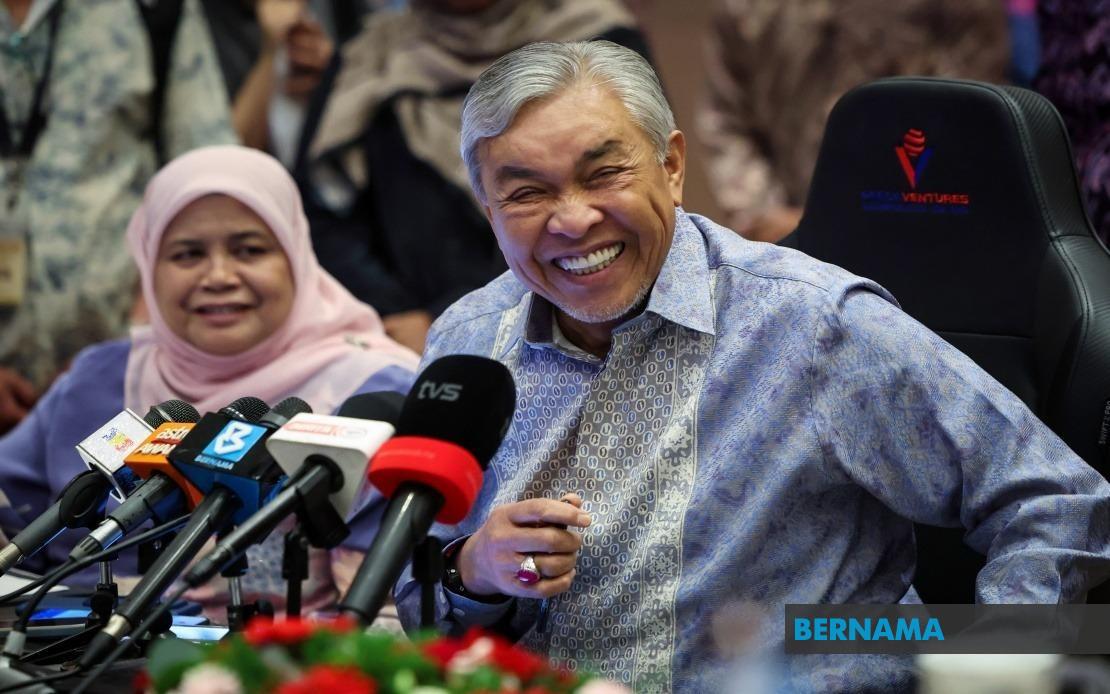
Deputy Prime Minister Datuk Seri Dr Ahmad Zahid Hamidi has moved to quell persistent rumours of Barisan Nasional's potential departure from the Unity Government, issuing a categorical statement that the coalition intends to remain as a partner in Prime Minister Datuk Seri Anwar Ibrahim's administration through to the end of the current parliamentary term. Speaking in George Town during the coordination meeting on rural development affairs, the BN chairman addressed swirling speculation about backroom manoeuvres that have long dogged Malaysian politics by name, explicitly dismissing references to the "Bangkok Move" and "Dubai Move"—coded terminology for covert regime-change attempts that have historically preceded dramatic shifts in Malaysia's political landscape.
The significance of Zahid's intervention extends beyond routine political reassurance. Since the formation of the Unity Government following the 2022 General Election, scepticism has periodically surfaced regarding whether traditional rivals could genuinely sustain cooperation. The Yang di-Pertuan Agong's directive to form a cross-party government was unprecedented in its scope, bringing together UMNO-led Barisan Nasional alongside Pakatan Harapan and other partners in a framework ostensibly designed to ensure political stability after years of electoral volatility. Zahid's explicit reference to the royal decree underscores that BN views its participation not merely as a tactical arrangement but as a constitutional imperative that transcends ordinary political calculation.
The timing of these remarks is particularly noteworthy given the concurrent Negeri Sembilan state election campaign, which has exposed fractures in the Unity Government coalition. The three-way contest in Klawang exemplifies the tensions inherent in a system where national-level partnership coexists with state-level competition. When BN declined to field a candidate for the Klawang state seat, the decision prompted the local polling district centre to suspend operations in protest—a relatively rare act of grassroots dissent that signals frustration among party machinery over perceived inequitable power-sharing arrangements. Zahid's acknowledgement of this issue, coupled with his confidence that resolution would be achieved within nine days before polling, reveals an administration alert to the risks that localized grievances pose to broader national cohesion.
Another dimension of Zahid's statement addresses emerging proposals for a "Perikatan Barisan Nasional" alliance, which would represent a fundamentally different political configuration by potentially uniting BN with Perikatan Nasional. Such a combination would ostensibly create a broader conservative coalition while excluding Pakatan Harapan. Zahid's characterization of these suggestions as merely rhetorical flourishes confined to campaign speeches rather than formal negotiations suggests either that meaningful discussions have not yet materialized, or that BN wishes to downplay their significance. Either interpretation carries weight: the former implies that transformative political realignments require more deliberate groundwork than casual pronouncements, while the latter suggests BN prefers to manage perceptions by maintaining ambiguity about its intentions.
The maintenance of cordial relations between Zahid and Prime Minister Anwar, despite their competing in opposite camps during the Negeri Sembilan campaign, illustrates a paradox at the heart of Malaysia's current political settlement. The two senior figures exchanged pantun—traditional Malay verse—highlighting themes of unity and discipline, suggesting that personal relationships can accommodate operational disagreements when underpinned by shared commitment to institutional stability. This cultural diplomacy serves multiple purposes: it reinforces public messaging about the government's cohesion while allowing the protagonists to campaign vigorously on behalf of their respective coalitions without triggering interpretations of fundamental breakdown.
From a Malaysian perspective, the structural sustainability of the Unity Government remains contingent upon managing expectations across disparate party memberships. Barisan Nasional's grassroots, predominantly composed of UMNO members, harbour ambitions to restore the coalition's historical dominance after its 2018 electoral defeat. Conversely, Pakatan Harapan's supporters expect that the partnership will institutionalize reforms initiated during the 2018-2020 period. These competing visions create perpetual tension, particularly when electoral outcomes in state contests appear to disadvantage one faction or another. The Negeri Sembilan campaign thus serves as a microcosm of broader coalition dynamics, where local disappointments can metastasize into threats against national arrangements if mismanaged.
Regionally, Malaysia's political stability carries significance that extends beyond domestic boundaries. Southeast Asia has witnessed considerable volatility in recent years, with democratic backsliding, military interventions, and constitutional crises affecting neighbouring states. Malaysia's successful navigation of a complex multi-party arrangement—albeit imperfect and frequently strained—represents a distinct model of democratic adaptation. The ability to sustain ideological competitors within a single government structure, however fraught, distinguishes Malaysia from regional peers and provides international investors and diplomatic partners with relative predictability regarding governance continuity and policy direction.
Looking forward, BN's reaffirmation of commitment likely reflects a strategic calculus that remaining within the Unity Government offers superior outcomes to realignment alternatives. A coalition involving Perikatan Nasional would shift Malaysia's political centre of gravity rightward on several issues, potentially alienating urban constituencies and minority communities whose electoral support proved decisive in 2022. Conversely, departing the government altogether would consign BN to opposition status indefinitely, foreclosing access to executive patronage and policy influence. The Unity Government arrangement, despite its frustrations, permits BN to exercise consequential authority while maintaining plausible deniability regarding responsibility for unpopular policies—a position yielding tangible benefits that exit scenarios would forgo.
Zahid's repeated emphasis on sincerity and steadfastness suggests recognition that rhetorical affirmations alone cannot sustain coalitions indefinitely. Malaysian political history demonstrates that formal agreements collapse when underlying interests diverge sufficiently or when opportunistic recalculation appears advantageous. The persistence of Unity Government partnership through successive challenges—from internal party conflicts to electoral disappointments—depends ultimately upon continued calculation that stability serves all constituent parties better than alternatives. As the 15th Parliament progresses, maintaining this equilibrium will require ongoing dialogue, accommodation of legitimate grievances, and demonstrated commitment to shared objectives that transcend individual party advantage.

