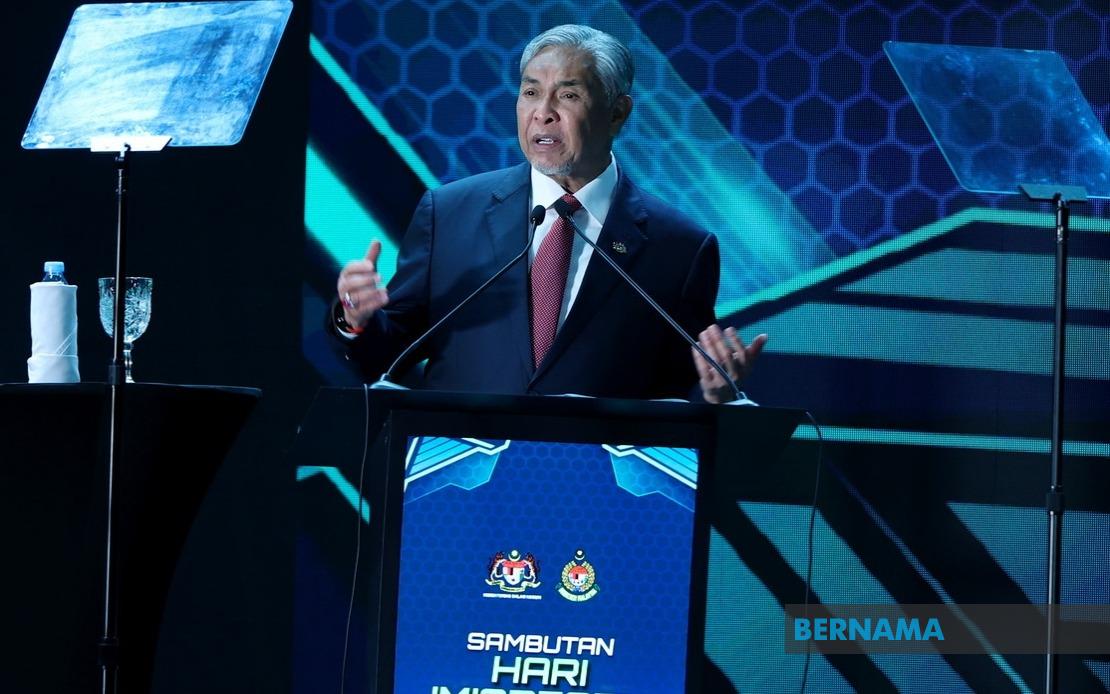
Barisan Nasional has reiterated its commitment to the Unity Government framework, with party chairman Datuk Seri Dr Ahmad Zahid Hamidi confirming that the coalition's participation continues in accordance with decisions made at UMNO's most recent General Assembly. Speaking at the 2026 Immigration Day celebration in Cyberjaya on July 21, the Deputy Prime Minister and UMNO president stressed that the party regards the assembly's resolution as the highest authority guiding its political stance, and expects all stakeholders to respect this determination without question.
The affirmation comes at a time of heightened scrutiny over the stability of Malaysia's governing coalition, which has faced intermittent tensions since its formation. Ahmad Zahid's unequivocal statement appears designed to quell speculation about potential fractures within the broader alliance, particularly amid campaign pressures from state-level electoral contests. By invoking the UMNO General Assembly—the party's supreme decision-making body—he positioned the Unity Government commitment as a matter of principle rather than tactical convenience, thereby lending it added weight and durability.
In the Malaysian political context, where party assemblies traditionally carry substantial symbolic and procedural significance, Ahmad Zahid's emphasis on the assembly's supreme authority carries particular resonance. The invocation suggests that any internal UMNO dissent on the coalition question has been resolved through the party's formal democratic processes, creating a binding mandate that individual leaders or factions cannot unilaterally challenge. This approach reinforces party discipline and prevents senior figures from deviating from the collectively endorsed position.
The timing of this reaffirmation gains additional significance when considered alongside reports that Prime Minister Datuk Seri Anwar Ibrahim recently issued stern warnings to Cabinet members and government office-holders regarding their conduct during state election campaigns. The Prime Minister reportedly cautioned ministers and deputy ministers against using their official positions to attack or undermine other Unity Government partners, with a clear threat that violations would result in demands for resignation. This development highlights underlying tensions within the coalition that persist despite the formal unity arrangement.
Ahmad Zahid's separate remarks on cabinet management underscored another critical dimension of coalition governance. He explicitly acknowledged that the Prime Minister possesses absolute discretion in appointing and removing Cabinet members, and that the Premier's judgment in identifying whether officeholders have breached coalition protocols remains entirely within his purview. By framing ministerial positions as serving at the Prime Minister's pleasure, Ahmad Zahid implicitly validated Anwar's authority to enforce discipline within the government, even against members from coalition partners like BN.
This delineation of authority reflects the inherent asymmetry within the Unity Government structure, where the Prime Minister wields concentrated power over the Cabinet while maintaining the prerogative to interpret and enforce coalition rules. For BN and other alliance members, this arrangement entails a degree of subordination to Anwar's political judgment, a reality that Ahmad Zahid's statements appear to accept as legitimate and necessary for coalition cohesion.
The broader context encompasses growing concerns that certain government officials have weaponised their positions to advantage their own parties during electoral campaigns, potentially causing friction among coalition members. State elections provide constituencies with opportunities to assess public sentiment and test competing political messages, but when officeholders blur the line between governance and partisan campaigning—particularly by directly attacking coalition allies—the Unity Government's foundational logic of mutual accommodation becomes strained. Anwar's warnings suggest that such behaviour has already surfaced in sufficiently problematic ways to warrant executive intervention.
For regional observers, Malaysia's Unity Government represents an important experiment in coalition politics within a Westminster-influenced system. Unlike some neighbouring democracies that have experience with formal grand coalitions or proportional representation systems that naturally produce multi-party governments, Malaysia's first-past-the-post electoral framework typically produces more ideologically coherent single-party administrations. The Unity Government thus requires constant negotiation and compromise among ideologically diverse partners—UMNO's Malay-Muslim conservative base, DAP's urban Chinese-majority support, and PKR's mixed constituency—creating inherent friction points that demand active management.
Ahmad Zahid's reaffirmation that BN will honour its assembly-endorsed commitment to the coalition provides temporary reassurance, but the necessity for such repeated affirmations itself hints at underlying vulnerability. Political coalitions in Malaysia remain subject to fluctuating party interests, leadership transitions, and electoral performance variations. The requirement for the Deputy Prime Minister to publicly reinforce the government's cohesion suggests that coalition stability cannot be taken as automatic but instead demands continuous political work and explicit leadership endorsement.
Looking forward, the intersection of state election campaigns and Unity Government management will likely remain a flashpoint. As political parties compete for regional advantage and mandate-building, the temptation to deploy government machinery or Cabinet-level actors for partisan benefit may intensify, necessitating robust enforcement mechanisms from the Prime Minister. Ahmad Zahid's acknowledgment of Anwar's ultimate authority over Cabinet composition suggests that such enforcement will be exercised when necessary, regardless of which coalition member faces consequences.
The episodes surrounding Anwar's warnings and Ahmad Zahid's response ultimately illustrate that while the Unity Government enjoys formal institutional support through party assembly resolutions and leadership commitments, it continues to operate within an environment of underlying political competition. Coalition partners remain distinct entities with separate electoral interests and organisational cultures, and their temporary alignment serves mutual benefit rather than reflecting deeper ideological convergence. Sustaining such arrangements requires vigilance, clear rule enforcement, and regular reaffirmation of commitment—elements that Ahmad Zahid's recent statements suggest remain active components of Malaysia's coalition management strategy.

