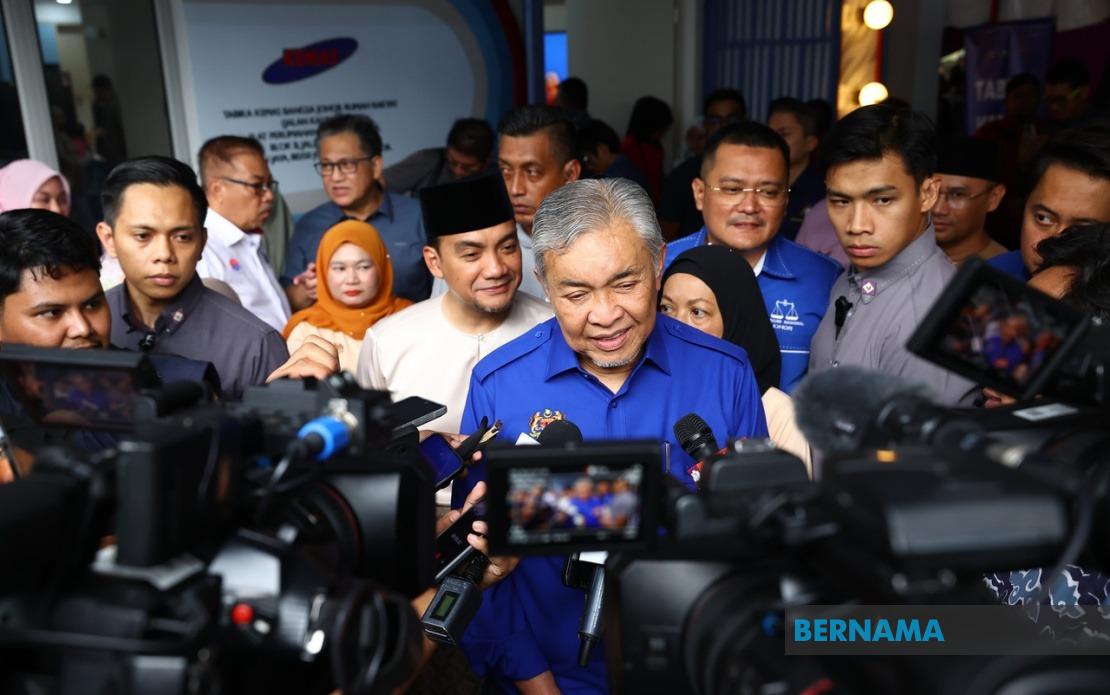
Barisan Nasional has publicly acknowledged the electoral manifesto unveiled by Pakatan Harapan for the upcoming Johor state election, with BN Chairman Datuk Seri Dr Ahmad Zahid Hamidi expressing respect for the opposition coalition's proposals. The Deputy Prime Minister's comments, made during a community engagement session in Johor Bahru on July 3, reflect a measured and courteous acknowledgment of rival political platforms as Malaysia continues to strengthen its democratic institutions. Ahmad Zahid's remarks underscore a broader acceptance of competitive electoral discourse within the nation's political framework, where multiple parties present their policy visions to voters without dismissive rhetoric.
Pakatan Harapan's manifesto for the state election centres on ten key pledges designed to address pressing concerns across various demographic segments. Among the headline commitments is the Johor Health Scheme, which aims to improve healthcare accessibility and affordability for residents. The coalition has also proposed deposit assistance programmes targeting first-time property purchasers, a measure intended to ease the financial burden faced by young Malaysian families entering the housing market. Additionally, PH has outlined a RM500 million youth development fund, recognising the economic and social importance of investing in younger generations who will shape the state's future economic trajectory.
Education emerges as another priority within PH's electoral platform, with specific initiatives designed to strengthen pedagogical outcomes and institutional capacity across the state. For Malaysian observers, these education-focused proposals carry particular significance given ongoing national conversations about curriculum quality, teacher development, and equitable access to learning resources across urban and rural contexts. The breadth of PH's agenda reflects an attempt to position the coalition as comprehensively addressing multiple life stages and socioeconomic challenges rather than pursuing narrowly targeted policies.
In response, Ahmad Zahid positioned Barisan Nasional's electoral platform as grounded in demonstrable governmental achievement rather than aspirational promises alone. The BN Chairman highlighted that the current state government, operating under the BN banner, had fulfilled more than 90 per cent of commitments made during the previous electoral cycle. This metric serves as BN's primary rebuttal to opposition proposals, suggesting that voters should evaluate competing parties not merely on the attractiveness of their promises but on their historical capacity to deliver tangible results. Such an argument carries weight in Malaysia's political discourse, where institutional continuity and proven administrative performance often weigh heavily in voter considerations.
The BN manifesto, according to Ahmad Zahid, has been constructed with deliberate attention to inclusivity across all segments of Johor's diverse society. Rather than targeting specific communities or social groups, BN frames its policy agenda as universal in scope, explicitly designed to benefit all residents regardless of ethnic or social background. This rhetoric of inclusive governance addresses longstanding concerns in Malaysian politics about equitable distribution of state resources and the avoidance of communal favouritism. By emphasising that benefits flow across life stages—from expectant mothers through childhood, schooling, university years, and into adulthood for single parents—BN attempts to position itself as a holistic provider of social welfare rather than a sectional interest representative.
Ahmad Zahid's invocation of the concept "Bangsa Johor" warrants particular attention for Malaysian readers. This framing seeks to transcend ethnic and religious divisions by promoting a shared Johor identity that supersedes other identity markers. The phrase "as long as anyone resides in Johor, they are considered part of Bangsa Johor" represents an aspirational vision of inclusive citizenship within the state, implicitly arguing that BN's governance philosophy prioritises residence and equal membership in the state community over other categorical distinctions. This rhetorical move reflects broader Malaysian political trends toward emphasising shared territorial identity rather than communal segmentation, though such aspirations face persistent challenges in implementation across diverse societies.
The Rural and Regional Development Minister also committed to sustained engagement with Johor's development trajectory beyond the immediate electoral cycle. Ahmad Zahid's assurance that he will continue supporting the state's advancement as long as he holds his ministerial portfolio signals BN's intention to maintain federal-level investment and attention in Johor's infrastructure and services. For Malaysian states, federal ministerial backing proves consequential for resource allocation, priority positioning within national development plans, and access to central government funding mechanisms. This commitment implicitly argues that voting for BN secures not merely state-level governance but also preferential relationship with federal decision-making structures.
The 16th Johor state election represents a significant moment in Malaysian electoral politics, with 172 candidates contesting across 56 state seats. The July 11 polling date will determine which coalition controls state governance for the ensuing term, with early voting scheduled for July 7. The scale of competition—involving more than three candidates per seat on average—indicates vigorous multi-party engagement in Johor's electoral process. For Southeast Asian observers, Johor's polls carry regional significance given the state's economic importance, its role in Malaysia's southern development corridor, and its proximity to Singapore, making state-level governance decisions consequential for cross-border economic relationships and regional stability.
The public acknowledgment of opposing parties' proposals, rather than their outright dismissal, reflects Malaysian political culture's evolution toward more professional electoral competition in certain contexts. Ahmad Zahid's respectful framing of PH's manifesto, while simultaneously emphasising BN's superior track record, demonstrates a strategy of comparative rather than purely adversarial politics. This approach potentially appeals to voters seeking rational policy evaluation rather than populist confrontation, though it also risks appearing insufficiently passionate to constituencies motivated by ideological conviction. The balance between acknowledging legitimate opposition proposals while defending one's own platform remains a perpetual challenge in competitive democratic systems.
For Malaysian political analysts, the contrast between BN's emphasis on historical delivery and PH's focus on future reforms encapsulates a fundamental electoral tension. Voters must weigh demonstrated past performance against promised future improvements, continuity against change, and proven competence against reformist vision. In Johor specifically, where BN has governed continuously and holds significant institutional advantages, this dynamic tilts toward evaluating incumbency performance. The state's relative economic development and social stability under BN governance provide empirical grounds for the ruling coalition's claims, yet economic pressures, demographic change, and evolving voter expectations may shift calculations away from simple historical assessment toward future-oriented considerations.
The manifesto exchange between BN and PH reflects Malaysia's continuing maturation as an electoral democracy where multiple organised coalitions present systematic policy visions to voters. Both camps have moved beyond simple ethnic or religious appeals toward comprehensive programmatic platforms addressing healthcare, housing, youth development, and education. This trend suggests that Malaysian voters increasingly demand substantive policy engagement from their political representatives. However, the question of which coalition more credibly commits to implementation—whether through proven track records or through programme design—will ultimately determine voter choice in the July 11 election and shape Johor's governance trajectory for the coming term.

