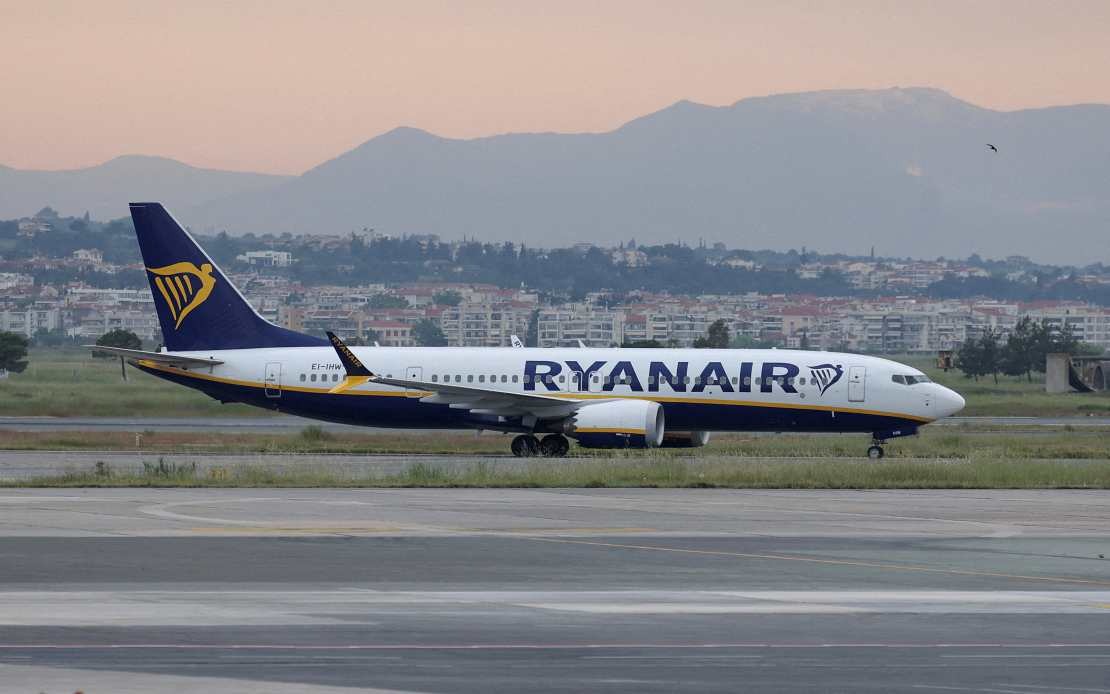
A US safety investigation has determined that bird remains were responsible for triggering a catastrophic engine failure aboard a Ryanair flight last month, an incident that resulted in a passenger being partially expelled from the aircraft before being rescued by nearby travelers. The National Transportation Safety Board released its findings this week regarding the July incident involving Malta Air, operating under the Ryanair brand, which was bound for Munich from Thessaloniki in Greece when the right engine's fan blade suddenly separated during the initial climb phase.
The investigation's technical findings paint a dramatic picture of structural damage unfolding at altitude. When the fan blade detached from the engine, the resulting fragmentation created a destructive trajectory through the aircraft's fuselage. The projectile force of the debris punched directly through the pressurized cabin wall at row 11, while additional fragments damaged the lower section of the fuselage skin located behind the right wing-to-body junction. This dual penetration compromised the aircraft's structural integrity in a manner that posed immediate danger to occupants.
The passenger occupying seat 11F experienced the full violence of this structural breach. As cabin pressure vented rapidly through the damaged window, aerodynamic forces drew the injured traveler partially through the opening. The window frame, weakened by the initial impact, offered no resistance as the person was pulled toward the opening. However, the quick thinking and physical intervention of other passengers proved lifesaving—they managed to grasp and secure the individual, preventing complete ejection despite the powerful depressurizing forces acting upon the cabin environment.
Bird ingestion remains one of aviation's most persistent hazards, particularly during the critical takeoff and initial climb phases when aircraft operate at lower altitudes where bird populations concentrate. The safety board's discovery of bird remains, including feathers distributed throughout various engine components, confirms that the wildlife strike initiated the cascade of failures. Such incidents highlight the vulnerability of jet engines to foreign object damage, despite decades of engineering advancement aimed at containing fan blade failures through titanium construction and design redundancy measures.
The specific mechanics of fan blade separation represent a known failure mode in turbofan engines, but the consequences depend heavily on operational factors. The timing of this failure—occurring during climb after takeoff from Thessaloniki International Airport—meant the aircraft was airborne with insufficient altitude for gliding descent options. The pilots' successful return to Thessaloniki and safe landing prevented what could have escalated into a more serious incident had the cabin breach expanded or affected flight-critical systems.
For Southeast Asian aviation operators and passengers, incidents such as this underscore the importance of rigorous maintenance protocols and bird strike prevention measures at regional airports. Malaysia's busy airports, including Kuala Lumpur International Airport and secondary hubs, face similar wildlife management challenges, particularly during monsoon migration seasons when bird activity intensifies. The investigation's findings reinforce regulatory frameworks requiring operators to document engine inspections following suspected wildlife encounters.
The injured passenger's survival depended on multiple factors converging favorably: the breach occurred in a location where other passengers could physically intervene, the crew maintained aircraft control despite the decompression event, and the window opening proved sufficiently constrained to allow rescue efforts. Had the debris pattern been slightly different or the cabin configuration alternate, the outcome could have proved tragic. This near-catastrophe provides valuable lessons for cabin safety protocols and crew training in responding to unexpected structural emergencies.
Ryanair's operational procedures for managing this emergency proved effective, as demonstrated by the crew's ability to return the aircraft to its departure airport without further incident. The airline has not disclosed details regarding maintenance checks performed on the aircraft following the incident or modifications implemented to prevent recurrence. Industry-wide, engine manufacturers continue refining fan blade design and containment strategies to withstand or limit fragmentation damage from foreign object encounters.
The investigation's conclusions carry implications beyond the specific incident. Bird strike frequency has increased proportionally with growing air traffic and expanding airport infrastructure that encroaches on wildlife habitats. Environmental changes, including agricultural intensification and altered migration patterns, have altered bird populations at many airports. Airport operators throughout Southeast Asia may need to reassess wildlife management strategies, implementing enhanced radar detection systems and habitat modification to reduce strike risk during vulnerable flight phases.
Passenger safety authorities will likely reference this incident when reviewing cabin safety standards related to window integrity and emergency decompression scenarios. While modern cabin windows undergo rigorous pressure testing and certification, the extreme forces generated by foreign object impacts demonstrate that certification standards based on design scenarios may not fully capture real-world hazards. Manufacturers and regulators may examine whether window reinforcement or redundancy measures warrant consideration for aircraft serving high-risk routes.

