The All England Club's manicured lawns and century-old customs present Wimbledon to the world as the epitome of refined British sporting tradition. For nearly 150 years, the oldest Grand Slam tournament has cultivated an image of decorum, with players adhering to strict all-white dress codes extending to their shoes, spectators adorning imaginative hats, and members of the royal family gracing the stands. Yet beneath this carefully maintained veneer of civility lies a tournament every bit as fiercely competitive as the FIFA World Cup that ran concurrently with this year's event, a reality that photographers documenting the championship were uniquely positioned to reveal.
The contrast between Wimbledon's presentation and its substance represents one of sport's more intriguing paradoxes. While the tournament's visual identity remains instantly recognisable—the pristine grass courts, the traditional dress code, the ritual of strawberries and cream—the 675 matches contested across all categories unfold according to the same unforgiving logic that governs any elite sporting competition. The best players in the world converge not merely to participate in a quaint British tradition, but to claim one of tennis's most coveted titles. This duality becomes apparent only when one looks beyond the tournament's polished surface to the moments that lie in between: the silence preceding a crucial serve, the grimace of concentration during a difficult volley, the explosive relief of triumph and the crushing weight of defeat.
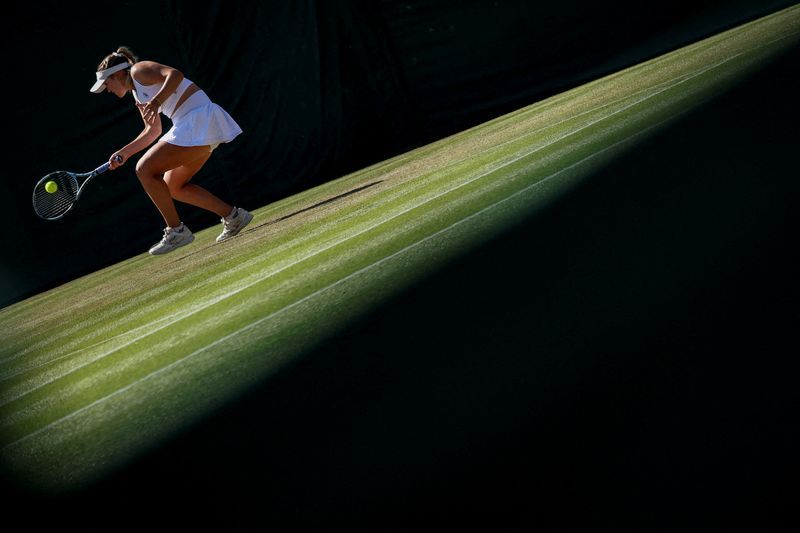
One such moment involved Philippine player Alexandra Eala, the 21-year-old who faced an uphill battle against third seed Iga Swiatek, a six-time Grand Slam champion. During their encounter, Eala fell while attempting a forehand return, her gritted teeth capturing perfectly the determination of an underdog refusing to surrender despite the odds stacked against her. Photographer Toby Melville, who had been positioned to capture what he anticipated would be a moment of celebration, instead found himself recording one of the tournament's most compelling competitive moments. The photographer's account of the incident reveals how such images often emerge from chance positioning and the photographer's instinct to document whatever unfolds before the lens. Melville's ability to frame Eala's full body within the frame as she fell transformed what might have been merely a stumble into a powerful statement about competitive resilience.
The emotional toll of Wimbledon's intensity manifests differently for different players. When Otto Virtanen, competing in a closely contested first-round match, found himself at a moment of frustration, he approached a courtside barrier as though he wished to escape entirely into the green canvas of the court itself. Photographer Jaimi Joy's image captured this telling moment of vulnerability, revealing how even professional athletes face moments when the pressure seems overwhelming. These instances, far removed from the sanitised highlight reels of tournament coverage, tell the story of athletes grappling with the psychological demands of elite competition. The All England Club's grass courts become, in such moments, not a symbol of genteel tradition but a stage where human emotion intersects with competitive ambition.
Not all narratives at Wimbledon unfold as tales of struggle and frustration. Naomi Osaka, the two-time Grand Slam champion, brought a different energy to Centre Court during her run to the quarter-finals for the first time since returning from a break from the sport. Photographer Marko Djurica captured Osaka striding across Centre Court in a kimono-inspired dress, an image that seemed to distil her fearless approach to the championship. For Osaka and others who thrived under the Wimbledon spotlight, the tournament's prestige and tradition served as a platform for showcasing excellence and cultural pride. Her presence throughout the tournament demonstrated how Wimbledon, despite its formal conventions, remains a stage where individual personalities and styles can flourish.
The interplay between light and shadow across Wimbledon's courts provides yet another dimension to understanding the tournament's competitive narrative. When Jannik Sinner, the men's champion, stretched to his absolute limit during the final against Alexander Zverev, his elongated shadow seemed to extend his reach beyond what his body could actually achieve. Melville's mid-air photograph captured not just a moment of athletic exertion but the very essence of striving at the highest level, where every centimetre and every fraction of a second determines the outcome. Similarly, Djurica's photograph of the women's doubles champions Guo Hanyu and Kristina Mladenovic embracing after their victory created an optical effect in which their shadow appeared to show one player raising a fist in triumph. Such images operate on multiple levels simultaneously, documenting both the literal event and the emotional resonance that accompanies victory at a prestigious championship.
The physical toll of Wimbledon extends beyond the emotional and psychological realm into tangible marks upon the courts themselves. As spectators filed out and the tournament's infrastructure was dismantled, evidence of the two-week competition remained etched into the grass courts that define the championship. Andy Couldridge's time-lapse photography of Centre Court revealed the progressive wearing of the grass caused by the passage of players' shoes throughout the tournament. This visual record of accumulated footsteps serves as a metaphorical and literal chronicle of the competitive intensity that had unfolded across the iconic venue. The patches of worn grass represent not mere wear and tear but rather the cumulative impact of each player's struggle for victory.
For Malaysian and Southeast Asian followers of tennis, Wimbledon's dual nature holds particular significance. The tournament's global reach means that Asian players increasingly compete at the championship, bringing their own narratives and styles to a stage long dominated by European and American competitors. The presence of players from across the region competing against the sport's elite hierarchy reflects the growing competitiveness of tennis in Southeast Asia and the region's capacity to produce world-class talent. As Wimbledon continues to evolve while maintaining its traditions, the tournament becomes a proving ground where regional players can measure themselves against the world's best.
The photographs taken by Reuters journalists and other visual documentarians at this year's Wimbledon ultimately reveal a truth about the championship that extends beyond any single tournament or year. Beneath the pageantry, the tradition, and the carefully curated image lies an event defined by raw competition and human emotion. Players arrive with ambitions of claiming one of sport's greatest prizes, knowing that only the very best will triumph. The white dress code, the strawberries and cream, and the royal patronage all serve as the tournament's distinctive cultural wrapper, but they obscure rather than define the intense struggle that constitutes Wimbledon's true essence. In capturing moments of vulnerability, determination, triumph, and defeat, photographers document not the tradition of Wimbledon but its beating competitive heart.

