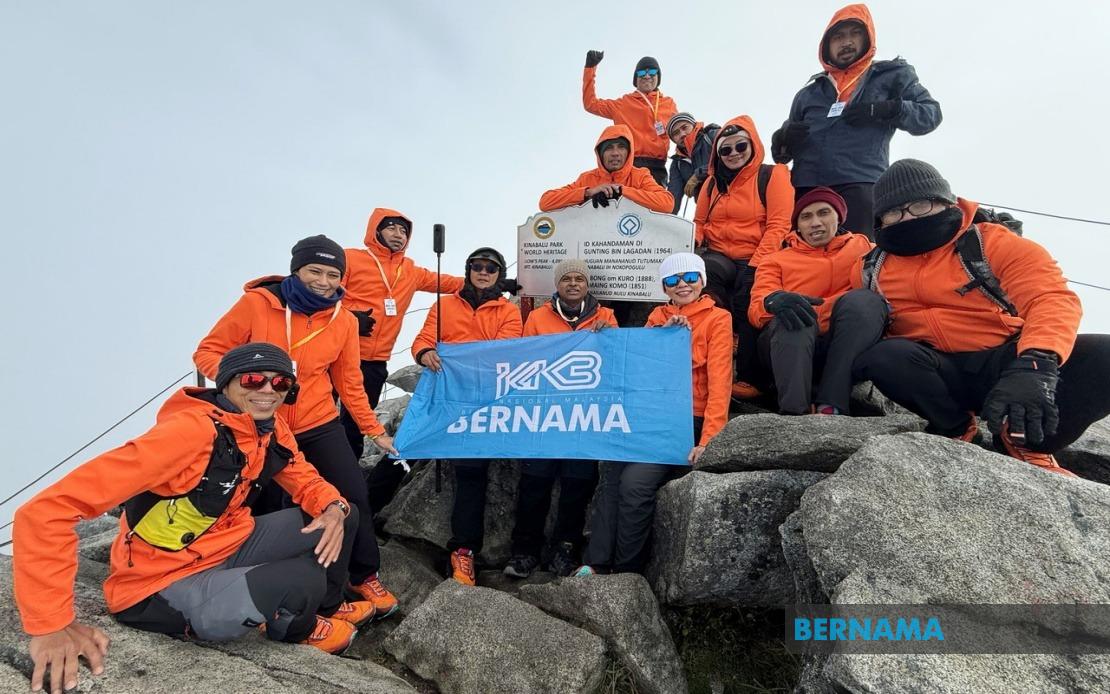
A contingent of 23 Malaysian National News Agency (Bernama) employees reached the summit of Mount Kinabalu on July 1, completing a challenging expedition designed to commemorate the country's National Journalists' Day (HAWANA) 2026. The ascent represents a significant organisational achievement and marks the first time the news agency has undertaken such a mountaineering endeavour through its staff club, the Bernama Staff Club (KKB).
Leading the expedition was Bernama Editor-in-Chief Arul Rajoo Durar Raj, who made history as the first person holding this position to successfully conquer Southeast Asia's highest peak. The expedition simultaneously pursued two Malaysia Book of Records entries: recognition as the largest group of media practitioners from a single organisation to climb Mount Kinabalu, and distinction as the first media organisation to produce news reports simultaneously in four languages from the mountain's summit. These dual record attempts underscore the expedition's ambition to combine physical achievement with professional excellence.
The team composition reflected the breadth of Bernama's operations, encompassing reporters, photographers, sub-editors, television crew members, and administrative personnel drawn from multiple departments. This cross-sectional approach extended the expedition's reach beyond traditional newsroom functions, demonstrating commitment to inclusive participation across the organisation's diverse workforce. The presence of technical staff and administrative teams highlighted how the climb served as a unifying force across departmental boundaries that typically operate separately in daily operations.
The actual summit push began at Timpohon Gate on June 30 at 10 am, with participants establishing an overnight camp at Panalaban before resuming their ascent at 2.30 am on July 1. The team reached the 4,095.2-metre peak at approximately 7.20 am, navigating treacherous conditions including intermittent rainfall, dense mist, and powerful winds that tested their physical endurance and mental fortitude throughout the challenging final hours. The unpredictable weather proved manageable, though such conditions on Mount Kinabalu—where atmospheric shifts occur rapidly due to elevation and exposure—posed genuine risks that the team successfully mitigated.
Beyond the symbolic and record-setting dimensions, the expedition functioned as a comprehensive personnel development initiative. Organisers emphasised that the climb specifically aimed to foster teamwork among staff members, strengthen both physical and mental resilience across the workforce, and promote healthier lifestyle choices within Bernama's operational culture. In an industry where deadline pressures and sedentary desk work dominate daily rhythms, such initiatives offer rare opportunities for journalists and support staff to engage in activities that build camaraderie while addressing occupational health concerns.
The successful execution depended substantially on support from strategic partners and sponsors who provided essential resources and expertise. International sportswear manufacturer BMAI, regional airline Batik Air, and beverage brand 100PLUS featured as primary sponsors, whilst supplementary support came from EHH Food Industry Sdn Bhd, Saloma Bistro, Malaysia Airports, Malaysia Insight, UFL, Sabah Parks, and Marathon Baker. This sponsorship network reflects how large-scale institutional expeditions increasingly rely on multi-stakeholder cooperation, with corporate partners gaining brand visibility whilst contributing to meaningful organisational initiatives.
Mount Kinabalu's significance extends well beyond its status as a climbing destination. Standing within Kinabalu Park's 754 square kilometres of protected forest, the mountain holds designation as a UNESCO World Heritage Site and forms part of the Kinabalu UNESCO Global Geopark (KUGGp). These designations acknowledge the peak's exceptional geological value, biodiversity importance, and cultural significance to indigenous communities in Sabah. The expedition therefore occurred within a landscape of recognised global importance, adding environmental and heritage dimensions to the purely journalistic objectives.
For Malaysia's media landscape, the expedition carries broader implications regarding institutional pride and professional identity among news organisations. As a government-owned news agency, Bernama's activities often reflect broader narratives about national institutions and their internal culture. That the organisation invested resources in such an ambitious team-building exercise suggests confidence in repositioning Bernama's public image beyond mere wire service functions towards an institution that values employee development, wellbeing, and collective achievement. This positioning proves particularly relevant as traditional news agencies worldwide seek renewed relevance amid digital disruption and changing information consumption patterns.
The HAWANA 2026 celebration context underscores how Malaysia's journalism community commemorates its professional identity. National Journalists' Day provides annual opportunity for the industry to reflect on its role, challenges, and aspirations. Bernama's decision to commemorate this occasion through a physically challenging mountain expedition rather than conventional seminars or awards ceremonies suggests deliberate messaging about the profession's resilience, adaptability, and capacity to operate effectively under demanding circumstances. The parallel between navigating Mount Kinabalu's hazardous terrain and navigating contemporary media's complex information environment carries metaphorical weight that likely resonated with participating journalists.
Should Bernama successfully secure both Malaysia Book of Records entries, the achievement would provide lasting institutional commemoration of the expedition whilst generating media attention across Malaysian and regional news networks. The multilingual reporting component—simultaneously producing news accounts in four languages from the summit—demonstrates integration of professional objectives with physical challenge. This approach transforms what could be merely recreational into a demonstration of Bernama's operational capabilities and multilingual news production expertise.

