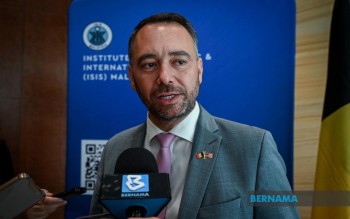
Belgium is pursuing a significant partnership with Malaysia in the offshore renewable energy sector, with Deputy Prime Minister Maxime Prévot positioning the initiative as a cornerstone of deepening bilateral ties during a working visit to Kuala Lumpur. Speaking at the 39th Asia-Pacific Roundtable, Prévot outlined a vision for cooperation that extends across multiple high-value industries including semiconductors, logistics, clinical trials, biotechnology and pharmaceuticals, yet placed particular emphasis on maritime wind as a domain where Belgium's concentrated expertise could directly benefit Malaysia's green energy ambitions.
The significance of Belgium's proposal lies in its apparent paradox: a nation with merely 60 kilometres of coastline has developed one of Europe's most sophisticated offshore wind infrastructures. Currently generating two gigawatts of electricity through offshore installations, Belgium intends to expand this capacity to between six and seven gigawatts within the coming years—an output equivalent to the output of five to seven nuclear power plants. This dramatic expansion underscores how technological innovation and policy commitment can overcome geographical constraints, a lesson potentially valuable for Malaysia as it evaluates its own offshore energy potential in the Straits of Malacca and South China Sea regions.
From Brussels' perspective, the offshore energy collaboration represents a practical extension of the European Union's broader strategic pivot toward Asia. The EU announced at the forum that it will mobilise €10 billion under its Global Gateway Strategy specifically to support the ASEAN Power Grid and facilitate the region's transition away from coal and fossil fuels. This financial commitment reflects calculations that Southeast Asian energy security directly influences European supply chain stability and geopolitical influence in the Indo-Pacific, particularly given the region's critical role in semiconductor manufacturing and maritime commerce. For Malaysia, such backing suggests an alternative to reliance solely on Chinese financing for infrastructure projects, potentially offering different standards for environmental compliance and labour practices.
Belgium's positioning itself as a knowledge partner rather than merely a vendor carries distinct implications for Malaysian energy policy. The country's experience managing offshore wind deployment in one of the world's busiest shipping lanes, with some of the most challenging North Sea conditions, has generated technical expertise in grid integration, subsea cable management, and environmental mitigation that directly translates to tropical maritime contexts. Unlike some energy technology suppliers who operate at arm's length, Belgium's explicit framing suggests a transfer of institutional knowledge and potentially joint ventures that could develop local capacity within Malaysia's renewable energy sector.
The EU's €10 billion ASEAN Power Grid initiative represents a recalibration of European development priorities. Rather than viewing Southeast Asia primarily through a trade lens, the investment signals recognition that regional energy infrastructure connectivity strengthens resilience against supply shocks and climate impacts. A more integrated ASEAN power network could theoretically allow Malaysia to export renewable electricity to less-endowed neighbours while importing cheaper energy during seasonal variations, optimising regional resource allocation. However, such integration requires harmonised technical standards, coordinated regulatory frameworks, and transparent pricing mechanisms that remain underdeveloped across the bloc.
For Malaysian policymakers, Prévot's visit arrives at a critical juncture in the country's energy transition. Malaysia has committed to achieving net-zero emissions by 2050, yet remains heavily dependent on natural gas and coal for baseload power generation. Offshore wind offers a high-capacity factor renewable source suited to Malaysia's geography, but developing this sector requires upfront capital investment, technical expertise acquisition, and management of maritime stakeholder interests including fishing communities and shipping operators. Belgium's willingness to share its regulatory playbook and technical know-how could accelerate Malaysia's learning curve considerably.
The bilateral trade relationship provides a foundation for deeper sectoral cooperation. In 2025, Malaysia-Belgium trade reached RM9.74 billion, with Malaysian exports comprising RM6.85 billion—predominantly electronics, petrochemicals, and palm oil products. Belgian imports of RM2.89 billion include machinery, chemicals, and specialty pharmaceuticals. More significantly, 67 approved projects involving Belgian companies represent RM5.1 billion in cumulative investment and 4,605 jobs created. These figures suggest Belgium maintains substantial operational presence in Malaysia across diverse sectors, providing infrastructure and institutional networks through which energy technology partnerships could be operationalised.
President Maxime Prévot's first visit to Malaysia since assuming office in February 2025 indicates Belgium's strategic recalibration toward Asian engagement. This represents a deliberate shift from historical patterns where Belgian foreign policy concentrated overwhelmingly on European and African interests. The selection of Malaysia as a priority destination reflects calculations about the country's economic weight, technological sophistication, and openness to European partnerships in ways that distinguish it from other ASEAN members. For Malaysia's government, attracting such high-level European attention validates its positioning as a preferred technology and investment partner within Southeast Asia.
The offshore wind proposal also carries subtle diplomatic signalling. By framing energy cooperation as mutual benefit rather than European aid, Belgium positions itself as a peer partner committed to shared prosperity in the green economy transition. This contrasts with narratives that portray climate action as a burden imposed on developing economies by wealthy nations. For Malaysian audiences and policymakers, the implicit message is that renewable energy leadership creates competitive advantage and job creation rather than representing merely a cost of environmental compliance.
Practical implementation will require navigating several challenges. Malaysia's offshore wind resource assessment remains incomplete in many coastal regions, requiring investment in meteorological data collection. Supply chain development for specialist equipment like floating wind turbine foundations and high-voltage subsea transmission cables does not yet exist regionally. Financing mechanisms that can attract institutional capital at competitive rates for long-duration renewable projects remain underdeveloped. Workforce training in advanced maritime engineering and grid operation requires substantial educational investment. Belgium's presence could address some constraints through technology licensing, joint ventures with Malaysian companies, and provision of engineering expertise during implementation phases.
The broader context suggests Belgium's offshore energy pitch reflects European recognition that ASEAN's energy choices over the next decade fundamentally shape global climate outcomes. The region accounts for approximately 4 percent of global emissions but hosts one-third of global tropical forests and critical maritime ecosystems. Accelerating ASEAN's renewable energy deployment reduces global carbon trajectories while simultaneously securing European strategic interests in regional stability. For Malaysia specifically, Belgian partnership offers a pathway to develop comparative advantage in offshore renewable technology manufacturing and services—sectors that could generate high-value exports and skilled employment if cultivated strategically.
Looking forward, the likelihood of concrete Belgian-Malaysian collaboration in offshore energy depends on Malaysian government commitment to establishing enabling regulatory frameworks, providing site access, and committing to procurement policies favouring renewable generation. Preliminary discussions may lead to feasibility studies for demonstration offshore wind projects, technology licensing agreements, or joint venture arrangements between Belgian firms and Malaysian counterparts. Success would position Malaysia as a regional leader in offshore renewable deployment and potentially create export opportunities for technologies and expertise to less-developed ASEAN neighbours, while deepening Malaysia's alignment with European strategic interests in Asia's energy transition.

