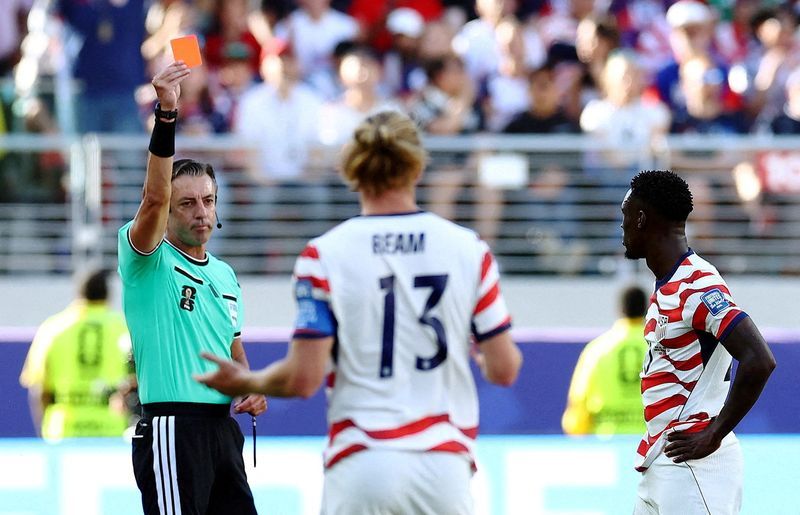
The prospect of Belgium facing the United States in the World Cup knockout round has been overshadowed by an extraordinary diplomatic row over FIFA's handling of player discipline, triggered by direct presidential involvement in the sport's most hallowed governing body. FIFA's decision to lift a red-card suspension for a key American striker following a personal appeal from President Trump has ignited widespread outrage in Brussels and raised fundamental questions about the independence of international football's regulatory processes. The move represents an unprecedented breach of sporting protocol, with one of the world's most powerful political figures apparently exercising influence over what should be an impartial disciplinary mechanism, and Belgian officials have not minced words in their condemnation of what they view as a circumvention of established rules.
The practical effect of FIFA's decision is straightforward: a suspension that would have prevented the American player from participating in the match has been erased, allowing him to take the pitch in what promises to be a fiercely contested encounter. What makes this development truly extraordinary, however, is the manner in which the reversal occurred. Rather than following standard appeals procedures or introducing fresh evidence that might justify overturning a disciplinary decision, the suspension was lifted after Trump personally intervened by contacting FIFA President Gianni Infantino. This direct presidential pressure on a supposedly independent sports organisation has alarmed observers across Europe and raised uncomfortable questions about the vulnerability of international sporting institutions to political manipulation.
The reaction from ordinary Belgians reflects a profound sense of injustice and fair play being violated. Speaking in the Belgian capital, one resident articulated the logical contradiction at the heart of FIFA's decision, questioning the entire basis upon which disciplinary cards are issued. She pointed out that red cards exist precisely because players commit serious infractions that warrant suspension from play—the card itself is not the punishment, but rather a record of misconduct that leads to automatic exclusion. By erasing the suspension without addressing the underlying misconduct, FIFA has created a nonsensical situation where the consequences of a serious breach of the rules have simply vanished, apparently through political channels rather than through any legitimate sporting review. Her exasperation captured a widespread sense that something fundamentally wrong has occurred in the treatment of this case.
Another Brussels resident, while acknowledging that the decision has been made and cannot be undone at this stage, urged his country's team to channel their frustration into their performance on the pitch itself. He suggested that rather than being demoralized by what many view as an unfair advantage handed to their opponents, Belgium's players should use the controversy as motivation to demonstrate their superior quality and commitment. This perspective reflects a pragmatic approach to an awkward situation—accepting that external circumstances sometimes lie beyond one's control while maintaining focus on the competition itself. His comments reveal how even those concerned about the integrity of the decision recognise that the match itself will be decided by the skill and determination of the players rather than by administrative controversies.
Belgium's Deputy Prime Minister Maxime Prevot has escalated the row by directly challenging the legitimacy of the decision-making process. He stated that if the suspension's lifting was indeed the result of Trump's telephone call to FIFA's leadership, then the sport's most fundamental principles have been violated. Prevot's intervention elevates the dispute from a matter of sporting fairness to one of political significance, suggesting that if a sitting president can successfully lobby for reversals of disciplinary decisions in major international competitions, then the entire system of governance stands compromised. His statement amounts to an accusation that FIFA has betrayed the trust placed in it as custodian of the sport's rules and standards.
The United States has disputed characterisations of Trump's actions as interference, with the American Ambassador to Belgium issuing a denial through social media. According to the ambassador's account, Trump merely expressed gratitude to FIFA after the reversal was announced, rather than actively pushing for the decision beforehand. This framing suggests that any conversation between the president and FIFA's leadership was merely a courtesy exchange rather than a lobbying effort intended to influence the outcome. However, the timing and sequence of events—with Trump's intervention preceding the decision by a matter of days—have undermined the credibility of this explanation for many observers who view the causal connection as self-evident.
The incident has exposed the vulnerability of international sporting bodies to pressure from powerful nations and their leaders. FIFA, despite its role as football's ultimate arbiter, operates within a complex political landscape where the interests of major football-playing nations carry considerable weight. When the leader of the world's most powerful military and economic superpower personally engages with the organisation's president regarding a specific disciplinary matter, the implicit pressure—whether intended or not—becomes difficult to resist. This dynamic reveals how even institutions designed to operate above politics can find themselves drawn into political calculations when sufficiently powerful actors choose to engage with them.
For Malaysia and other Southeast Asian nations, the incident carries broader implications for how international sporting competitions are administered. The principle that disciplinary decisions should be made on sporting grounds alone, free from political interference, is one that benefits smaller nations that cannot rely on political leverage to influence outcomes in their favour. If established precedent permits direct presidential intervention in FIFA's processes, then the competitive playing field tilts decisively toward nations with greater geopolitical influence, undermining the meritocratic ideal that distinguishes sports from other human endeavours. The row between Belgium and the United States therefore touches on questions of institutional integrity that extend far beyond this particular World Cup match.
The controversy also highlights the tension between FIFA's aspirations as a global governing body and its practical dependence on the cooperation of major football nations. While FIFA prides itself on fairness and impartial administration, its actual operations depend on maintaining relationships with powerful member associations whose political leaders can make life difficult if dissatisfied. This structural vulnerability means that even well-intentioned officials within FIFA may face pressure—direct or indirect—to accommodate requests from leaders of influential nations. The incident suggests that FIFA's disciplinary processes may require stronger insulation from political pressure, perhaps through genuinely independent arbitration panels or appeals bodies that lack formal ties to FIFA's political structures.
Belgian supporters have rallied behind their national team with characteristic determination, viewing the situation as all the more reason to demonstrate their superiority on the field. The controversy has, if anything, intensified emotions surrounding what was already a significant match, with the suspension reversal adding a layer of perceived injustice to fuel Belgian resolve. Rather than demoralising the team, the widespread public support and shared sense of grievance may provide psychological benefit, uniting supporters and players around a common cause. The message from Brussels is clear: whatever advantages FIFA's decision may have bestowed, only the Red Devils' performance in Seattle will ultimately determine the outcome.
As the match approaches, questions about the integrity of FIFA's decision-making processes will linger well beyond this particular encounter. The incident has illustrated how even the most prestigious international sporting institutions can be subject to political pressure and influence from powerful figures, raising uncomfortable questions about whether fair competition remains possible in a world where geopolitical leverage can be translated into sporting advantage. Belgium's vocal protest represents not merely objection to a single decision, but a defence of the principle that sport should remain independent from political manipulation—a principle whose importance extends throughout global athletics and competitions where smaller nations must rely on fair application of rules to compete on equal terms.

