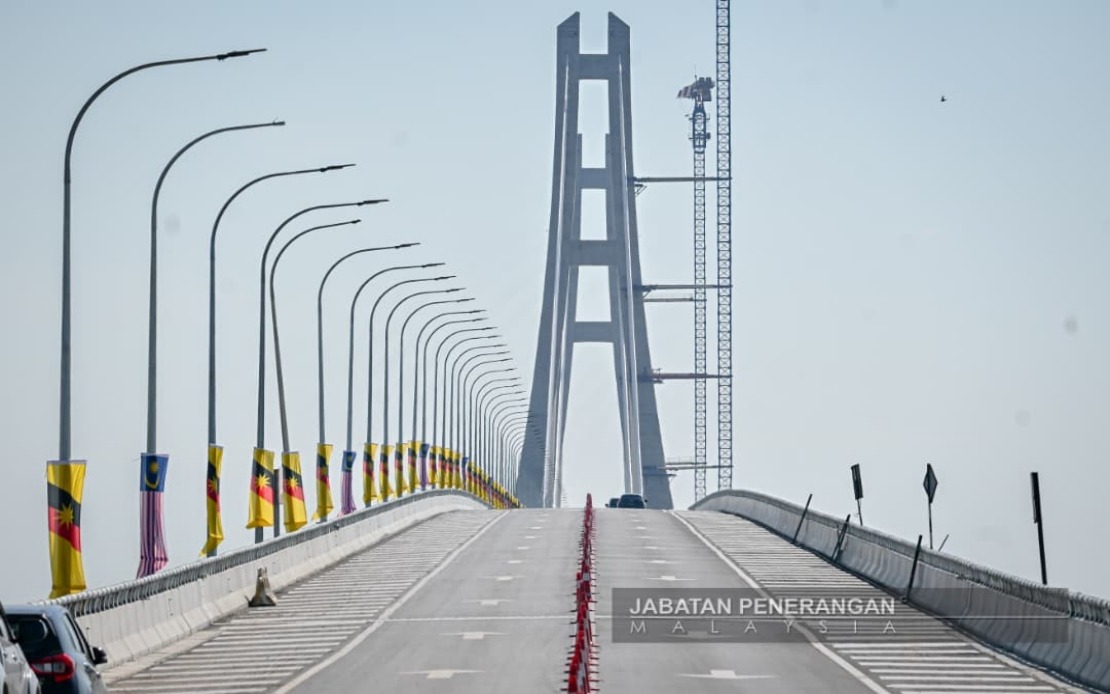
Sarawak has crossed a major infrastructure threshold with the official opening of the Batang Lupar 1 Bridge, a 4.844-kilometre engineering feat that State Premier Tan Sri Abang Johari Tun Openg describes as transformative for the coastal regions. Spanning the country's longest river, the bridge represents far more than a transport link; it signals the culmination of years of local agitation for safer, more reliable connections between Kuching, Sri Aman, Betong, and Samarahan. The RM848.75 million investment reflects the Sarawak government's recognition that infrastructure deficits were constraining development prospects across four economically significant coastal districts.
For decades, the Sebuyau-Triso ferry service was the lifeline connecting these communities, yet it carried significant human cost. The treacherous conditions at the Batang Lupar River's mouth—where strong waves and winds frequently disrupted crossings and caused fatal accidents—underscored why the bridge became a grassroots priority. Local elected representatives, both former and current, consistently channelled community demands for permanent connectivity to state planners. This bottom-up pressure translated into policy action, demonstrating how regional governance sometimes responds to sustained localised advocacy, though Sarawak's extended timeline from initial demands to completion also reflects the magnitude of such megaprojects.
The bridge functions as the centrepiece of the Sarawak Second Trunk Road (STRR) initiative, a RM3.21 billion coastal development programme designed to modernise transportation infrastructure along the state's littoral zone. Deputy Premier Datuk Amar Douglas Uggah Embas, who also oversees infrastructure and port development, highlighted a crucial metric: the new road network will compress the Kuching-to-Sibu journey from 396 kilometres to 252 kilometres, eliminating 144 kilometres of travel distance. This reduction has immediate implications for supply chain efficiency, tourism competitiveness, and emergency services response times. For agricultural producers in hinterland areas, shorter transport times translate to fresher produce reaching urban markets, potentially improving profitability and market access for rural farmers.
The recognition accorded by the Malaysia Book of Records, certifying Batang Lupar 1 as Malaysia's longest river-spanning bridge, carries symbolic weight beyond engineering achievement. Such designations serve multiple purposes: they anchor state pride, signal competence in project delivery, and provide international credibility when competing for investment. For Sarawak, already positioning itself as a heavyweight in regional infrastructure development, the accolade reinforces the narrative that the state possesses both ambition and execution capability. This matters strategically, as it enhances Sarawak's profile among potential investors considering Southeast Asian locations.
The economic implications extend across multiple sectors. Agriculture stands to benefit substantially—the bridge facilitates movement of produce from farming zones toward processing facilities and export terminals without weather-dependent delays. The improved connectivity creates conditions for agribusiness consolidation and value-addition ventures that previously faced logistical constraints. Investment in downstream agricultural industries becomes more viable when transport reliability is assured. Tourism operators likewise gain from enhanced accessibility; previously isolated or difficult-to-reach areas become viable destination components within broader Sarawak itineraries.
From a policy perspective, the Batang Lupar 1 Bridge exemplifies how singular infrastructure investments catalyse broader regional transformation. The STRR project targets completion by 2030, suggesting multiple phases remain. This extended timeline indicates that the state is implementing a staged approach rather than attempting wholesale reconstruction simultaneously. Phased development carries financial advantages—spreading capital expenditure across fiscal years—while allowing communities to adjust incrementally to improved connectivity rather than experiencing disruptive shock.
The ferry service's retirement marks psychological closure for residents who navigated decades of unreliable transit. Hours-long crossings during adverse weather will become historical anecdotes rather than routine frustrations. For businesses dependent on just-in-time supply chains, the predictability of bridge transit versus ferry gambling removes significant operational uncertainty. Property valuations in connected areas typically appreciate as accessibility improves, generating wealth effects that can fund local consumption and investment.
Regionally, the bridge advances Sarawak's integration into broader Southeast Asian transport corridors. Improved coastal connectivity supports the state's participation in transnational supply networks, whether in resource extraction, manufacturing, or service sectors. As ASEAN economic integration deepens, infrastructure that facilitates cross-border movement gains strategic importance. Sarawak's coastal road development positions the state advantageously within evolving regional trade patterns.
The infrastructure investment also carries political dimensions. Governments typically derive legitimacy from delivering tangible improvements to constituent welfare. Abang Johari's emphasis on responsive governance—framing the bridge as fulfillment of community requests—illustrates how infrastructure projects function as political currency. The opening ceremony itself serves ceremonial and communicative functions, demonstrating to rural constituencies that their voices influence resource allocation. This matters in Malaysian federal contexts where state governments navigate competing demands for central government funding.
Looking forward, the bridge's success will be measured not merely by traffic volumes but by whether the anticipated economic activity materialises. If agricultural output, tourism arrivals, and business investment increase as projected, the infrastructure investment validates Sarawak's development strategy. Conversely, underutilisation would suggest that connectivity alone proves insufficient without complementary investments in productive capacity, skills development, or market access mechanisms. The real test extends beyond engineering excellence to whether improved transport infrastructure catalyses genuine economic transformation in previously marginalised coastal areas.

