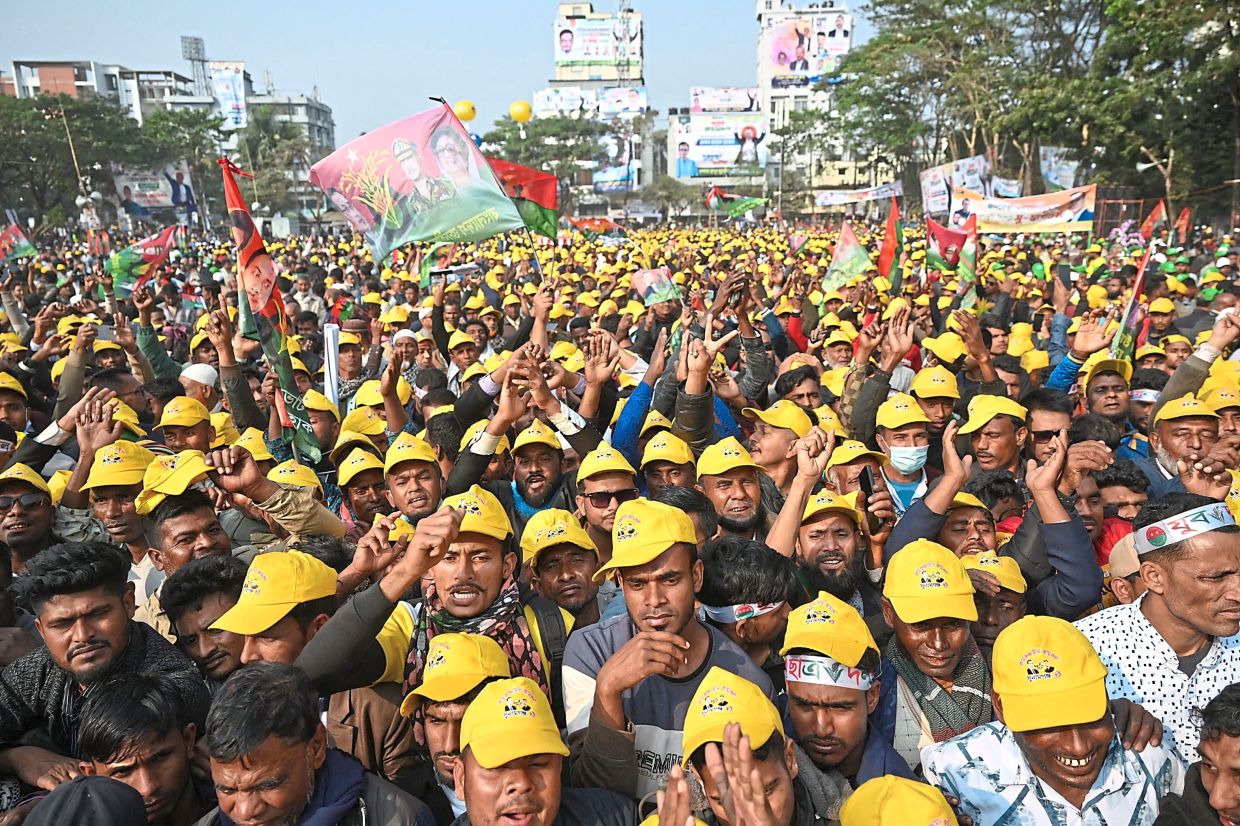
Bangladesh's parliament will vote on Thursday to elect Mirza Fakhrul Islam Alamgir as the nation's new president, a largely ceremonial position that marks a significant moment for the 170-million-strong country following its dramatic political upheaval in 2024. Alamgir, 78, currently serves as secretary general of the Bangladesh Nationalist Party (BNP) and local government minister, is expected to secure the five-year post with overwhelming support from the ruling coalition.
The election comes at a pivotal juncture in Bangladesh's recovery from the turmoil that toppled former Prime Minister Sheikh Hasina's government last year. Alamgir's ascension to the presidency underscores the BNP's consolidation of power following its commanding victory in February elections—the first electoral contest since the 2024 revolution fundamentally reshaped the country's political landscape. His elevation signals continuity for the current administration led by Prime Minister Tarique Rahman, whose party has mobilised substantial parliamentary support behind his candidacy.
Alamgir expressed his humility about the prospect when addressing reporters earlier this week, framing his potential elevation as both an honour and a responsibility to serve the nation. His comments reflect the measured tone expected of a figure stepping into the ceremonial role, though the presidency carries limited executive powers in Bangladesh's parliamentary system. Nevertheless, the position commands respect and symbolic authority within the nation's constitutional framework.
The political trajectory that brings Alamgir to this moment reveals much about Bangladesh's recent history and the BNP's struggle during the Hasina era. Born on 26 January 1948, Alamgir emerged as a prominent student activist during the 1969 uprising that challenged Pakistan's military rule—a formative period that preceded Bangladesh's independence in 1971. His early political engagement positioned him as someone willing to resist authoritarian governance, a credential that would resonate powerfully decades later.
Throughout his career, Alamgir held several ministerial positions spanning agriculture, aviation and tourism portfolios, building administrative experience across different government functions. However, his most defining role came during the tumultuous Hasina administration, when he served as an opposition figurehead while BNP leader Khaleda Zia languished in prison and her son Tarique Rahman operated from overseas exile. This period tested Alamgir's political resilience and organisational acumen as he worked to maintain the BNP's institutional coherence and public presence amid systematic government harassment.
The persecution Alamgir faced under Hasina's rule was substantial and deliberate. He endured multiple arrests supported by charges he and independent observers characterised as politically motivated rather than based on legitimate legal concerns. His survival of this pressure campaign without defecting or compromising BNP principles earned him considerable respect within the party hierarchy. Analysts credit him with preserving the BNP's organisational structure during years when the ruling establishment deployed state machinery to suppress opposition activity—a function that party officials have explicitly recognised as crucial to the BNP's eventual comeback.
Alamgir's primary opponent in Thursday's vote will be Oli Ahmed, the candidate nominated by the 11-party opposition alliance that includes the Jamaat-e-Islami party. This contest, however, appears largely symbolic given the BNP's parliamentary dominance and the ceremonial nature of the presidency. The voting process is scheduled to begin around 2 pm, with the outcome widely considered predetermined.
The election itself represents a consequence of the dramatic political transition that unfolded over the previous year. Former President Mohammed Shahabuddin, a close associate of Hasina who had occupied the position since 2023, resigned in July citing health concerns. His departure removed a figure who symbolised continuity with the ousted government and cleared the way for the BNP to install a president aligned with their political interests. Shahabuddin's decision to step down several years before his constitutionally mandated term expiration reflected the precarious position of Hasina-era officials in the post-revolution environment.
The broader context of Alamgir's election cannot be separated from the reckoning with Hasina's governance that has unfolded since her downfall. The former prime minister remains in India, having refused to return to Bangladesh to face trial for crimes against humanity charges. In November, a Bangladeshi court convicted her in absentia and sentenced her to death, a verdict that reflects the depth of public anger over her administration's abusive record. International human rights organisations extensively documented her government's systematic violence, including the targeted elimination of political opponents, the decimation of independent institutions, and the engineering of elections to eliminate genuine competition.
For Southeast Asian observers, Bangladesh's presidential transition illustrates the region's continuing political volatility and the uneven nature of democratic accountability across the bloc. The BNP's return to power and Alamgir's elevation signal both genuine electoral choice—the February voting was widely regarded as substantively more competitive than Hasina-era elections—and the persistence of power concentrated within elite-dominated structures. The presidency may be ceremonial, but the fact that it goes to someone who resisted Hasina's authoritarianism carries symbolic weight for a nation processing recent trauma.
Alamgir's personal background reflects the kind of traditional political credentials still valued in South Asia. Married to Rahat Ara Begum, a retired financial official, with two daughters, he represents an older generation of nationalist-oriented politicians who came of age during the independence struggle. His appointment as the 23rd president completes a cycle in which Bangladesh's founding-era political forces reassert control after a period of governmental excess and decline. Thursday's parliamentary vote, therefore, represents not merely an administrative procedure but a moment of institutional reaffirmation after the turbulence of revolution.

