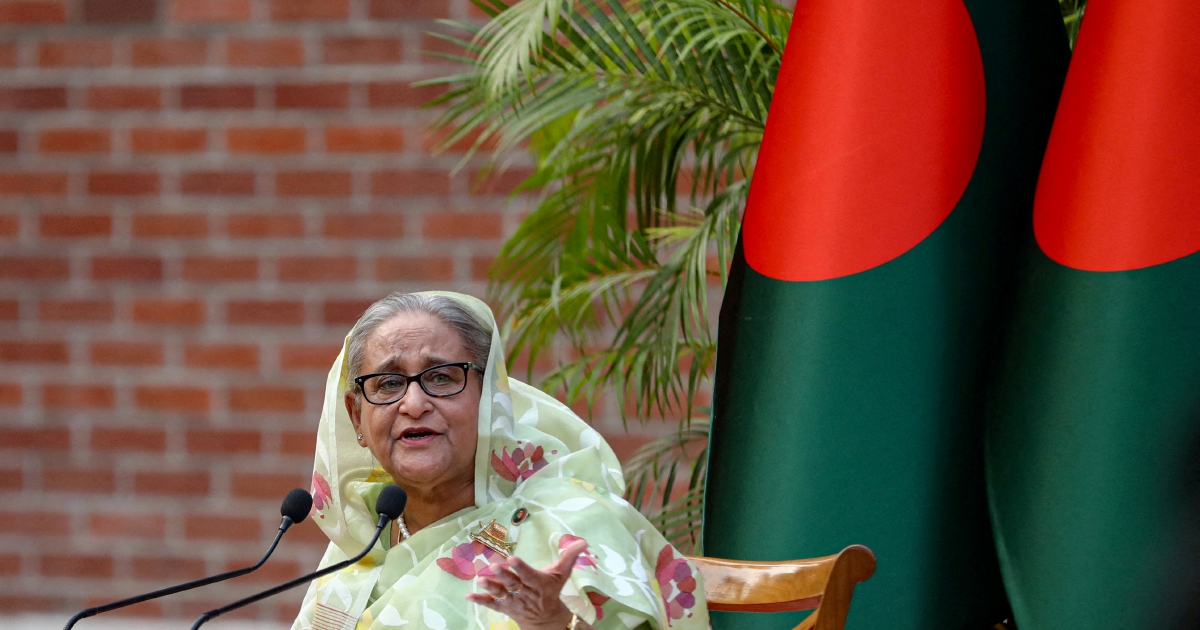
Bangladesh authorities announced Wednesday that they have successfully seized assets worth 760 billion taka—equivalent to approximately US$6.2 billion—belonging to former Prime Minister Sheikh Hasina, members of her immediate family, and a network of ten significant business groups with alleged ties to her administration. The massive confiscation represents one of the largest asset recoveries initiated by the interim government since the political transition that removed Hasina from office, signalling a determined push to reclaim state resources that investigators claim were diverted or improperly accumulated during her tenure.
The seizure underscores the sweeping nature of Bangladesh's post-transition accountability agenda. Beyond targeting the former premier directly, authorities have broadened their investigation to encompass a constellation of commercial entities and business magnates whose operations purportedly benefited from privileged access to government contracts, regulatory favours, or strategic exemptions during Hasina's administration. This multi-pronged approach reflects a broader institutional strategy to untangle the perceived nexus between political power and economic advantage that shaped Bangladesh's recent governance landscape.
For Malaysian and Southeast Asian observers, the Bangladeshi precedent illustrates the scale at which asset recovery operations can unfold in the region when new administrations prioritize accountability. The confiscations serve as both a symbolic assertion of institutional independence and a practical mechanism for replenishing state coffers—a consideration particularly relevant for countries in the region wrestling with fiscal pressures and questions of transparent resource management. The operation also demonstrates how transition governments can mobilise legal and investigative apparatus to systematically address alleged misappropriation, creating a template that influences regional discourse on governance standards.
The temporal context matters significantly. Sheikh Hasina had governed Bangladesh for much of the period between 2009 and her departure from office in August 2024, a tenure marked by rapid economic growth alongside persistent allegations of corruption, nepotism, and political suppression. Critics contended that her administration fostered an environment where politically connected entrepreneurs enjoyed disproportionate advantages, while wealth concentration among insider business circles accelerated. The interim government's aggressive asset recovery strategy can be interpreted partly as redressing this accumulated imbalance and partly as building political capital by demonstrating commitment to anti-corruption principles that motivated her removal.
The identification of ten specific business groups signals methodical investigative work beyond surface-level targeting. These entities likely represent major players across Bangladesh's commercial landscape—spanning textiles, banking, real estate, manufacturing, and other sectors—whose financial trajectories intersected substantially with government favour under Hasina's watch. The decision to confiscate their assets suggests investigators found sufficient evidence of illicit enrichment, fraudulent dealings, or regulatory circumvention to justify property seizure. Such breadth implies systemic corruption rather than isolated incidents, indicating how thoroughly political patronage had permeated economic structures.
From a regional perspective, Bangladesh's asset recovery operation carries implications for how Southeast Asian governments approach transitions and institutional reform. It demonstrates both the technical feasibility and the political will to recover substantial sums when administrations treat anti-corruption as a genuine priority rather than rhetorical flourish. Malaysia, which has pursued its own significant asset recovery efforts following the 1MDB scandal and subsequent political changes, offers a parallel cautionary tale about the challenges of tracing cross-border assets and the lengthy judicial processes required to secure convictions and permanent seizures. Bangladesh's approach, moving swiftly and substantially, may reflect lessons from regional precedent about the importance of acting decisively early in transition periods.
The practical implications of the confiscations extend to Bangladesh's economic management. The recovered capital theoretically becomes available for reallocation toward development priorities, debt servicing, or buffer reserves. Given Bangladesh's ongoing infrastructure needs and fiscal constraints, even partial recovery of these assets could fund meaningful investments in education, health, or transport systems. However, translating seized assets into productive use requires robust governance—a challenge Bangladesh itself has not fully mastered historically. The risk exists that recovered wealth, absent strong institutional safeguards, could be redirected through patronage networks or inefficient state projects rather than genuine public benefit.
International perspectives on the seizures likely remain mixed. Western governments generally welcome anti-corruption measures and asset recovery, viewing them as evidence of institutional strengthening. However, concerns may arise if confiscations lack transparent due process or target opposition figures disproportionately rather than pursuing genuine cases against all implicated parties regardless of political affiliation. Bangladesh's international creditors and development partners will likely monitor whether asset recovery follows consistent legal standards or becomes a tool for political vendetta. The distinction between accountability and retribution shapes how the international community perceives the legitimacy of interim government actions.
The broader question of how seized assets are managed and deployed will ultimately determine whether this operation represents genuine institutional reform or merely symbolic score-settling. If Bangladesh establishes clear protocols for asset oversight, transparent disposition criteria, and parliamentary scrutiny of recovered fund utilisation, the confiscations could establish precedent for systematic corruption accountability. Conversely, if seized assets disappear into government accounts without clear purpose or accountability, the operation risks reinforcing public cynicism about institutional integrity.
For Southeast Asian economies grappling with governance challenges and entrenched corruption networks, Bangladesh's decisive action against former leadership and connected business interests provides both inspiration and caution. The region increasingly recognises that addressing corruption requires not merely prosecuting individuals but dismantling the structures and incentive systems that enable it. Whether Bangladesh can sustain this momentum and extend investigation and recovery mechanisms equitably across the political spectrum will determine whether this episode marks genuine institutional transformation or merely temporary disruption of underlying power dynamics.

